1.4 Measuring principle: Time-of-flight method
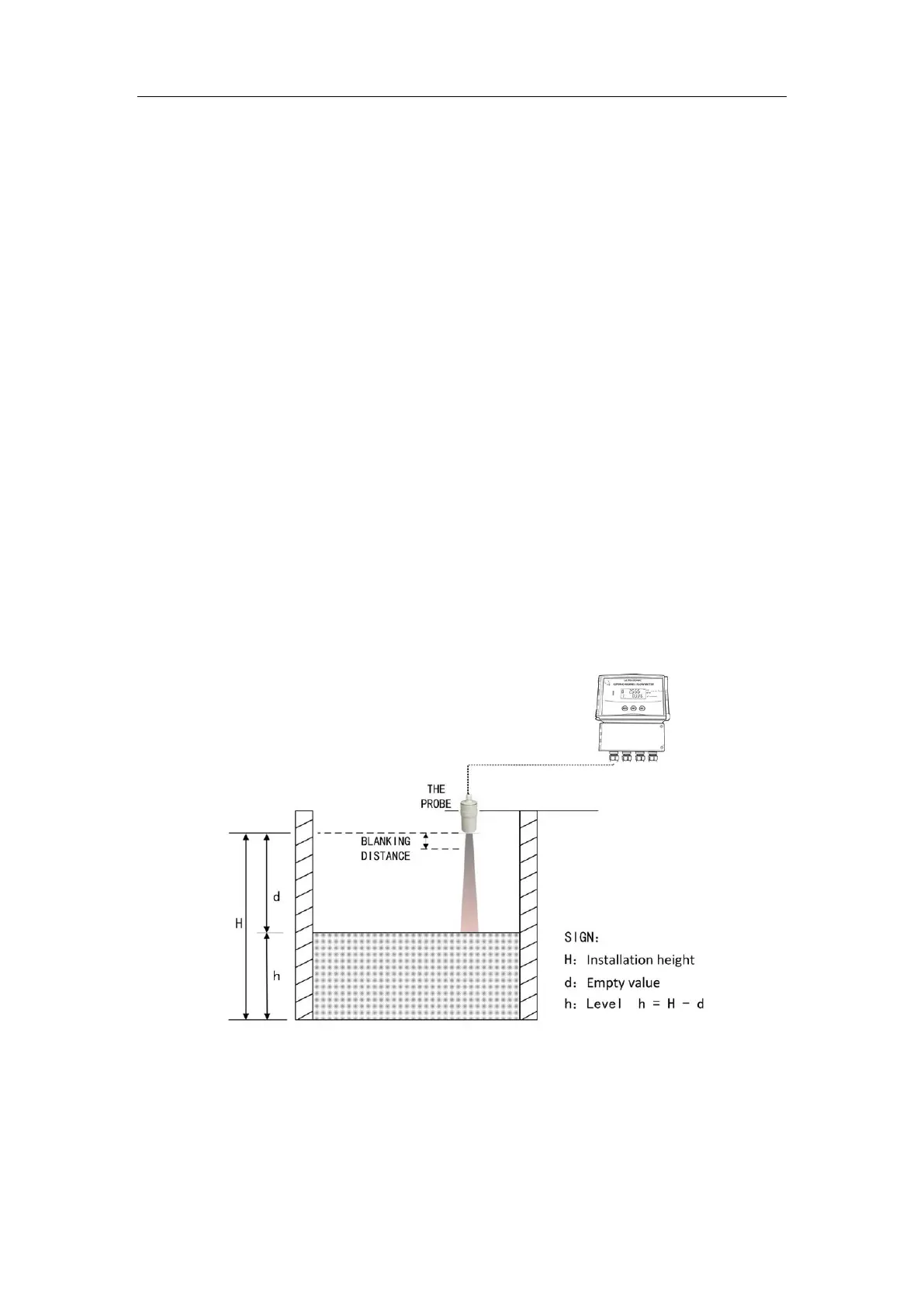
The probe is mounted on the top of the flume, and ultrasonic pulses is
transmitted by the probe to the surface of the monitored material. There,
they are reflected back and received by the pro be. The host measures the
time t between pulse transmission and reception. The host uses the time t (and
the velocity of sound c) to calculate the distance d between the sensor bottom
and the monitored liquid surface: d = c •t/2. As the host knows the installation
height H from parameters setting, it can calculate the level as follows: h = H –
d .
Since speed of sound through air is affected by changes in temperature, the
BUFM660 O.C.M. has integrated a temperature senor to improve accuracy.
For determined flumes, there is a fixed functional relationship between the
instantaneous flow and liquid level. The formula is Q=h (x). Q means
instantaneous flow, h means liquid level in flumes. So the host can calculate
the flow rate though determined flumes and the level value.
It is very important to understanding the working principle for further
installation and operation.
Blind zone: Level echo from the blind zone cannot be evaluated due to the
transient characteristics of the sensor. Span F may not extend into the
blanking distance B.



 To Next Page