EasyManua.ls Logo

Bauknecht GSF 4851 - User Manual

Bauknecht GSF 4851
11 pages
Print Icon
To Next Page IconTo Next Page
Loading...
Further indications are given in the pages to follow and in the user instructions.
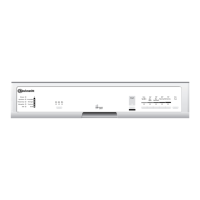
Water supply indicator
Check the appliance fills with water.
Lower
spray arm block indicator
Release the spray arm.
“Water stop” device indicator
“Water stop” device not working. Switch off
the dishwasher and shut off the water tap.
Rinse aid level indicator
Add rinse aid.
Salt level indicator
Add regeneration salt; only add regeneration salt
immediately before starting a wash programme.
Programme progress indicator
Option
Delayed start button
The wash cycle can be programmed
to start after 3-6-9 hours.
Then press the Start button.
The dishwasher will start at the set time.
Start button
Indicator lamp lit while the dishwasher is operating.
Flashes when a fault occurs.
Switches off at the end of the programme.
On / Off Button
Pre-rinse /
Pre-wash
Washing
Drying
Programme
end
Programme Symbol
and Temperature
Programme selection and
recommended load type
Place the detergent in the:
small large
compartment compartment
Consumption
1)
Normal load
Water
(Litres)
Energy
(kWh)
Time
(Min.)
Pre-wash
Crockery to be washed later.
- - 5.0 0.02 9
Bio-Eco 50° C
Normally soiled crockery.
- X 12.0 1.25 73
Bio-Normal 50° C
2)
Normally or heavily soiled crockery with dried-on food.
X X 16.0 1.40 86
Normal 65° C
3)
Normally or heavily soiled crockery with dried-on food.
X X 16.0 1.60 86
Intensive 70° C
Heavily soiled pans and saucepans.
X X 21.0 1.68 93
Quick Reference Guide
GB
5019 100 90338
(We reserve the right to make technical modifications)
1) Values may vary in relation to usage, e.g.: different loads, water
temperatures - above or below 15° C - as well as water hardness and power supply voltage etc.
2) Programme recommended when using detergents of type B (enzyme-based detergents).
Reference programme for energy label.
3) Programme recommended when using detergents of type A (non enzyme-based detergents).
GSF 4851

Question and Answer IconNeed help?

Do you have a question about the Bauknecht GSF 4851 and is the answer not in the manual?

Overview

This document describes the Bauknecht GSF 4851 dishwasher, providing a quick reference guide, usage instructions, technical specifications, and maintenance information.

Function Description

The Bauknecht GSF 4851 is a domestic dishwasher designed for washing crockery, cutlery, and pans. It offers multiple wash programs and features to optimize cleaning and drying performance while ensuring user convenience and safety. The appliance includes indicators for water supply, spray arm blockage, water stop device malfunction, rinse aid level, and salt level, helping users monitor its operation and address issues promptly. A delayed start function allows users to program the wash cycle to begin after 3, 6, or 9 hours.

Important Technical Specifications

  • Load Capacity: 12 place settings.
  • Water Hardness Settings: 7 levels, from 0-5 °dH (soft) to 36-60 °dH (extremely hard), adjustable via a selector inside the door.
  • Water Inlet Temperature: Maximum 25°C for models with "25°C Max" hose; maximum 60°C for all other models.
  • Power Supply: Complies with EC Directives 73/23/EC, 89/336/EC, and 93/68/EC.
  • Detergent Dispenser: Features a small and a large compartment for detergent, with recommended dosages varying by program and detergent type.
  • Rinse Aid Dispenser: Adjustable dosage regulator with 6 settings, factory set to position 4.
  • Programmes:
    • Vorspülen (Pre-wash): 5.0 litres water, 0.02 kWh energy, 9 minutes duration. For crockery to be washed later.
    • Bio Spar (Bio-Eco 50°C): 12.0 litres water, 1.25 kWh energy, 73 minutes duration. For normally soiled crockery.
    • Bio Normal (Bio-Normal 50°C): 16.0 litres water, 1.40 kWh energy, 86 minutes duration. For normally or heavily soiled crockery with dried-on food. Recommended for enzyme-based detergents (Type B) and as the reference program for the energy label.
    • Normal (Normal 65°C): 16.0 litres water, 1.60 kWh energy, 86 minutes duration. For normally or heavily soiled crockery with dried-on food. Recommended for non-enzyme-based detergents (Type A).
    • Intensiv (Intensive 70°C): 21.0 litres water, 1.68 kWh energy, 93 minutes duration. For heavily soiled pans and saucepans.
  • Indicators:
    • Water Supply: Checks if the appliance fills with water.
    • Lower Spray Arm Block: Indicates if the lower spray arm is blocked.
    • Water Stop Device: Alerts if the water stop device is not working.
    • Rinse Aid Level: Indicates when rinse aid needs to be added (visual and/or electric).
    • Salt Level: Indicates when regeneration salt needs to be added (visual and/or electric).
    • Programme Progress: Lights for Pre-rinse/Pre-wash, Washing, Drying, and Programme End.
    • Start Button: Lights up during operation, flashes for faults, switches off at program end.
    • Delayed Start: Lights for 3h, 6h, or 9h delay.

Usage Features

  • Loading: Crockery should be arranged to avoid touching, with large items in the lower rack and smaller items in the upper. Cups should be loaded at an angle for drainage. Cutlery should generally be placed handles down, but sharp knives and forks handles up for safety. Ensure water jets can reach all items and spray arms rotate freely.
  • Rack Adjustment: The upper rack height can be adjusted even when loaded. To lower, pull out side handles and gently lower. To raise, pull up side handles until it clicks into place, ensuring it is level on both sides.
  • Crockery Holders: Upper rack holders can be positioned down for cups and long-stemmed glasses, or up for plates. Lower rack plate holders can be lowered or removed to increase available space.
  • "Vario Organizer" Support: A multi-purpose support in the upper rack for long-handled utensils, cups, and glasses, offering three different positions.
  • Cutlery Basket: Removable to increase available space in the lower rack.
  • Detergent Filling: Use only detergents recommended for domestic dishwashers. For programs with pre-rinse, 2/3 of detergent goes into the large compartment and 1/3 into the small. For programs without pre-rinse, the entire recommended dosage goes into the large compartment, with any excess over 45ml in the small compartment.
  • Rinse Aid Filling and Adjustment: Fill the dispenser up to the "max" line (approx. 100 ml) using only recommended rinse aids. Adjust the dosage regulator (settings 1-6) if crockery shows whitish streaks (reduce dosage) or is not perfectly dry (increase dosage).
  • Salt Filling: Fill the salt container with regeneration salt before first use, and regularly thereafter when the salt level indicator lights up. Fill with water first, then salt, stirring with a spoon. Immediately run a wash program (not just pre-wash) to eliminate residual saline solution.
  • Starting a Programme: Close the door, open the water tap, press On/Off, select the desired program, and press Start.
  • Changing a Programme: Press the Start button for about 5 seconds until the Start indicator lamp switches off, then select a new program and press Start.
  • Interrupting a Programme: If the dishwasher is switched off during a wash, it will resume from where it left off when switched back on.
  • Safety: Do not open the door during a wash cycle unless strictly necessary, and exercise caution due to hot steam. Keep packaging materials, detergents, rinse aids, and salt out of reach of children. Do not use solvents inside the dishwasher. Do not put liquid fat or candle wax into the dishwasher.

Maintenance Features

  • Exterior Cleaning: Use a neutral detergent and a damp cloth. Avoid abrasive detergents.
  • Interior Cleaning: Regularly wipe the door seal and inside of the door with a damp cloth to remove food residues.
  • Spray Arm Cleaning:
    • Upper Spray Arm: Slacken the fixing nut (A) counter-clockwise, detach the spray arm (B), rinse nozzles, remount by aligning with the rotary mounting, and tighten the fixing nut clockwise until it clicks. Ensure free rotation.
    • Lower Spray Arm: Press the two levers (C) inwards, detach by pulling up (D), rinse nozzles, remount by aligning with the rotor pin, push down firmly until fixed, and ensure levers are correctly inserted. Ensure free rotation.
  • Filter Cleaning:
    1. Fully unscrew the wide-mesh central filter (E) counter-clockwise and extract it.
    2. Fully unscrew the fine-mesh filter (F) and extract it from the wide-mesh central filter, paying attention to the holes in the bottom.
    3. Remove the large filter (G).
    4. Clean all filters regularly under running water, ensuring no impurities remain.
    5. Reassemble: Insert the fine-mesh filter into the wide-mesh central filter (paying attention to the holes in the bottom), then insert the filter unit and fix it by turning it clockwise. Ensure correct insertion for good wash results.
  • Troubleshooting: The manual provides a guide for common issues like the dishwasher not working, crockery being dirty, or marked crockery/glasses. It advises checking power, water supply, filters, spray arms, salt/rinse aid levels, and program selection before contacting After-Sales Service.
  • After-Sales Service: If issues persist, switch off the appliance, turn off the water tap, and contact service, providing details of the fault, appliance type/model, and service code (found on the rating plate inside the door).

Bauknecht GSF 4851 Specifications

General IconGeneral
BrandBauknecht
ModelGSF 4851
CategoryDishwasher
LanguageEnglish

Related product manuals