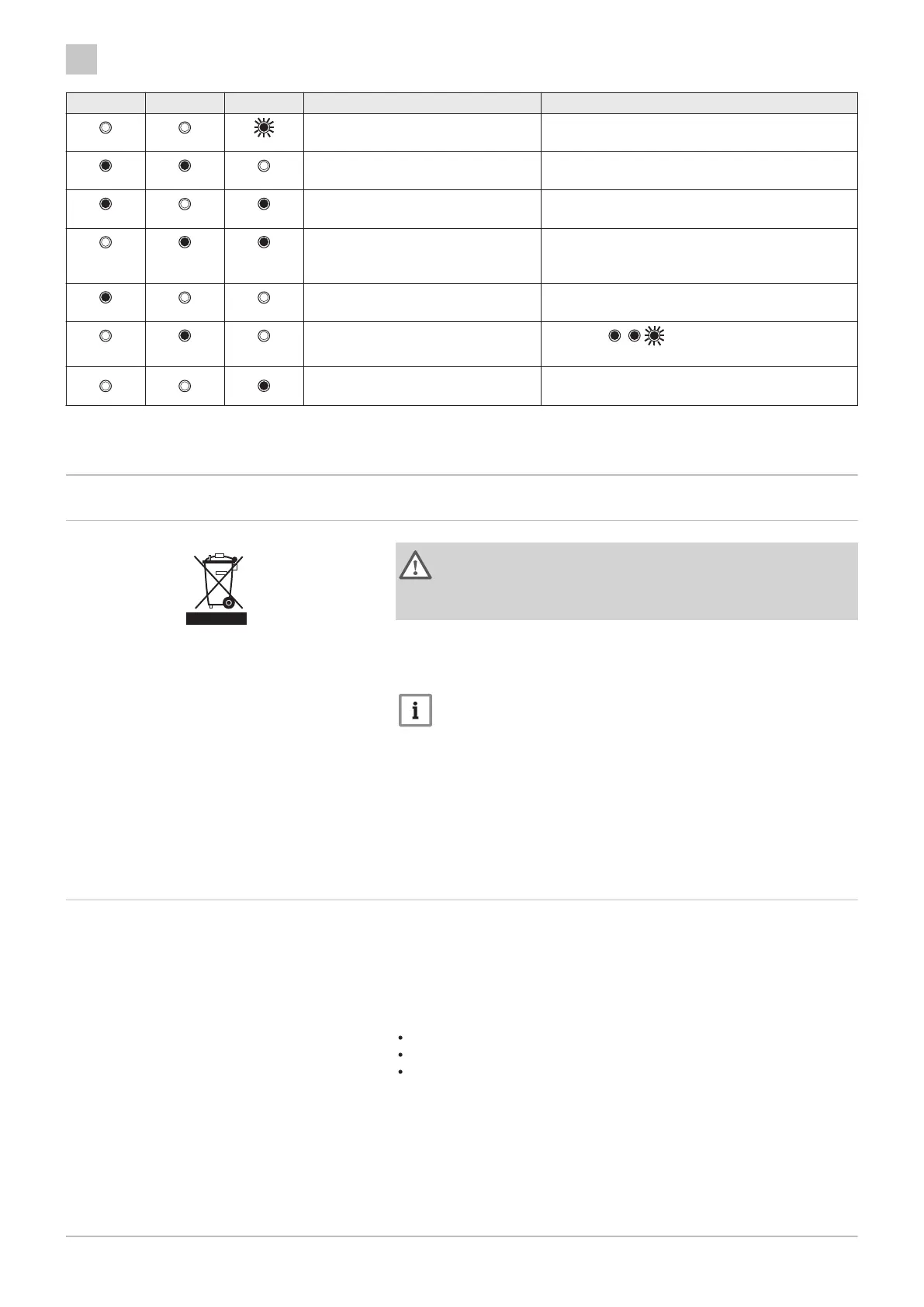
LED 1 LED 2 LED 3 Error name Probable Trouble Location
Over current protection Power voltage, system pressure, module panel,
main external control panel.
Exhaust sensor error System pressure, exhaust sensor, main external
control panel.
Cooling overload protection Condenser, external fan, capillary, external coil
sensor, main external control panel.
Indoor high temperature heating pro
tection
Evaporator, internal fan, thin unit connection
pipe, internal coil sensor, main internal control
panel.
Indoor cooling freezing protection Evaporator, internal fan, capillary, internal coil
sensor, main internal control panel.
Compressor shell temperature pro
tection
Same as Compressor cap sensor er
ror.
OVP or UPV error
Power voltage, reactor, module panel, main ex
ternal control panel.
9
Disposal
9.1 Disposal and recycling
Warning
Removal and disposal of the air conditioner must be carried out by
a qualified professional in accordance with prevailing local and
national regulations.
1. Switch off the air conditioner.
2. Cut the mains supply to the air conditioner.
3. Recover the refrigerant in accordance with prevailing regulations.
Important
Do not allow the refrigerant to escape into the atmosphere or the
nature.
4. Disconnect the refrigerant connections.
5. Dismantle all hydraulic connections.
6. Dismantle the air conditioner.
7. Scrap or recycle the air conditioner in accordance with prevailing local
and national regulations.
9.2
Recover refrigerants
When decommissioning the air conditioner, all refrigerants need to be
recovered safely. Prior to the task being carried out, an oil and refrigerant
sample shall be taken in case analysis is required prior to re-use of
recovered refrigerant. It is essential that electrical power is available
before the task is commenced.
Before attempting the procedure, ensure that:
All personal protective equipment is available and being used correctly.
The recovery process is supervised at all times by a qualified person.
Recovery equipment and cylinder conform to the appropriate standards.
1. Become familiar with the equipment and its operation.
2. Isolate system electrically.
3. Pump down refrigerant system, if possible.
4. Connect a manifold and apply a vacuum so that refrigerant can be
removed from various parts of the system.
Fig.132
en
9 Disposal
136 7798815 - v04 - 07122022


 To Next Page