
 Need help?
Do you have a question about the Bayliner 205 and is the answer not in the manual?
Specifications for Bayliner 185 model including length, beam, and tank capacities.
Specifications for Bayliner 195 model including length, beam, and tank capacities.
Specifications for Bayliner 205 model including length, beam, and tank capacities.
Specifications for Bayliner 225 model including length, beam, and tank capacities.
Information on obtaining service and parts from your Bayliner dealer.
Details on the Bayliner Limited Warranty and how to obtain a copy.
Guidance on gaining handling and operating experience for new boaters.
Advice on referring to engine and accessory manuals for proper operation and maintenance.
Critical information regarding propeller selection, condition, and potential engine damage.
Details on the load limit and design of the transom platform extension.
Specifies that only trained personnel should service key boat systems.
Recommendations for hull maintenance and protection when the boat is moored.
Outlines critical safety standards and hazard warnings for boat operation.
Information on the dangers of carbon monoxide, its sources, and effects.
Key facts about carbon monoxide poisoning and its prevalence in boating.
Lists factors that make individuals more susceptible to CO poisoning.
Illustrates conditions that lead to CO buildup in and around the boat.
Provides essential steps and precautions to prevent CO exposure.
Offers checklists for trip, monthly, and annual maintenance related to CO safety.
Regular inspection tasks to ensure exhaust system integrity and prevent CO leaks.
Recommended annual maintenance by a trained technician for safety systems.
Contact information for organizations providing boating safety tips and CO prevention resources.
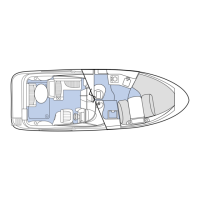
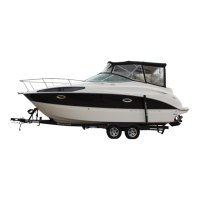
Diagrams illustrating the external components and features of the boat hull.
Labeled diagrams showing deck components for the 185 model with different seating layouts.
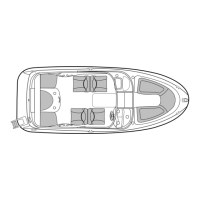
Labeled diagrams showing deck components for the 195 model with different seating layouts.
Labeled diagrams showing deck components for the 205 model with different seating layouts.
Labeled diagram showing deck components for the 225 model.
Typical helm layout diagrams for 185, 195, and 225 models, noting variations.
Typical helm layout diagram for the 205 model, noting variations.
Illustrates the location of various electrical components like 12-volt outlets and fuse blocks.
Emphasizes the importance of reading the engine manual before any engine-related work or operation.
Explains the function of the bilge blower system in preventing fire and explosion hazards.
Highlights critical safety warnings regarding fire, explosion, and open flame hazards with fuel systems.
Instructions on proper fuel filling and venting procedures, and troubleshooting tips.
Information on fuel pickup screen filters and engine-mounted fuel filters, including replacement.
Details the function and location of the anti-siphon valve for gas engines.
Instructions for inspecting, draining, and replacing the fuel filter/water separator for diesel engines.
Instructions for installing and using the quick oil drain hose assembly for engine oil changes.
Describes the power-assisted rack-and-pinion steering system and its characteristics.
Warns about the consequences of improper maintenance on the shift/throttle control.
Information about the stern drive's power trim and tilt system.
Provides cleaning instructions for gauge lenses and bezels, warning against specific cleaners.
Explains the cause of gauge fogging and how to mitigate it with gauge lights.
Notes that VHF transmissions may cause temporary tachometer readings.
Explains that normal fuel gauge pointer bounce is due to fuel sloshing.
Warns against using the depth finder as a primary navigational aid for collision avoidance.
Describes the bilge pump's function and warns against discharging waste into navigable waters.
Instructions on how to test the bilge pump and check for clogging debris.
Explains the autofloat switch operation and provides testing procedures.
General overview of seawater systems and associated warnings.
Critical safety and system damage warnings related to closing seacocks when unattended.
Instructions for cleaning seawater strainers, including closing the seacock first.
Operational and troubleshooting guidance for the livewell system, including flooding hazards.
Details on safe water use, hose types, and system pressurization for the freshwater system.
Instructions for using the transom shower and the required pump switch setting.
Step-by-step guide for winterizing the freshwater system using compressed air or gravity draining.
Mentions drain systems and keeping deck drains clear of debris.
Explains that deck drains route water overboard and require debris removal.
Warning against using cleats or bow/stern eyes for lifting the boat.
Advises reading the manufacturer's manual before using the trolling motor.
Provides safety warnings and guidelines for towing water sports equipment with the ski-tow ring.
Critical safety guidelines and warnings for using the ski-tow tower.
Step-by-step instructions with diagrams on how to attach the ski-tow rope.
Instructions for safely folding and unfolding the ski-tow tower, emphasizing it's a two-person task.
General caution about stowing canvas and vinyl properly before road transport.
Detailed instructions with diagrams for installing the 185 model's Bimini top.
Detailed instructions with diagrams for installing the 205 and 225 models' Bimini tops.
Step-by-step instructions with diagrams for installing the convertible top.
Instructions for attaching side curtains to the canvas top and windshield frame.
Instructions for attaching the bow cover, including pole adjustment.
General advice on rinsing and drying canvas after use to maintain its properties.
Detailed steps for cleaning canvas using mild soap, warning against detergents.
Methods for removing stubborn stains from canvas, with cautions about finish.
Precautions for storing and cleaning clear vinyl to prevent damage like milky film or cracking.
Notes that AM radio reception may be impaired when the engine is running.
Describes the movement and conversion of sleeper seats into lounge or chaise positions.
Instructions for sliding seats forward and backward in their upright position.
Steps to convert sleeper seats into a flat lounge or chaise lounge.
Detailed instructions with diagrams for converting jump seats into a sunlounge.
Instructions for converting the passenger seat into a sunlounge on 225 models.
Guides for installing, removing, and stowing the table leg and table.
Warnings and instructions for removing and stowing fishing seats before operation or trailering.
Common reasons for light failure and basic maintenance steps like fuse replacement.
Advises conservative use of battery power for interior lights and ensuring the battery switch is ON.
Notes the legal requirement for running lights and avoiding obstruction of navigation lights.
Overview of the 12-volt DC system for lights, accessories, and engine starting.
Describes the battery's role in supplying power and refers to other manuals for care.
Illustrates fuse block layouts for different models and explains fuse locations.
Information on using 12-volt DC accessory outlets, their amperage limits, and fuse protection.
Explains the alternator's function in charging the battery while the engine is running.
Shows the routing of the 12-volt DC hull harness connecting various components.
Diagram showing the 12-volt DC deck harness for 185 and 195 models.
Diagram showing the 12-volt DC deck harness for the 205 model.
Diagram showing the 12-volt DC deck harness for the 225 model.
Diagram illustrating the trolling motor harness wiring for specific models.
Illustrates battery cable connections, noting color coding for positive and negative cables.
Fields for recording dealer contact and sales/service personnel information.
Fields for recording ignition and other key identification numbers.
Spaces to record engine manufacturer, model, serial number, and oil/filter details.
Fields for recording manufacturer, model, and serial numbers for various electronic components.
Spaces to record propeller manufacturer, model number, and pitch.
Section to detail the boat's specifications, registration, and distinguishing features.
Section to record the operator's personal information, experience, and contact details.
Fields to list the names, ages, health status, and contact information of all passengers.
Checklist for essential survival equipment such as marine radio, PFDs, flares, and food.
Fields to detail trip plans, including departure/arrival times, stopovers, and final destination.
Spaces to record information about the vehicle used for trailering the boat.


 To Next Page
 General