A - 2 TC305/TC303 - Functional Description
2 SECTION A
The A-section microprocessor takes care of electrical measurements and
generations/simulations. It also makes all calculations required for temperature
sensor simulations and measurements. It uses one A/D-converter for all these
measurements and one D/A-converter for generations/simulations.
In resistance measurement TC305/TC303 generates the measurement current
and measures the voltage across the resistance. It switches off the current for a
part of the time. This enables compensation of the thermovoltages in the
resistance measurement circuit.
In voltage and current generation TC305/TC303 makes the output with the D/A-
converter and assures the accuracy by continuously measuring the generated
value.
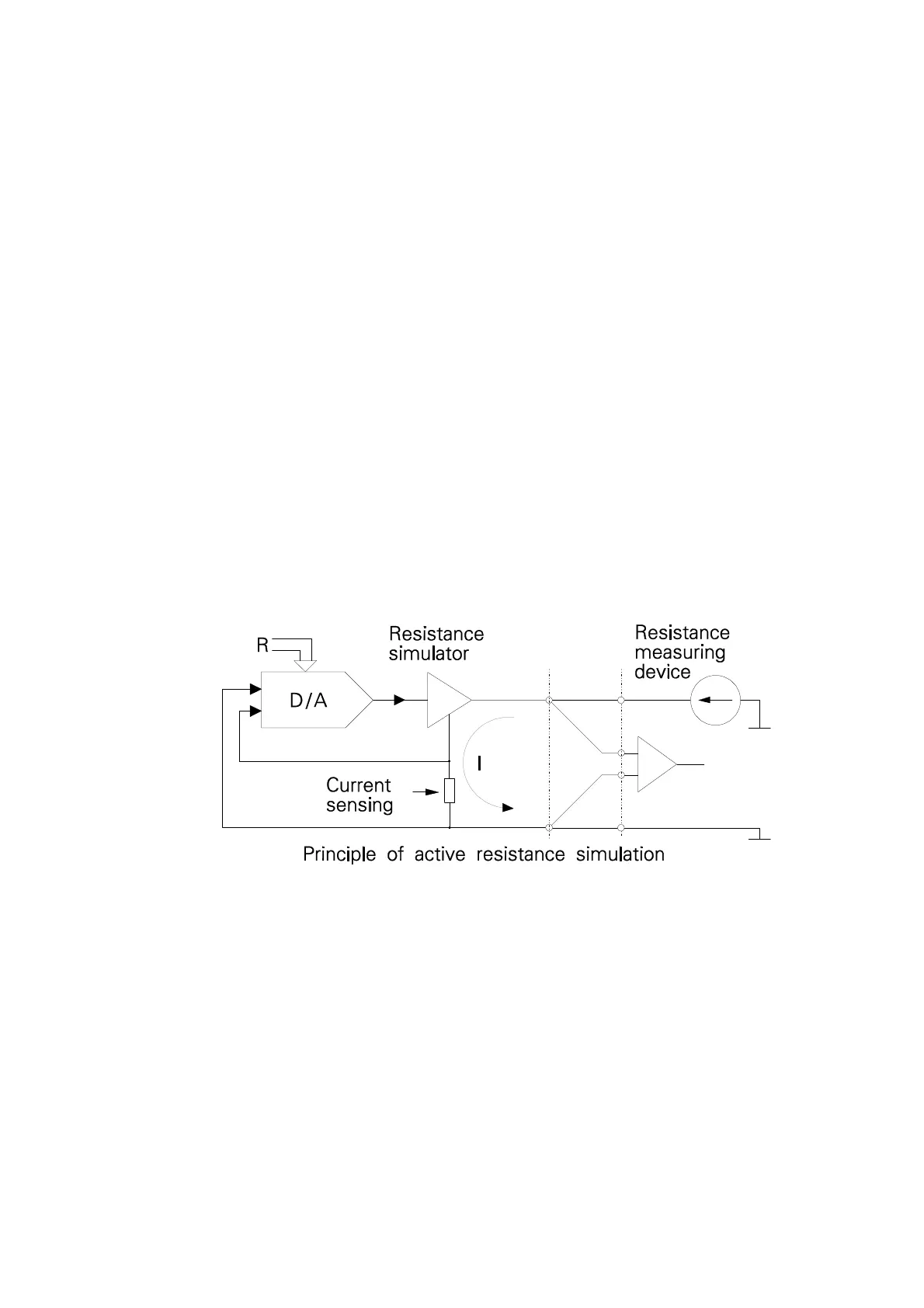
In resistance simulation there should be an external resistance measurement
device measuring the resistance between the TC305/TC303 output terminals.
The D/A-converter detects the measurement current coming from the external
measurement device. It controls the voltage across the resistance output
terminals so that it is in the correct ratio to the detected current. The
microprocessor defines this ratio according to the Ohm's law and the simulated
resistance value.
Theoretically the resistance simulation could be able to simulate the given
resistance also to an AC circuit. In practice, anyhow, it is always too slow to
achieve reasonable accuracy, if the measurement device uses AC supply for
resistance measurement. Fortunately AC measurement of resistance is very
seldom used nowadays.
Some resistance measurement devices - like TC305/TC303 itself - use pulsed
current for resistance measurement. Simulation to these devices is possible with
TC305/TC303. The measurement device should, however, give enough time for
the circuits to settle after switching the current on. This is normally necessary also
because of the inductance and capacitance of the industrial resistance
measurement circuits.


 To Next Page