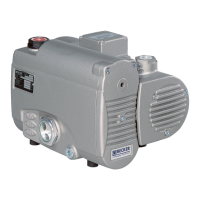
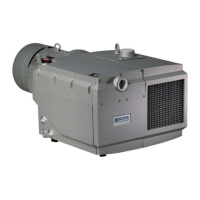
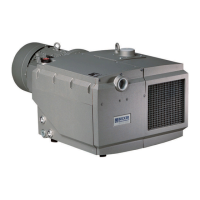
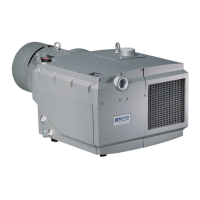
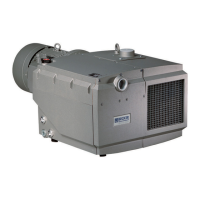
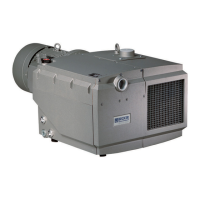
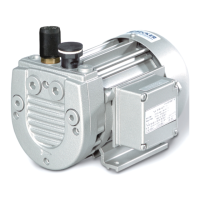
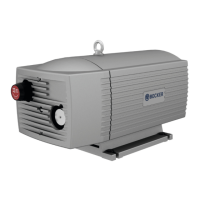
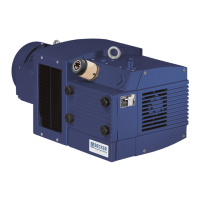
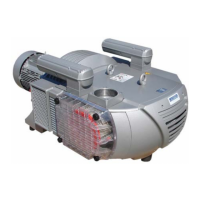
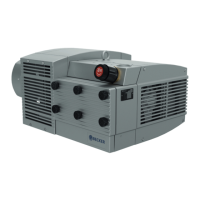
This document describes the Becker U 5.100 series vacuum pump, a robust and versatile industrial device designed for various applications requiring reliable vacuum generation. The manual provides comprehensive instructions for operation, maintenance, and safety, ensuring optimal performance and longevity of the unit.
Function Description
The Becker U 5.100 is a dry-running rotary vane vacuum pump, meaning it operates without the need for oil in the compression chamber, which simplifies maintenance and prevents oil contamination in the process. Its primary function is to create and maintain a vacuum by drawing air or other gases from a system. The pump is designed for continuous operation and is suitable for applications where a consistent vacuum level is required. The "MAX. VACUUM" indicator on the device suggests its capability to achieve high vacuum levels, making it suitable for demanding industrial processes. The pump's design, including the "AIR" inlet and exhaust, indicates a system for air handling, which is typical for vacuum pumps. The exhaust air must escape without back-pressure (max. +0.1 bar) to ensure efficient operation.
Important Technical Specifications
Model: U 5.100
Compliance: CE certified, compliant with 2006/42/EG machinery directive, DIN EN ISO 14001:2005 (environmental management), and DIN EN ISO 9001 (quality management).
Weight: Approximately 67 kg (148 lbs), indicating a substantial and sturdy build.
Dimensions: The device requires a minimum clearance of 2m (MIN 2m) for proper operation and maintenance, and for air circulation, suggesting a significant footprint. The air inlet diameter is specified as Φ1¼" for standard installations up to 2m, and Φ1½" for installations between 2m and 10m, indicating flexibility in installation length.
Noise Level:
- LpA = 65 dB(A) - 50Hz
- LpA = 68 dB(A) - 60Hz
- KDA = 3 dB(A)
These values, measured according to DIN EN ISO 3744, indicate the acoustic pressure level, which is an important consideration for workplace safety and comfort.
Operating Temperature: The optimal operating temperature range for the pump is >0°C/32°F and <40°C/104°F. This range is critical for maintaining performance and preventing damage.
Altitude: The pump is designed for operation up to a maximum altitude of 1000m (max. 1000m).
Humidity: Maximum relative humidity for operation is 90% (max. 90%).
Electrical Specifications: The pump is available in both 50 Hz and 60 Hz versions, accommodating different regional power supplies.
- 50 Hz Version:
- Type: U 5.100
- Frequency: 50 Hz
- Speed: 1450 min⁻¹
- Power Required: 2.9 kW
- Inlet Capacity: 100 m³/h
- Max. Vacuum: 100 mbar abs.
- 60 Hz Version:
- Type: U 5.100
- Frequency: 60 Hz
- Speed: 1750 min⁻¹
- Power Required: 3.5 kW
- Inlet Capacity: 120 m³/h
- Max. Vacuum: 100 mbar abs.
Motor Protection: The pump can be equipped with a bi-metal thermal switch or a PTC thermistor for motor protection, ensuring safety against overheating.
Vacuum Levels:
- Standard Operation:
- Pos. 450: 0.1/0.5 mbar [abs] (No.: 76875199626)
- Pos. 480: No.: 54840254200
- Optional Operation:
- Pos. 450:1: 0.1/3.0 mbar [abs] (No.: 76875499626)
- Pos. 480:1: No.: 94840100800
These specifications highlight the pump's capability to achieve different vacuum levels depending on the configuration.
Oil Type and Quantity: While a dry-running pump, the gearbox and other components require lubrication. The manual specifies Becker Lube M/S/SL 100 oil. The quantity required is 2.0 liters.
Usage Features
Installation:
- Air Inlet: The pump requires specific air inlet diameters based on the length of the piping: Φ1¼" for ≤2m and Φ1½" for >2m to 10m. This ensures proper airflow and prevents restrictions.
- Exhaust: The exhaust air must be vented without back-pressure (max. +0.1 bar) to ensure efficient operation and prevent damage to the pump.
- Clearance: A minimum clearance of 100mm (A > 100mm or A > 4") around the pump is necessary for adequate air circulation and cooling.
- Optional Features: The manual indicates optional configurations for the pump, suggesting adaptability to specific application needs.
Operation:
- Start-up: The pump should be started with the motor protection in mind. The "ON (I)" and "OFF (0)" sequence, with a 60-second delay for "OFF (0)>", indicates a controlled start-up and shut-down procedure. Maximum 10 starts per hour (MAX 10x/h) is specified, which is important for motor longevity.
- Vacuum Control: The pump can operate at various vacuum levels, with standard and optional configurations available. The graph showing Pabs (mbar) vs. V [ml] illustrates the pump's performance characteristics.
- Ambient Air: The pump's performance is influenced by ambient air conditions. The "AMBIENT AIR?" section suggests that the quality of the ambient air, possibly in terms of filtration, is important. The use of EN149 - FFP3 or 42 CFR 84 - N100 filters is recommended for specific operating conditions (40-200h).
- Temperature Monitoring: The temperature graph (T [°C] vs. t [h]) shows the operating temperature range and the maximum allowable temperature (TMAX), emphasizing the importance of thermal management.
Maintenance Features
Regular Checks:
- Oil Level Check: The manual indicates regular oil level checks (MIN 1x/a) for the gearbox, with specific oil types (Becker Lube M/S/SL 100) and quantities (2.0 liters) specified. The oil level should be between MIN and MAX marks.
- Filter Maintenance:
- Intake Filter: The intake filter needs regular cleaning or replacement. For operation between 40-200 hours, the intake filter should be checked. For operations up to 2000 hours, the intake filter should be checked, and for vacuum applications between 0-400 mbar abs, the filter should be checked. The "not permitted" symbol for vacuum applications above 400 mbar abs suggests that the pump is not designed for such high vacuum levels without specific filtration or configuration.
- Exhaust Filter: The exhaust filter also requires maintenance.
Scheduled Maintenance:
- Oil Change:
- 500 h: First oil change.
- 2000 h: Second oil change.
- 4000 h: Third oil change.
- Minimum 2x/a: Oil change at least twice a year, regardless of operating hours, if the pump is used intermittently.
- The oil change procedure involves draining the old oil and refilling with new Becker Lube M/S/SL 100 oil. The oil fill cap and drain plug are clearly marked.
- Vane Replacement: The manual indicates a major service interval at 6000 hours, which likely includes vane replacement. This is a critical maintenance task for rotary vane pumps to restore performance.
- General Cleaning: Regular cleaning of the pump, especially the cooling fins, is important for efficient heat dissipation.
Safety Precautions:
- Personal Protective Equipment (PPE): The manual shows symbols for wearing gloves and eye protection, emphasizing safety during maintenance and operation.
- Electrical Safety: The "OFF" symbol and the warning about electrical hazards highlight the need to disconnect power before any maintenance.
- Hot Surfaces: The "SSS" symbol warns about hot surfaces, requiring caution during operation and maintenance.
- Back-pressure: The exhaust air must escape without back-pressure (max. +0.1 bar), which is crucial for safety and pump performance.
Spare Parts: The manual provides part numbers for different types of Becker Lube oil:
- Becker Lube M 100 (Mineral oil):
- 1 Liter: 96000900000
- 5 Liter: 96000900200
- Becker Lube S 100 (Synthetic oil):
- 1 Liter: 96001600100
- 5 Liter: 96001600200
- Becker Lube SL 100 (Food):
- 1 Liter: 96002300100
- 5 Liter: 96002300200
These part numbers facilitate ordering the correct lubricants for maintenance.
Service Network: The manual provides contact information for Becker's service network, including their address, email, and website, ensuring access to professional support and spare parts.

 Need help?
 General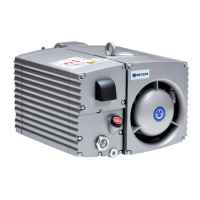

 To Next Page