Need help?
Do you have a question about the Beckhoff CP7011 and is the answer not in the manual?
Essential safety guidelines for operating the control panel.
Outlines the user's responsibility for safe and proper operation.
Details the physical connections for the Control Panel.
Lists pin configurations for CP-Link A and B BNC connectors.
Explains the CP-Link connection and protective earthing.
Details the CP-Link connection for data and power.
Explains the protective earthing connection method.
Details the functionality of various keys on the control panel.
Table detailing common faults, their causes, and recommended measures.
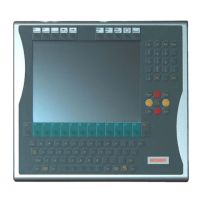
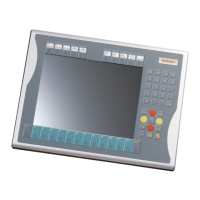
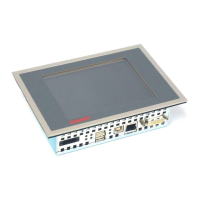
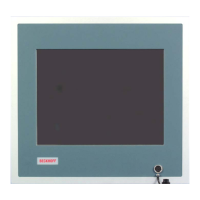
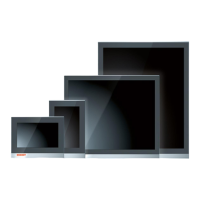
The CP70xx Control Panel is an industrial-grade device designed for use in machine and plant engineering applications. It features an aluminum housing that encases a TFT display, with optional touch-screen/pad and a PC keyboard. The panel is designed for robust installation, typically mounted via four holes in its backplane or through an optional mounting arm system adapter. It is crucial to note that this control panel is not suitable for use in areas where there is a risk of explosion.
The primary function of the CP70xx Control Panel is to serve as a human-machine interface (HMI) for industrial PCs. It does not possess its own mains power switch; instead, it activates as soon as the power supply is connected. Data transmission between the Control Panel and an Industrial PC is facilitated through a CP-Link connection, which also supplies power to the panel. This connection requires two coaxial cables, with a maximum recommended length of 100 meters between the Control Panel and the Industrial PC. For correct connection, a red point on the CP-Link card and a corresponding red marking on the coaxial cable or bend protection serve as orientation aids. A low-resistance protective earthing connection is established via a ground bolt located at the rear of the housing, ensuring electrical safety.
For installation, it is imperative to handle the CP70xx Control Panel with care due to its sensitive components. Despite its robust design, it is susceptible to strong vibrations and impacts during transport. Therefore, the original packaging should be used for any relocation. When transporting the device in cold weather or exposing it to extreme temperature variations, precautions must be taken to prevent moisture (condensation) from forming inside. Should condensation occur, a delay of approximately 12 hours is required before switching on the unit to allow it to adjust to room temperature. Unpacking involves removing the packaging, checking for completeness against the order, retaining all associated paperwork, inspecting for shipping damage, and notifying Beckhoff Service in case of discrepancies or damage.
Connecting the Control Panel requires adherence to specific safety guidelines. It must never be connected or disconnected in an area with explosion hazards, and the mains plug of the Industrial PC must always be disconnected first. Users should consult the documentation for external devices before connecting them. During thunderstorms, plug connectors should neither be inserted nor removed. When disconnecting, always handle the plug itself, not the cable, to prevent damage. The connection process involves switching off the Industrial PC, disconnecting it from the power supply, connecting all cables at the Control Panel and to the devices, ensuring all screw connections are tight, and finally, reconnecting all devices to the power supply.
Operation of the CP70xx Control Panel is straightforward, primarily through its membrane keypad and optional touch screen/pad. The membrane keypad should only be actuated with fingertips to prevent damage; touch screen pens are also acceptable for the touch screen. Operators wearing gloves must ensure no hard particles like metal shavings or glass splinters are embedded, as these could scratch the display.
The Control Panel's functional description highlights that control software, typically used in these panels, allows for assigning different user rights. This is important because attempting to shut down the software while it is running, especially if it is writing data to the Compact Flash memory card, can lead to data loss or corruption. The software frequently writes to the CF card, making improper shutdown a high risk.
The keyboard codes provide a comprehensive set of input functionalities. Cursor keys move the insertion point in associated directions. The Home key moves the cursor to the beginning of a line, while End moves it to the end. Pg Up and Pg Dn keys scroll pages back and forward, respectively. The Tab key navigates to the next input field, and Shift + Tab moves to the previous. The mouse cursor can be controlled via the touch screen or touch pad, with corresponding keys for left and right mouse clicks. The Del key deletes the character to the right of the cursor. The Ins key toggles overwrite mode. Print-Screen captures a hard copy of the text screen. The Pause key temporarily stops the computer (MS-DOS only). The Enter key confirms input. The Backspace key deletes the character to the left. The Shift key, when pressed with another key, allows for uppercase letters or alternative characters. Caps Lock activates and locks the Shift function. Ctrl and Alt keys modify the meaning of other keys. A dedicated key brings up the Start menu of the operating system, and another opens the property sheet of the active object. The Esc key closes dialog windows and interrupts computer operations. All other keys input their printed characters. Function keys (F1-F12) have meanings determined by the software and displayed at the bottom of the screen. Special keys above the display also have software-determined functions, indicated by an orange LED.
Maintenance of the CP70xx Control Panel is minimal as it is largely maintenance-free. However, cleaning the Control Panel requires switching off the Industrial PC and all connected devices to prevent accidental key operations. The front can be cleaned with a soft, damp cloth, avoiding aggressive cleaning materials, thinners, scouring agents, or hard objects that could cause scratches.
A key maintenance feature is the replacement of fluorescent lamps in the display, which are consumable items and need replacement after several years of operation. This task should be performed by a technically competent person and may require partial disassembly of the display. For 6.5-inch displays, plastic clips below the lamp supply cable are pressed down, and the lamps are carefully pulled out in the direction of the arrows. Installation is the reverse. For 12-inch displays, a screw is released, and the fluorescent tubes with their brackets are gently tilted outwards. For 15-inch displays, two screws are released, and the lamps are carefully pulled out. After replacement, installation proceeds in reverse order.
In emergency situations, such as fire, the control panel should be extinguished using powder or nitrogen. For disposal, the device must be fully dismantled. The housing can be recycled as metal, while electronic parts, including lamps and circuit boards, must be disposed of according to national electronics scrap regulations.
Troubleshooting guidance is provided for common issues. If the Control Panel shows no function upon Industrial PC startup, the power supply cable should be checked. If the CP-Link cable is incorrectly connected or exchanged, it should be correctly reconnected, ensuring the plug with the red marking is inserted into the socket with the red point. If the Industrial PC does not boot fully, a floppy disk in the drive should be removed, or if the hard disk is damaged (e.g., due to improper shutdown), booting with a diskette and running SCANDISK is recommended. Incorrect setup settings should be checked. If the computer boots and software starts but control does not operate correctly, the issue might be software-related or with external equipment, requiring a call to Beckhoff Service or the machine/software manufacturer. Floppy disk access errors suggest a faulty disk or drive, requiring disk checks or a call to Beckhoff Service. If the control panel exhibits only partial function or a dark picture despite the disk drive operating, a faulty fluorescent bulb in the display is indicated, requiring replacement as per maintenance instructions. Defective components in the control panel necessitate a call to Beckhoff Service. It is important to note that pixel errors in the TFT display are production-caused and do not constitute a reason for complaint.
 General
| Product Category | Control Panel |
|---|---|
| Model | CP7011 |
| Display Type | TFT LCD |
| Touchscreen | Yes |
| Brightness | 400 cd/m² |
| Ethernet Ports | 1 |
| USB Ports | 2 x USB 2.0 |
| Power Supply | 24 V DC |
| Operating System | Windows Embedded Compact 7 |
| RAM | 2 GB |
| Protection Rating | IP65 |


 To Next Page