The
voltage sensing function is performed
by an
electro-magnetic
device, which
in
turn,
controls
the degree of compression between
a
number
of carbon
discs, an increase in compression
results in a decrease in
resis-
tance,
and
vice
versa.
The
disadvantages of
this type
are at
least
threefold:
(1)
The
electromechanical
nature
of the device is
inherently
less reliable
than a
device
using all
static
elements.
(2)
The carbon pile regulator
sensing
device
consumes power
in order to
control
the pile.
(3)
The carbon
pile
itself
must
dissipate power in order to
perform
its function.
For
example,
if
the
steady
state field current
is
2
amps and the voltage
drop across the
carbon
pile
is 10
volts,
then
the
dissipation
within the pile
must
be 20
watts.
It
will
be seen
that the characteristics mentioned in (2) and
(3)
both
contribute
to a
loss in
efficiency
and to generation of
heat.
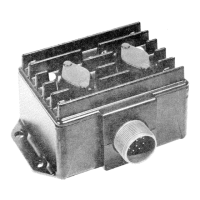
The
Model
20138
voltage regulator
utilizes
all solid
state
circuitry
for
long
life and
reliability. The series regulating
element
employs
the
switching
principle for low
heat generation and
increased
efficiency.
Figure
3-2
shows
the
basic concept.
SERIES
ELEMENT
ALTERNATOR
FIELD
VOLTAGE
SENSING
DONTROL
ELEMENT
GRDUND
1
Y
IQ'
FIG.
3-2
VOLTAGE
REGULATOR, SWITCHING
TYPE
3-2


 To Next Page