– 21 –
behrotest
®
K8 / K12 / K20 / K16 / K24 / K40
059111
© behr Labor-Technik GmbH
Keep your Device Working
Reliably as Long as Possible
The Kjeldahl digestion produces a highly aggressive
mixture of sulfuric acid vapour, sulfur dioxide and organic
vapours. This gas mixture will, with time, corrode even
stainless steel surfaces and make them look shabby.
If acid drips in the aluminium heating block, it will eat
away the aluminium and transform it into bloomings of
aluminium oxide. The sample vessels won‘t match into
the block any more (or they cannot be taken out any
more) or they are no longer heated properly.
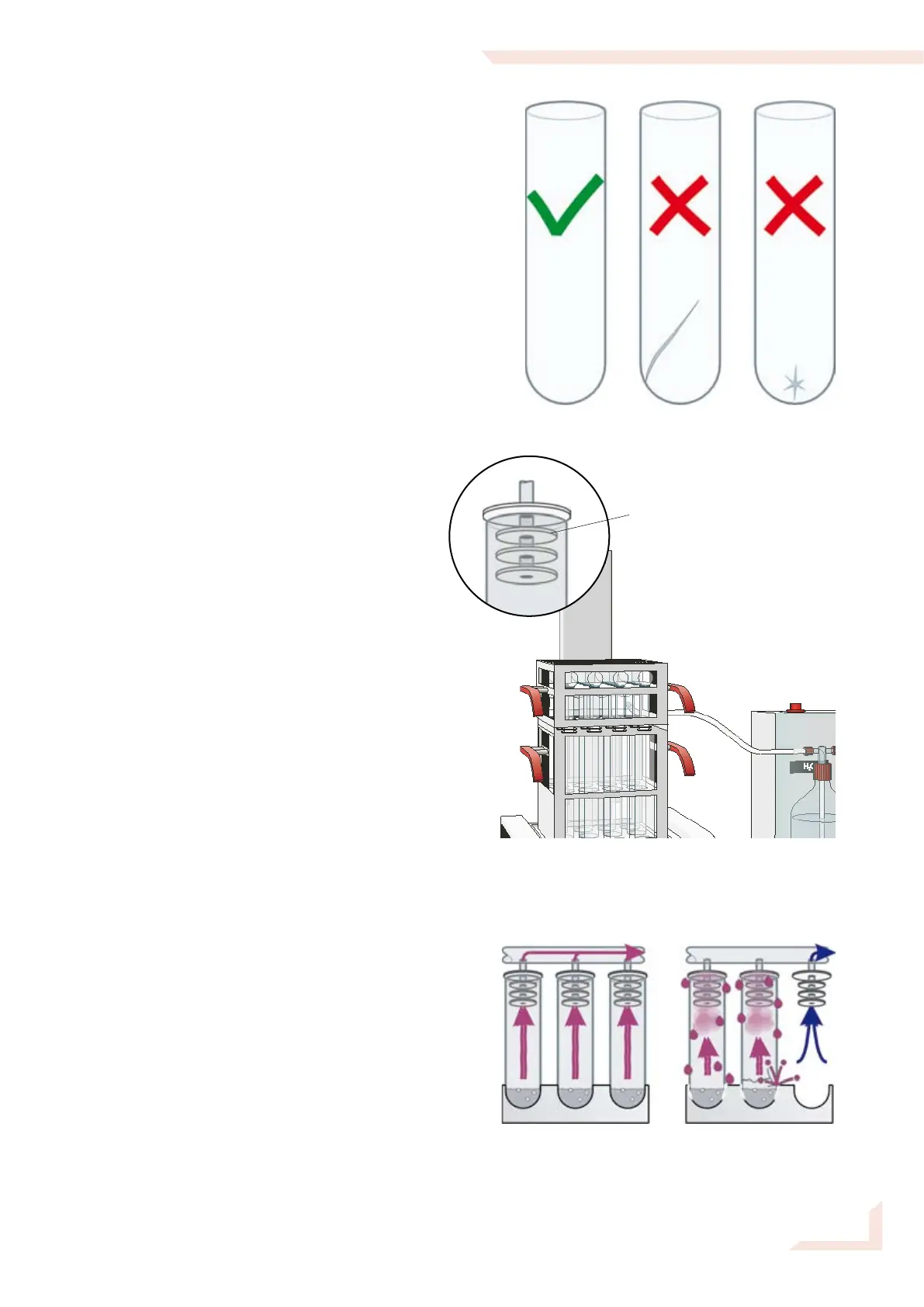
Do Not Use Damaged Vessels!
Before preparing the samples, check the sample ves-
sels. Do not use vessels that have a fissure; they might
burst when heated.
Always Use a Scrubber!
The exhaust gases coming out of a Kjeldahl digestion
are corrosive; moreover they are poisonous, and they
will also damage your lab equipment. So always use a
scrubber system, as e. g. the behrosog 3. Fill the gas
washing flasks according to the user’s manual (the first
one with water, the second one with diluted NaOH). Con-
nect the suction hose to the outlet nozzle in the rear of
the exhaust collector.
Make sure to insert the exhaust collector properly on the
sample vessels. The suction nozzles must reach into the
vessels; the uppermost disk on the nozzles will rest on
the rim of the vessel. Adjust the suction flow rate in such
a way that the white fumes are sucked off but no vacuum
will arise.
Don‘t Leave Any Places Empty!
The suction air current will always go the way of least
resistance. So if you leave some sample places empty,
if there is no sample vessel under the suction nozzle,
the scrubber will aspirate most of its air from there.
The caustic vapours coming out of the samples are not
removed; instead, they will creep over the rim of the ves-
sel. Caustic condensate may drip down from there, dam-
aging the heating block and the sample rack. If worst
comes to worst, drops may come into the gap between
the vessel and the boring in the heating block, evaporat-
ing explosively and cracking the vessel. So always insert
samples on all sample places; at least, insert empty
sample vessels.
Never use vessels that have
fissures
Suction nozzle must reach
into the sample vessel
Samples in all
places:
Waste gas will be
removed smoothly
Some places left free:
Scrubber will draw air,
gas will accumulate and
come out sideways
Condensate can
drip down, corrode
the block and crack
the vessels


 To Next Page