S.p.A. BT 2001 R
16
.
21) MOVING ON THE ROAD
The tractor conforms to EC regulations, it can move on
the road, if the following conditions are respected:
Ø The tractor must be registered and insured. It must
be equipped with a plate, which has to be fitted
correctly.
Ø It must be equipped with a working light system.
Ø The brake system must be efficient.
Ø The driver must have a valid driving licence.
Ø The rear-lift must be in its highest position and the
arms locked (ref.4 fig.9), if no implement is fitted, as
it is indicated in the paragraph “Use of the three point
linkage”. Always remove the top link (ref.3 fig.9) if it is
not connected with any implement.
Ø Moving on the road with implements fitted to the
tractor is allowed, if the instructions stated above are
respected and only within the limits stated in the
highway regulations. The lights must be visible and the
flashing amber light must be working during the day.
Ø In order to move the tractor on the road, start the
machine and select the transmi ssion gear as indicated
in the paragraph “STARTING THE MOTOR”.
22) USE OF TOWING BRACKETS
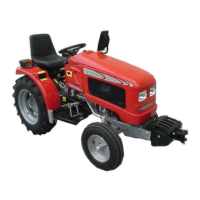
The tractor can be fitted with a front towing bracket
and two types of rear towing brackets.
Front towing bracket fig.10 ref.1 is to be used for towing
the tractor in an emergency, and it is obligatory when
the tractor is travelling on the road. Rear towing bracket
is the standard one (fig.11 ref.1) for towing agricultural
accessories.
A CE certified rear-towing bracket is also available. See
fig.9 ref.8
This bracket can be used for towing on the road and can
be connected to a single-axle trailer. This trailer must
be certified and its characteristics have to conform to
those stated on the tractor’s plate (see point 7).
Fit the towing bracket correctly. Fit the hand brake.
Connect the trailer’s electric system with the power
point (ref.1, fig.12), on the back of the tractor.
ATTENTION
When you are towing a trailer on a slope greater than
10%, you must use a front-ballast of 60 KG.
Fig.10 Fig.11


 To Next Page