EasyManua.ls Logo

BendPak BB 1302-BAS - User Manual

BendPak BB 1302-BAS
68 pages
Print Icon
To Next Page IconTo Next Page
Loading...
OPERATION AND SERVICE MANUAL
“America’s Most Popular Tubing Bender”
MODELS:
BB (“Blue Bullet”)
1302-BAS 1302-BA
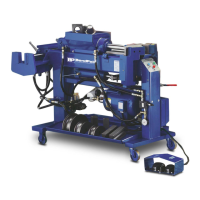
Model 1302-BA
shown.
SHIPPING DAMAGE CLAIMS
When this equipment is shipped, title passes to the
purchaser upon receipt from the carrier. Consequently,
claims for material damaged in shipment must be made by
the purchaser against the transportation company at the
time shipment is received.
BE SAFE
BendPak, Inc. benders are designed and built with safety
in mind. However, your overall safety can be increased by
proper training and thoughtful operation on the part of the
operator. DO NOT operate or repair this equipment without
reading this manual and the important safety instructions
shown inside.
1645 Lemonwood Dr.
Santa Paula, CA. 93060, USA
Toll Free 1-800-253-2363
Tel: 1-805-933-9970
www.bendpak.com
PLEASE READ THE ENTIRE CONTENTS OF THIS MANUAL PRIOR TO
INSTALLATION AND OPERATION. BY PROCEEDING YOU AGREE THAT YOU
FULLY UNDERSTAND AND COMPREHEND THE FULL CONTENTS OF THIS
MANUAL. FORWARD THIS MANUAL TO ALL OPERATORS. FAILURE TO
OPERATE THIS EQUIPMENT AS DIRECTED MAY CAUSE INJURY OR DEATH.
REV. C - FEB. 2018
pn# 5900103
Keep this operation manual near the
machine at all times. Make sure that ALL
USERS read this manual .

Table of Contents

Question and Answer IconNeed help?

Do you have a question about the BendPak BB 1302-BAS and is the answer not in the manual?

Overview

The device described in the manual is a "press-style" tubing bender, specifically the BendPak "Blue Bullet" (BB), 1302-BAS, and 1302-BA models. Its primary function is to bend, flare, and swage tubing up to 3 inches in diameter. The machine is designed for automotive service applications, particularly for exhaust system fabrication.

Function Description:

The bender operates using a hydraulic system with a top cylinder that activates the bending or radius die, moving it forward through back shoes. A bottom cylinder applies resistance pressure to the back shoes via a chain assembly and an integrated hydraulic sequence valve, helping the tubing maintain its shape during bending. Beyond bending, the machine performs various end-finishing operations through a swager box and an internal expander. The swager box uses pipe collars with bullet-shaped expander/forming dies for end finishing, while the internal expander utilizes segmented expander dies with a tapered arbor for expanding tubing to exact inside diameters or creating male ball expansions.

Important Technical Specifications:

The bender handles tubing from 1/2" OD to 3" OD. Maximum bending radius is 5", and minimum is 3-1/2". Swaging capability ranges from 1" OD to 3" OD tubing. The motor is a 5 HP unit, available in single or three-phase configurations (220-380-440 VAC). The pump output is 3 GPM at 4200 psi (max. output). Bending force is 55,000 pounds maximum. The machine features a canister-type hydraulic filter. Overall dimensions are approximately 62" in length, 30" in width, and 41" in height for 1302-BAS/BA models, and 68" in length for 1302BL models. Bend-depth control varies by model: BAS models use a degree plate with an adjustable pointer, while BA models feature a digital readout. The manual provides a detailed chart for tubing gauge/wall thickness and corresponding maximum bend depth for different radius sizes (3-1/2", 4", 5", 180° Style). For instance, 13 gauge (.095) tubing can be bent up to 3" OD, while 18 gauge (.049) is limited to 1"-1-3/4" OD. Special size dies are available upon request.

Usage Features:

The bender offers different control modes depending on the model:

  • BL or Blue-Bullet Models: Manual control via a hydraulic knee control valve and a degree plate for bend depths. No automatic features.
  • BAS Models: Two control modes – electric foot switch for manual bending and a three-button control board (GREEN for automatic cycle, BLUE for retract, RED for emergency stop) for automatic functions. A degree plate with an adjustable slide pointer sets bend depth.
  • BA Models: Similar to BAS but with a digital control board featuring a "DIE ANGLE" readout. It allows programming bend depths in sequence, with memory erased when power is off. "AUTO" button initiates the sequence, "STOP" pauses, and "REVERSE" activates return. Foot switches override digital controls. Bending operations can be performed using program cards (which contain specific instructional data) or by pattern bending (duplicating an existing pipe or wire pattern). The manual details step-by-step procedures for both, including marking center marks, setting pipe rotation, and adjusting bend depth. End-finishing tools include standard segment expanders for straight expansions, ball-joint segment sets for male ball expansions, flare segment sets for 45-degree flares, manifold flange segment sets for donut-type flanges, and reducing tools for shrinking pipe ends. Specific dies like STED expander dies (solid expander dies) and HPF-300/CFT tools are used for various end-finishing tasks.

Maintenance Features:

Regular maintenance is crucial for performance and longevity.

  • Hydraulic Oil Service: The bender uses approximately seven gallons of hydraulic oil. Oil level should be checked weekly via a sight gauge and maintained midway on the gauge. Oil should be changed after 1,500 hours or yearly, along with the oil filter. Recommended hydraulic oils include Chevron OC Turbine 46, Mobile DTE Medium, Texaco Rando HD 46, etc., or any 10 medium-weight mineral-based fluid with a non-foaming additive.
  • Weekly Maintenance: Clean and re-grease guide plate, arbor, and swager clamp blocks. Check for equal chain tension, inspect all hydraulic hoses for wear/cuts, and repair leaks immediately.
  • Monthly Maintenance: Check depth-of-bend accuracy, grease zirk fittings on barrel assembly, clean and spray dies with rust inhibitor, tighten all hydraulic hoses, check squareness of back gates and guide plate (shim/adjust as required), re-torque mounting bolts on hydraulic components, lubricate caster assemblies, remove nicks/burrs from tooling, and ensure arbor and ST-1 are tight to the cylinder shaft.
  • Pressure Settings: Three critical pressure settings: back pressure (normal 1600 PSI, max 2000 PSI for 3" tubing), return pressure (normal 350 PSI, max 350 PSI), and system pressure (normal 3200 PSI, max 3200 PSI). These should be checked weekly and adjusted as needed.
  • Chain Adjustment: Chains should have equal tension, with the threaded chain connector protruding about 1/4" from the adjusting nut.
  • Guide Plate Leveling: The guide plate should be square with the back gates. Adjustment involves shimming if there's a gap or misalignment.
  • Barrel Bushing Maintenance: Bushings should be checked every six months for excessive wear. If worn (inside diameter > 2.005"), they should be replaced to prevent tubing wrinkling.
  • Swager Box Cylinder Alignment: Checked periodically to ensure the cylinder is square and centered with clamp blocks for correct expansion.
  • Pusher Block Maintenance: Checked for wear and squareness to the guide plate. If worn (> 1/32" movement), it should be replaced.
  • Calibration: Depth-of-bend plate (BAS/Blue-Bullet) and digital readout display (BA) require calibration to ensure accurate bend angle readings.
  • Electrical Repair: Electrical components should only be serviced by a certified electrician. The manual provides troubleshooting guides for common issues like motor problems, control malfunctions, and hydraulic system failures, along with wiring diagrams for BA and BAS models. A jumper board is available for diagnostic purposes on BA models.

BendPak BB 1302-BAS Specifications

General IconGeneral
BrandBendPak
ModelBB 1302-BAS
CategoryConstruction Equipment
LanguageEnglish

Related product manuals