Copyright © BEP Marine Limited, All rights reserved
INST-600-GD-V5
29/11/07
Page 4
4 Features
The 600-GD and 600-GDL gas detectors offer the following features: -
Self testing capability
Microprocessor control
Dual sensor capability
Provision for an external alarm
Provision for automatic bilge blower switching
Automatic shut-off solenoid control with Pulse and Hold circuit technology for low power draw
(600-GDL only)
Manual override – Important: Disables gas detector (600-GDL only)
5 Specification
Voltage: 600GD 10V-30V DC / 600GDL 10-15V DC
Current: Total 350mA Max
Alarm: 20% LEL (Lower Explosive Limit)
Current at outputs: 800mA Max (per output)
NOTE: If you are using a solenoid valve other than BEP’s VR2. The solenoid current draw must
be checked to make sure it is 800mA or less at 12.5 volts.
6 Introduction
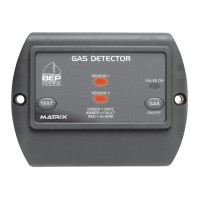
The Contour model LPG, Petrol and CNG detector is the product of continuing research and
development, which BEP Marine Ltd devotes to their product range. The 600 series detectors use the
latest in solid state technology available, with a microprocessor control head connected to the latest in
sensor technology. The 600 series detectors have the capability to control two sensors with both
visual and audible alarms. There is a test switch to check the operation of the sensors with indicators
for fault detection.
The 600-GDL has provision for the connection of an external alarm, bilge blower, gas on/off valve and
manual override to disable faulty sensor.
Read these installation and operation instructions carefully before installing, as any damage caused
by faulty installation will result in the warranty being null and void.
There is no power on/off switch provided in either unit. It is intended that for maximum protection the
unit should be on all the time while you are on your boat or vehicle.
7 Fault Detection
The nominal alarm point of the 600 series is 20% of the LEL (Lower Explosive Limit) of LPG/CNG in
Air. In the event of a gas leak and the alarm activating, close the manual valve on your gas bottles
and open hatches to ventilate the area. All fans and blowers used to ventilate must be ignition-
protected types.
In the event of a sensor being contaminated, damaged, cable shorting or a faulty connection, the
amber light will come on for the particular sensor. If the sensor fault persists then the sensor could be
damaged and will need to be replaced.
In detecting LPG the sensor can also detect hydrocarbons in other products such as cleaners and
strong adhesives, this can cause nuisance alarms. See section 3 - ‘Cautions when using gas sensors’
for more details.


 To Next Page