35
If necessary, re-attach the cu after 1 minute.
The device switches o automatically after approx.
30seconds. The value is saved to the selected or most
recently used user.
Multiple measurement
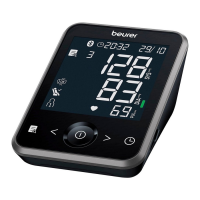
1. Press . All display elements are briefly displayed.
2. The start screen welcomes you for selected or for se-
lected . From this start screen you can access all menu
items, e.g. user memory.
3.
Multiple measurement can be selected by pressing < or
>. flashes on the display. To start the measurement,
confirm with .
The cu inflates itself automatically. The measurement
starts.
4.
The device displays the first measurement cycle for 3
seconds and then performs a regular measurement that
is repeated three times. In the second and third cycle, a
30-second countdown is also displayed, indicating the
time to wait until the next measurement.
To cancel the measurement, press
.
5. After the third measurement, the average measurement of
systolic pressure, diastolic pressure and pulse is displayed
and indicated with .
The cu position control symbol
OK
is displayed through-
out the entire measurement. If the cu is too loose,
and will be displayed. In such cases, the measure-
ment is cancelled after approx. 5 seconds and the device
switches itself o.
is displayed if the measurement could not be per-
formed properly. In this case, please refer to the “Trou-
bleshooting” section.
If necessary, re-attach the cu after 1 minute.
The device switches o automatically after approx.
30seconds. The value is saved to the selected or most
recently used user.
6.4 Evaluating the results
General information about blood pressure
• Blood pressure is the force with which the bloodstream
presses against the arterial walls. Arterial blood pressure
constantly changes in the course of a cardiac cycle.
• Blood pressure is always stated in the form of two values:
- The highest pressure is the systolic blood pressure.
This occurs when the heart muscle contracts and
blood is pumped into the blood vessels.
- The lowest pressure is the diastolic blood pressure.
This occurs when the heart muscle has completely re-
laxed again and the heart is filling with blood.
• Fluctuations in blood pressure are normal. Even during
repeat measurements, there may be considerable dier-
ences between the measured values. One-o or irregular
measurements therefore do not provide reliable informa-
tion about the actual blood pressure. Reliable assess-
ment is only possible when you perform the measure-
ment regularly under comparable conditions.


 To Next Page
 Loading...