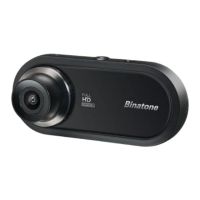
This document is a Quick User Guide for the Binatone Dashboard Camera, model FHD300GW. It provides instructions for installation, operation, and maintenance of the device, as well as important safety information and legal considerations.
The primary function of the Binatone Dashboard Camera is to continuously record the road ahead while driving. It is designed to automatically record and save footage of incidents or accidents that may occur. The camera is equipped with a Li-polymer battery, which serves as a backup power source, but the device is primarily intended to be powered by the car's cigarette charger to maintain battery level during operation.
Usage Features:
- Recording: The dash camera automatically powers on and begins recording when connected to a power source that activates with the vehicle's engine. Users can also manually power on the device using the Power On/Off button. The device records video in clusters, with a default duration of 1 minute per cluster, and utilizes loop recording, overwriting the oldest files once the memory card is full.
- Storage Management: The SD card storage space is allocated for different file types: approximately 60% for general recordings, 30% for event recordings, and 10% for photos and cache files.
- Mode Switching: The camera supports switching between video recording mode and playback mode using the Mode button. Video mode is the default.
- Event Recording (G-Sensor): The G-Sensor detects forces, such as those from a collision, and automatically protects the current recording, saving it to an "EVENT" folder. The sensitivity of the G-Sensor can be adjusted (Off/High/Medium/Low).
- Manual Video Lock: In an emergency, users can manually lock the current video by pressing the Lock button during recording. This footage will also be saved in the "EVENT" folder.
- Parking Mode: Although disabled by default for technical reasons, the parking mode feature allows the dash camera to record events when the car is parked with the engine off. The built-in battery keeps the sensor in standby, and recording starts automatically for 30 seconds if vibration or shock is detected.
- Audio Recording: The device has a microphone for audio recording, which can be enabled or disabled. A hotkey allows for muting/unmuting the microphone during video mode.
- Photo Capture: Users can take photos by short-pressing the OK button during recording.
- LCD Display: The device features a color screen. The LCD can be set to never turn off, or to turn off after 1 or 3 minutes. A hotkey (short press of the power button) can toggle the LCD on/off in a power-on state.
- GPS Functionality: The device includes a GPS module. When "GPS Time" is enabled, the device automatically synchronizes its time with GPS data, rendering manual date/time settings unnecessary. The GPS status can be checked in the settings.
- Wi-Fi Connectivity: The dash camera can connect to a smart device (Android or iOS) via Wi-Fi using the HubbleClub Dashcam APP. Wi-Fi is "On" by default when power is supplied. A long press of the lock button in video recording mode can turn Wi-Fi off. The Wi-Fi icon changes color to indicate its status (White for On, Red slash for Off, Green for Connected). Note that the dashcam cannot be operated directly when Wi-Fi is connected to a smart device.
- Playback: Recorded files can be viewed directly on the device in playback mode. Alternatively, videos and photos can be played back on a PC by connecting the device via a USB cable or by using a microSD card reader.
- Settings Customization: The device offers various settings that can be adjusted:
- Main Settings: GPS Time (On/Off), Date/Time, Date Format, Beep Sound (On/Off), Language, Frequency (exposure level), LCD OFF duration, Exposure adjustment, GPS Status, Format SD Card, Default Setting.
- Video Settings: Video Resolution (1920*1080 30fps default, or 1280*720 30fps), Loop Recording duration (1 Minute default, 3 Minutes, 5 Minutes), G-Sensor sensitivity (Off/High/Medium/Low default), Parking mode (disabled by default), Record Audio (enable/disable microphone), Date Stamp (enable/disable on videos/photos).
- Playback Settings: Options to delete files (current file or all files) from the SD card. Locked photos or videos cannot be deleted.
Maintenance Features:
- SD Card Formatting: It is recommended to format a new SD card before first use. The device provides a "Format" option in the main settings to delete all storage contents from the SD card.
- Reset Function: A Reset Button is available to restart the device if it becomes unresponsive.
- Default Settings: The device can be reset to factory default settings via the "Default Setting" option in the main settings.
- Battery Disposal: The Li-polymer battery must be recycled or disposed of properly and not in household waste or by burning.
- Packaging Retention: Users are advised to keep the packaging materials in a safe place for potential future transportation of the unit.
Important Considerations:
- SD Card Requirement: A Micro SD card (not provided) of 4GB or above, Class 10 or above, and up to 32GB capacity is required. Removing the SD card during recording can prevent the current video from being saved.
- Safety Instructions: The device should not be installed within the driver's or passenger airbag operation range. Settings or modes should not be modified while the car is in motion. The device and its power cord must be installed without obstructing the driver's line of sight or driving controls.
- Battery Safety: The Li-polymer battery should not be used in humid, wet, or corrosive environments, or stored in high temperatures (>60°C) or direct sunlight. The battery casing should not be pierced or broken to avoid leakage, overheating, explosion, or ignition. In case of contact with leaked battery acid, the affected area should be thoroughly washed, and medical attention sought.
- Legal Compliance: Users are responsible for checking applicable laws regarding the use and mounting of dash cameras in their jurisdiction, as these devices may be considered an invasion of privacy or subject to specific mounting regulations. The manufacturer disclaims responsibility for wrong or unlawful use.

 Need help?
 General

 To Next Page