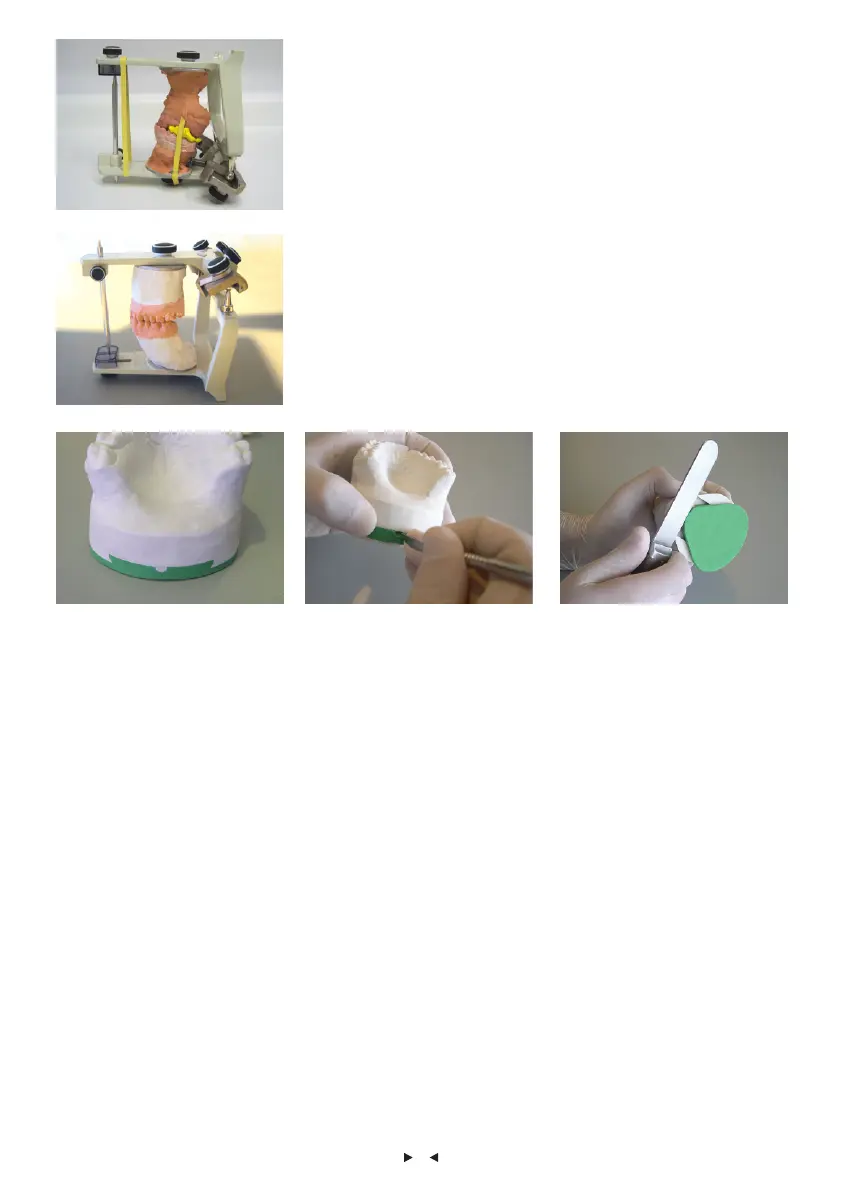
d) Make sure the condylar elements are duly positioned and
close the lower frame until the Incisal guide pin touches the
Incisal table. Afterwards, fasten the articulator frames
using rubber bands to prevent possible distortion occurred
by the plaster expansion (fig. 59)
Note: The sides of the mounting plates, which are in
contact with the articulator frames, should be devoid of
plaster.
e) After the plaster hardens, turn the articulator back to its
upright position (lower frame resting on the laboratory
bench) and complete the work, filling the cast fixation
towers with plaster for the finishing touches (fig. 60).
FIG. 59
FIG. 60
TROCAR
A FOTO
FIG. 61 FIG. 62 FIG. 63
3.5
P
ARTICULARITIES OF THE
RAIL MOUNTING
PLA
TE
The
Rail
Mounting Plate
was
specially
developed to
allow
the removal
of
the
plaster
cast
without
the
needs
of
breaking it,
as
occurs
in most
of the
conventional
mounting
plates.
In order to
use
of
this resource satisfactorily,
the
professional
should
take
some cares,
mainly
during
the
confection
of the cast, and
afterwards when handling
the removal
of
the
plate, occording to the following
procedure:
a) The
plaster
finishing
on
the edge
of the mounting
plate should
be
done in
such way
to
avoid
excess
of
plaster
around
the edge and to allow
the splitting
and
the
sliding of the plate
afterwards, i.e.,
during
the
removal procedure (fig.
61).
b) Before
the
removal
of the
cast, the
plaster contained in
the
retention hole
should be
removed
with
an instrumental tip.
The
function
of
this retention
hole
is to avoid
displacement
of
the
plate
when
handling
the
cast
(fig. 62).
c)
Once
the plaster contained
in the
retention
hole
is removed,
the
cast
should
be firmly held
and a slight strike
must be applied
on the
edge
of
the plate, in
the
direction
of
the arrows
stamped
in
the plate
lower face.
This procedure
will
detach the
mounting plate
from the
cast
and enable its removal through the sliding
(fig. 63).
PS:
Once the
cast is
removed
from
the
rail
mounting
plate,
we
do not
assure
its
returning to
the
initial precision
since
it
dependes
on
the
technique applied
and
quality
of
the
materials used
in
the
process (specially the
plaster).
9



 To Next Page