Biodex Ergometers Support METS and Aid Exercise Prescription
for Both Cardiopulmonary Rehabilitation and Medical Fitness
A cardiac stress test typically reports the max MET level achieved by the patient and/or
the MET level achieved at the point the test turned positive (often demonstrating ischemic
changes in the heart muscle and/or inappropriate arrhythmias). Cardiologists often ask
therapists to keep a patient below a certain MET level based on this information from the
cardiac stress test. The Cardiologist will report, for example, "ischemic changes at 10
METs/Heart Rate 128. Exercise at or below 9 METs".
Different types of cardiovascular exercise machines require the user to work at different
work loads (watts) to ensure a consistent elevation of an individual’s metabolic rate and
the corresponding appropriate heart rate. Cranking an upper body cycle at 100 watts will,
for example, have a very different effect on one’s metabolic rate and heart rate when
compared to pedaling a lower body cycle at 100 watts. It is up to the clinician to set the
appropriate workloads on each ergometer, or speed and elevation on the treadmill, to
achieve the appropriate MET level.
The Relationship of Calories Burned to Oxygen
Consumption and METS
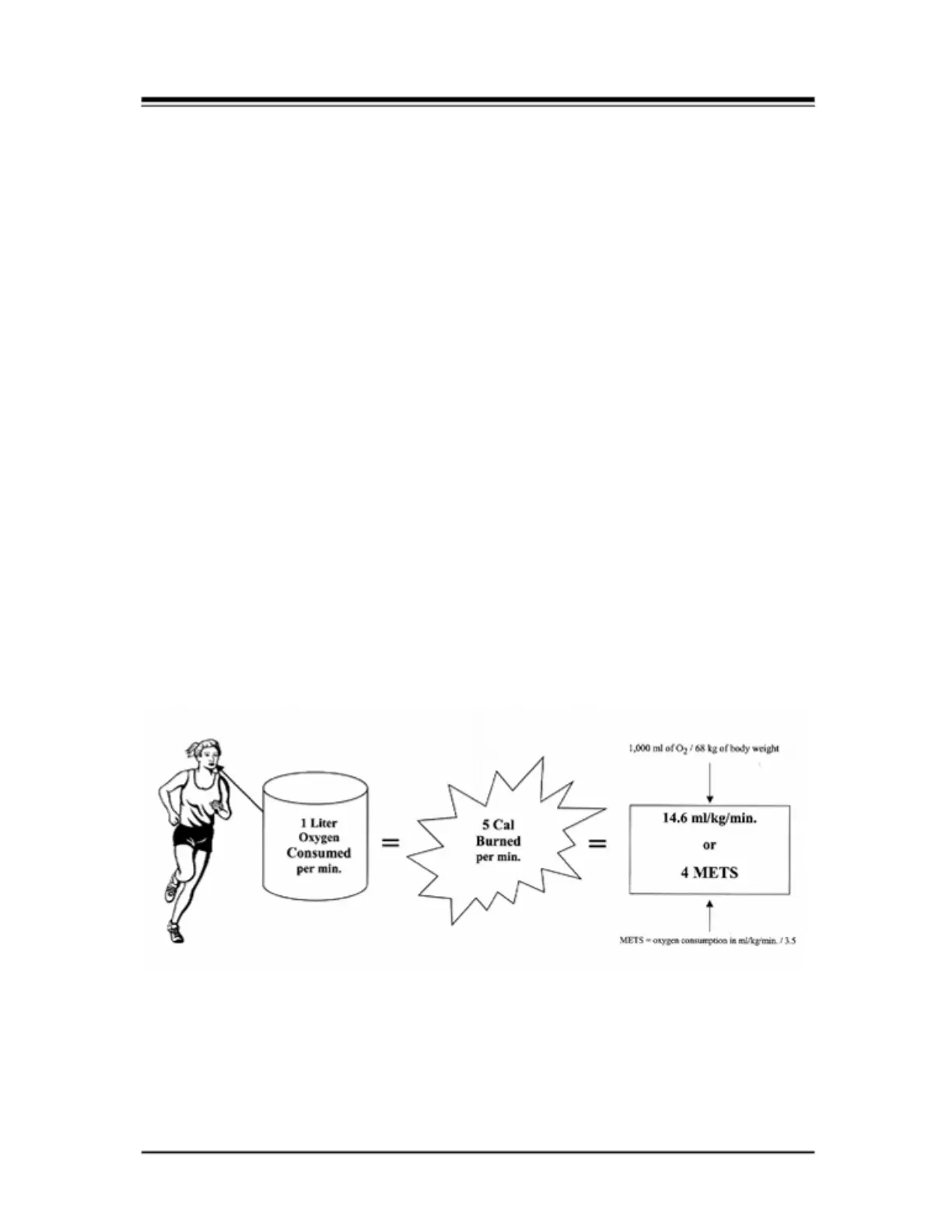
For every liter of oxygen consumed by the body during exercise, the body burns approximately
5 calories. The example below shows a 150 lb (68 kg) individual exercising at a level
requiring an oxygen consumption of 1 liter (1,000 ml) of oxygen each min., which would
require that they burn 5 calories each min. to supply the appropriate amount of energy for
the exercise. This same individual would be burning 14.6 milliliters of oxygen for each
kilogram of body weight per min. (1,000 ml of oxygen / 68 kg of body weight). Since one
MET = (oxygen consumption in ml/kg/min.) / (3.5), this individual would be exercising at
4 METs. They would need to elevate their resting metabolism approximately 4 times to
sustain this rate of exercise.
— 15 — CLINICAL CONSIDERATIONS


 To Next Page