7
8.3. Protective tip cone fi lters
The tip cone design of the Biohit m LINE pipettes (>10 μl) allows the
use of Biohit Safe-Cone fi lters in the tip cones. These removable
fi lters prevent liquids and aerosols from entering the pipette and,
thus, protects the pipette from contamination and damage.
The Safe-Cone fi lters are available as Standard or Plus versions. It
is recommended to use the Standard fi lter for general applications
and the Plus fi lter for more demanding applications such as cell
culture, bacterial and virological work and molecular biology.
Filters need to be changed regularly. The interval for fi lter changing
is application dependant but the recommendation is to change the
fi lter daily (after 50 - 250 pipetting cycles) and always in case of
over-aspiration. (See Chapter 2 for ordering information.)
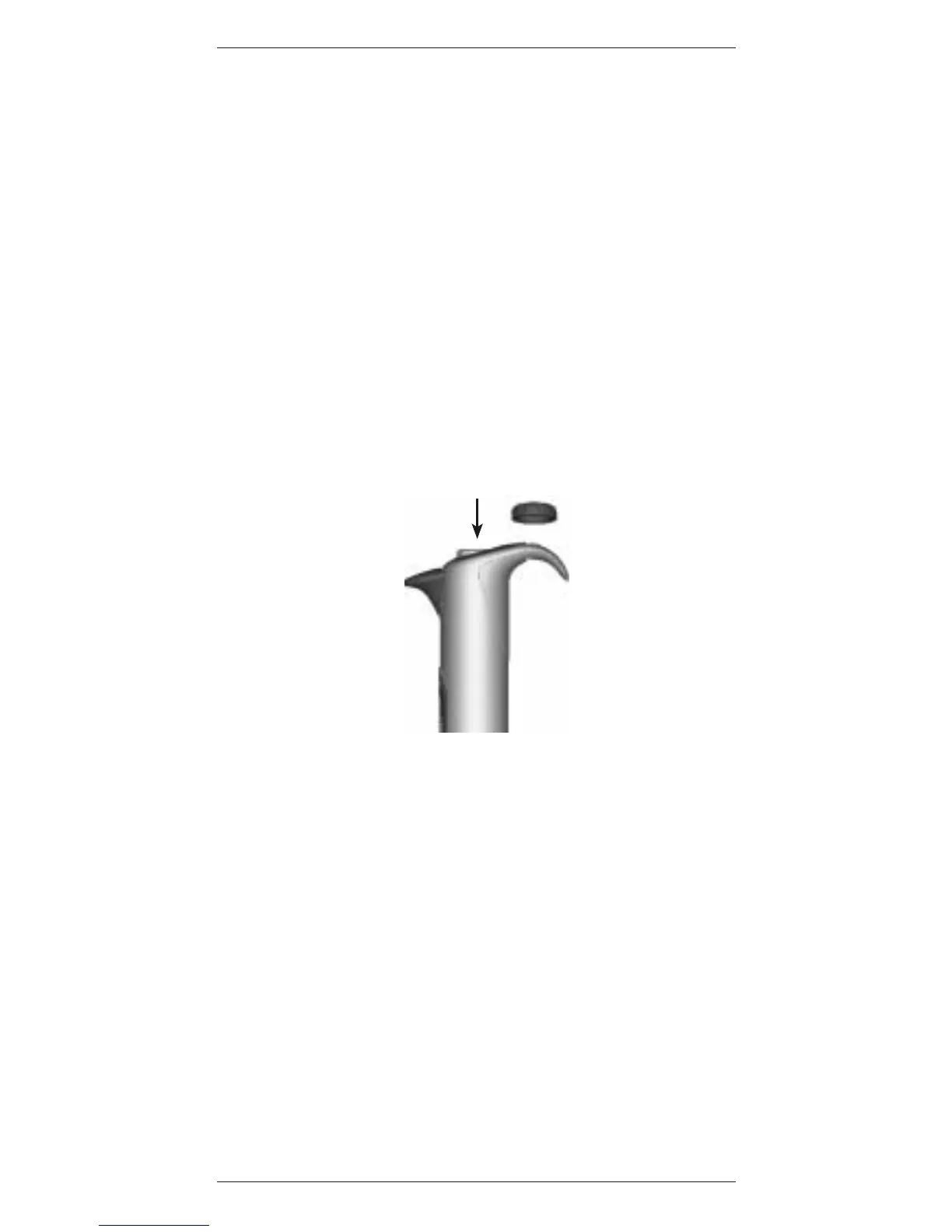
The Safe-Cone fi lters can be removed with the unique fi lter ejector
without touching the fi lters by hand. Remove the operating button
cap and eject the fi lter by pressing the operating button down
(Fig. 7). Make sure that the fi lter is disposed into a suitable waste
container. Clean the tip cone if needed and put the new fi lter in
place.
Fig. 7.
9. PIPETTING TECHNIQUES
Two basic pipetting techniques, forward and reverse pipetting,
are associated with mLINE pipettes. Forward pipetting is the
most common used pipetting technique. The technique employs
the blow-out function ensuring complete delivery of the liquid.
Reverse pipetting is recommended for highly viscous, biological
or foaming liquids, or very small volumes of liquid. A selected
volume plus an excess is aspirated into the tip. The delivery is done
without blow-out, and, thus, the excess volume remains in the tip.
The reverse technique also facilitates the repeated delivery of the
same volume. If reverse pipetting technique is used the pipette
might need recalibration.
Artisan Scientific - Quality Instrumentation ... Guaranteed | (888) 88-SOURCE | www.artisan-scientific.com


 To Next Page