4
ENGLISH
d. Remove any adjusting key or wrench before turning
the power tool on. A wrench or a key left attached to a
rotating part of the power tool may result in personal injury.
e. Do not overreach. Keep proper footing and balance at
all times. This enables better control of the power tool in
unexpected situations.
f. Dress properly. Do not wear loose clothing or
jewellery. Keep your hair, clothing and gloves away
from moving parts. Loose clothes, jewellery or long hair
can be caught in moving parts.
g. If devices are provided for the connection of dust
extraction and collection facilities, ensure these are
connected and properly used. Use of dust collection
can reduce dust-related hazards.
4. Power tool use and care
a. Do not force the power tool. Use the correct power
tool for your application. The correct power tool will do
the job better and safer at the rate for which it was
designed.
b. Do not use the power tool if the switch does not turn it
on and off. Any power tool that cannot be controlled with
the switch is dangerous and must be repaired.
c. Disconnect the plug from the power source and/or the
battery pack from the power tool before making any
adjustments, changing accessories, or storing power
tools. Such preventive safety measures reduce the risk of
starting the power tool accidentally.
d. Store idle power tools out of the reach of children and
do not allow persons unfamiliar with the power tool or
these instructions to operate the power tool. Power
tools are dangerous in the hands of untrained users.
e. Maintain power tools. Check for misalignment or
binding of moving parts, breakage of parts and any
other condition that may affect the power tools
operation. If damaged, have the power tool repaired
before use. Many accidents are caused by poorly
maintained power tools.
f. Keep cutting tools sharp and clean. Properly
maintained cutting tools with sharp cutting edges are less
likely to bind and are easier to control.
g. Use the power tool, accessories and tool bits etc. in
accordance with these instructions, taking into
account the working conditions and the work to be
performed. Use of the power tool for operations different
from those intended could result in a hazardous situation.
5. Battery tool use and care
a.
manufacturer. A charger that is suitable for one type of
another battery pack.
battery packs. Use of any other battery packs may create
c. When battery pack is not in use, keep it away from
other metal objects, like paper clips, coins, keys,
nails, screws, or other small metal objects, that can
make a connection from one terminal to another.
Shorting the battery terminals together may cause burns
d. Under abusive conditions, liquid may be ejected from
the battery; avoid contact. If contact accidentally
additionally seek medical help. Liquid ejected from the
battery may cause irritation or burns.
6. Service
a.
person using only identical replacement parts. This will
ensure that the safety of the power tool is maintained.
Additional power tool safety warnings
@
Warning! Additional safety warnings for
drills
u Use auxiliary handles supplied with the tool. Loss of
control can cause personal injury.
u Hold power tool by insulated gripping surfaces when
performing an operation where the cutting accessory
may contact hidden wiring. Cutting accessory contacting
a "live" wire may make exposed metal parts of the power
tool "live" and could give the operator an electric shock.
u Hold power tool by insulated gripping surfaces, when
performing an operation where the fastener may
contact hidden wiring. Fasteners contacting a "live" wire
may make exposed metal parts of the power tool "live"
and could give the operator an electric shock.
u Use clamps or another practical way to secure and
support the workpiece to a stable platform. Holding the
work by hand or against your body leaves it unstable and
may lead to loss of control.
u
location of wiring and pipes.
u Avoid touching the tip of a drill bit just after drilling, as it
may be hot.
u The intended use is described in this instruction manual.
The use of any accessory or attachment or performance
of any operation with this tool other than those recom-
mended in this instruction manual may present a risk of
personal injury and/or damage to property.
Safety of others
u This tool is not intended for use by persons (including
children) with reduced physical, sensory or mental capa-
bilities, or lack of experience and knowledge, unless they
have been given supervision or instruction concerning use
of the tool by a person responsible for their safety.
u Children should be supervised to ensure that they do not
play with the appliance.
Residual risks
Additional residual risks may arise when using the tool which
may not be included in the enclosed safety warnings. These
risks can arise from misuse, prolonged use etc.
Even with the application of the relevant safety regulations
and the implementation of safety devices, certain residual
risks can not be avoided. These include:
u Injuries caused by touching any rotating/moving parts.
u Injuries caused when changing any parts, blades or ac-
cessories.
u Injuries caused by prolonged use of a tool. When using
any tool for prolonged periods ensure you take regular
breaks.
u Impairment of hearing.
u Health hazards caused by breathing dust developed when
using your tool (example:- working with wood, especially
oak, beech and MDF.)
5
ENGLISH
Labels on tool
The following symbols are shown on the tool along with the
date code:
:
Warning! To reduce the risk of injury, the user
must read the instruction manual.
Additional safety instructions for batteries and
chargers
Batteries
u Never attempt to open for any reason.
u Do not expose the battery to water.
u Do not store in locations where the temperature may
exceed 40 °C.
u Charge only at ambient temperatures between 10 °C and
40 °C.
u Charge only using the charger provided with the tool.
u When disposing of batteries, follow the instructions given
in the section "Protecting the environment".
p
Do not attempt to charge damaged batteries.
Chargers
u Use your BLACK+DECKER charger only to charge the
battery in the tool with which it was supplied. Other batter-
ies could burst, causing personal injury and damage.
u Never attempt to charge non-rechargeable batteries.
u Have defective cords replaced immediately.
u Do not expose the charger to water.
u Do not open the charger.
u Do not probe the charger.
$
The charger is intended for indoor use only.
+
Read the instruction manual before use.
Electrical safety
#
Your charger is double insulated; therefore no
earth wire is required. Always check that the
mains voltage corresponds to the voltage on
the rating plate. Never attempt to replace the
charger unit with a regular mains plug.
u If the supply cord is damaged, it must be replaced by the
manufacturer or an authorised BLACK+DECKER Service
Centre in order to avoid a hazard.
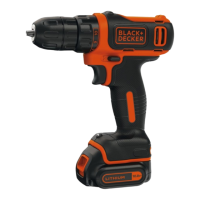
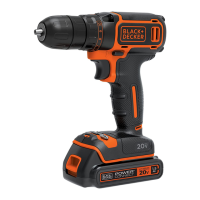
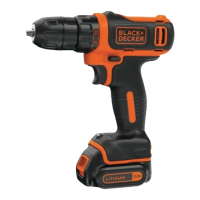
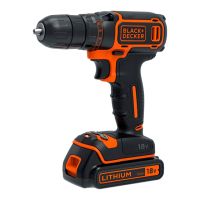
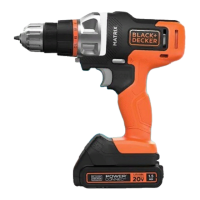
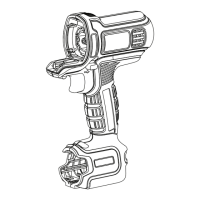
Features
This tool includes some or all of the following features.
1. Switch
2. Forward/reverse slider
3. Keyless chuck
4. USB charging port
5. USB charger
6. Charging indicator
Assembly
Use
Warning! Let the tool work at its own pace. Do not overload.
-
done before. The battery may become warm while charging;
this is normal and does not indicate a problem.
Warning! Do not charge the battery at ambient temperatures
below 10 °C or above 40 °C. Recommended charging tem-
perature: approx. 24 °C.



 To Next Page
 Loading...