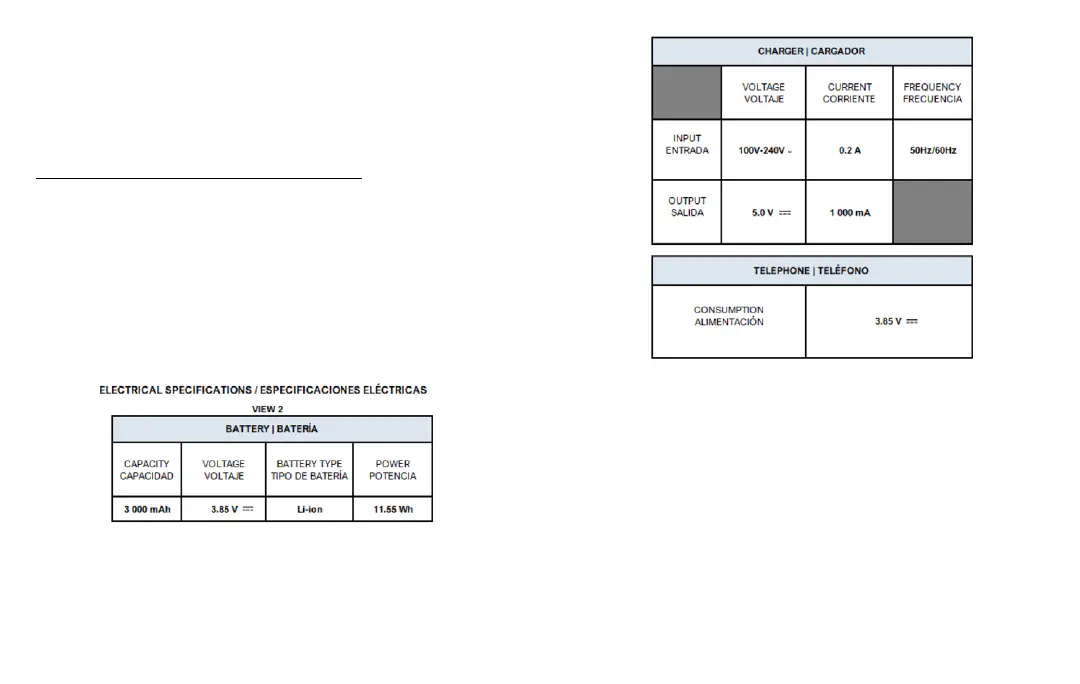
• Avoid dropping the phone or battery. If the phone or battery is dropped, especially on a hard surface, and
the user suspects damage, take it to a service center for inspection.
• Improper battery use may result in a fire, explosion, or other hazard.
If the battery leaks:
• Do not allow the leaking fluid to come in contact with skin or clothing. If already in contact, flush the affected
area immediately with clean water and seek medical advice.
• Do not allow the leaking fluid to come in contact with eyes. If already in contact, DO NOT rub; rinse with clean
water immediately and seek medical advice.
• Take extra precautions to keep a leaking battery away from fire as there is a danger of ignition or explosion.
Hearing Aid Compatibility (HAC) for Wireless Telecommunication Devices
This phone has a HAC rating of M3/T3
What is hearing aid compatibility?
The Federal Communications Commission has implemented rules and a rating system designed to enable people
who wear hearing aids to use these wireless telecommunications devices more effectively. The standard for
compatibility of digital wireless phones with hearing aids is set forth in American National Standard Institute
(ANSI) standard C63.19. There are two sets of ANSI standards with ratings from one to four (four being the best
rating): an “M” rating for reduced interference making it easier to hear conversations on the phone when using
the hearing aid microphone, and a “T” rating that enables the phone to be used with hearing aids operating in
the tele-coil mode thus reducing unwanted background noise.
How will I know which wireless phones are hearing aid compatible?
The Hearing Aid Compatibility rating is displayed on the wireless phone box. A phone is considered Hearing Aid
Compatible for acoustic coupling (microphone mode) if it has an “M3” or “M4” rating. A digital wireless phone
is considered Hearing Aid Compatible for inductive coupling (tele-coil mode) if it has a “T3” or “T4” rating.
FCC Regulations
This mobile phone complies with part 15 of the FCC Rules. Operation is subject to the following two conditions:
(1) This device may not cause harmful interference, and (2) this device must accept any interference received,
including interference that may cause undesired operation.
This mobile phone has been tested and found to comply with the limits for a Class B digital device, pursuant to
Part 15 of the FCC Rules. These limits are designed to provide reasonable protection against harmful interference
in a residential installation. This equipment generates, uses and can radiated radio frequency energy and, if not
installed and used in accordance with the instructions, may cause harmful interference to radio communications.
However, there is no guarantee that interference will not occur in a particular installation. If this equipment does
cause harmful interference to radio or television reception, which can be determined by turning the equipment
off and on, the user is encouraged to try to correct the interference by one or more of the following measures:
• Reorient or relocate the receiving antenna.
• Increase the separation between the equipment and receiver.
• Connect the equipment into an outlet on a circuit different from that to which the receiver is connected.
• Consult the dealer or an experienced radio/TV technician for help.
Changes or modifications not expressly approved by the party responsible for compliance could void the user‘s
authority to operate the equipment.
The antenna(s) used for this transmitter must not be co-located or operating in conjunction with any other
antenna or transmitter.


 To Next Page