APP-1
APPENDIX A - RO400CV/RO400BCV/RO600CV
CONNECTING THE WATER PURIFIER
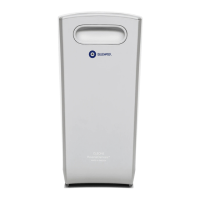
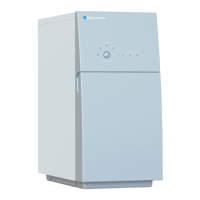
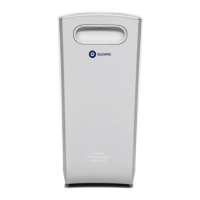
Before moving the water purifier into its permanent location,
remove the four thread-protection plugs from the water purifier
connectors, and the transit support from under the filter con-
tainer, see FIG. 15. Next, connect up the four hoses as shown in
FIG 16.
Use a hose clip to secure the reject water hose’s bent
end to the connector in the centre of the water puri-
fier.
Screw the bent end of the feed water hose onto the
feed water valve. Check first that the packing is in
place in the valve before screwing the hose tight.
Open the cut-off valve and check that the connection
does not leak.
Connect the purified water hose (which is led off to
the reject water outlet via an airlock to the solenoid
valve on the purified water side) to the connector
which points outwards. Check that grommets are
fitted in both ends of the hose. Push the hose into
bottom position, up to the mark (about 17 mm), see
FIG 16.
Connect the purified water hose to the solenoid valve
connector which points inwards (towards the reject
water hose connection). Check that grommets are
fitted in both ends of the hose. Push the hose into
bottom position, up to the mark (about 17 mm), see
FIG 16.
The CV and BCV products are equipped with a special diverted
valve. This valve rejects the first amount of water produced by
the water purifier and thereby prevent a lower initial water qual-
ity due to back-diffusion. A suggestion for a complete instal-
lation is shown in FIG. 17. Note that tanks and valves ar not
supplied with the water purifier.
THE BASIC PRINCIPLE
Please see FIG. 17. The purified water leaves the RO (A) and
then goes into the solenoid valve (B). The valve feeds the first
volume of water (of non-approved reduction efficiency) from
each operating cycle into the reject water outlet via an airlock
(C). After a set time it then feeds the water to an air humidify-
ing system, for example. The airlock prevents bacteria from the
reject water outlet getting back up the hose into the water puri-
fier. The reject water from the water purifier runs out through
the connector (E). Cold water is plumbed in at (F). In certain
cases this application needs a pressure tank to be connected
up to the purified water from the RO (G). This means that
operational times are longer when the RO starts up, which is
an advantage. In order to take water samples, or water for any
other purposes, e.g. battery water, a ball valve (H) is connected
from a branch connector on the hose between the RO and the
tank. In order for the RO to start instead of the tank emptying,
a non-return valve (J) is inserted between the branch connector
and the tank. Fitting a ball valve on the other side of the tank
allows the tank to be drained.
1.
2.
3.
4.
Please see FIG. 18. The solenoid valve directs the initial
volume of water from each operational cycle, which is not of
approved quality. When the RO is supplied the timer is set to 30
seconds. This time can be changed.
The timer is wired in parallel with the water supply valve and it
is activated when the water supply valve on the RO is opened.
The timer can be set at four different functions by the rocker
switches 4 and 5. The correct setting is switch 4 up and
switch 5 down. When the timer is activated, the solenoid
valve immediately switches over to direct the purified water to
the reject water outlet (when it is at rest, the valve switches to
another appliance or ancillary item of equipment).
There are 8 time periods used for adjusting the time. To select a
time period, use switches 1, 2 and 3. The factory setting is
1.5 - 30 seconds (i.e. switches 1 and 2 are down and switch 3 is
up). To adjust the setting, turn the left screw clockwise as far as
possible. For longer or shorter rinse periods the period may be
changed. The exact time is controlled by the right switch.


 To Next Page
 Loading...