NOTE
Battery chargers for the vehicle battery can op‐
erate with high voltages and high currents,
which can overload or damage the 12-volt on-
board network. There is a danger of damage to
property. Only connect battery chargers for the
vehicle battery to the jump-starting connec‐
tions in the engine compartment.
Jump-starting connections
Only charge the battery via the jump-starting
connections, see page 351, in the engine com‐
partment and with the engine switched off.
Battery charger
Battery chargers developed especially for the ve‐
hicle and suitable for the on-board network can
be obtained from a Service Partner of the manu‐
facturer or another qualified Service Partner or a
specialist workshop.
Power failure
Following an electrical power outage, some
equipment will have to be reinitialised or individ‐
ual settings will need to be updated, for example:
▷ Memory function: save positions again.
▷ Time: update.
▷ Date: update.
▷ Glass Roof: initialise system.
Disposing of the old battery
Dispose of old batteries at a Service
Partner of the manufacturer or another
qualified Service Partner or a specialist
workshop or hand them into an authorised col‐
lecting point.
Fuses
Safety note
WARNING
Incorrect or repaired fuses can overload electri‐
cal cables and components. There is a risk of
fire. Do not repair blown fuses or renew them
with fuses of a different colour or amp rating.
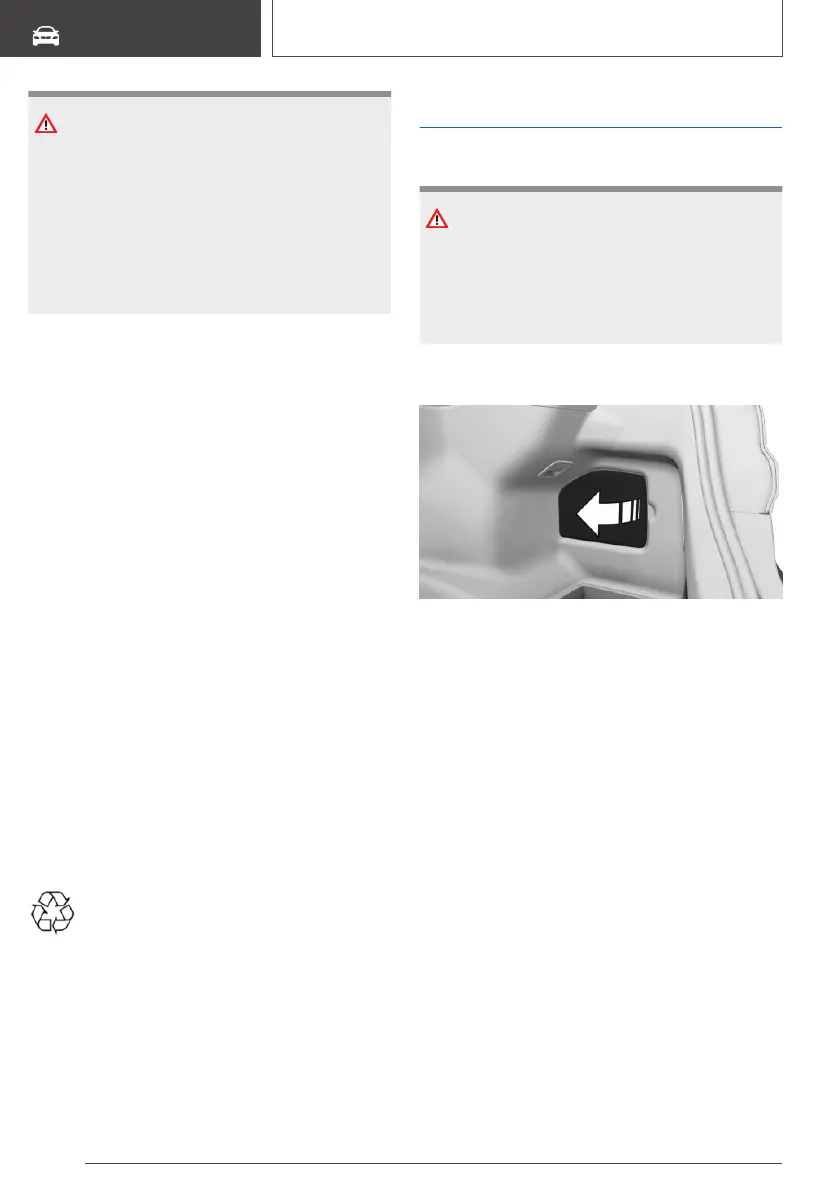
Accessing the fuses
Remove the cover from the right-hand trim
panel.
Fuse assignment information and details on the
positions of any other fuse boxes can be found in
a separate leaflet in the fuse box.
Replacing fuses
The manufacturer of the vehicle recommends
having fuses changed by a Service Partner of the
manufacturer or another qualified Service Partner
or a specialist workshop.
Seite 346
MOBILITY
Replacing parts
346
Online Edition for Part no. 01402989787 - II/18


 To Next Page