Coolant
Vehicle equipment
This chapter describes all standard, country-spe‐
cific and special equipment available for the
model series. Therefore equipment which is not
installed in your vehicle, for example on account
of the optional equipment selected or the coun‐
try specification, may also be described here.
This also applies to safety-relevant functions and
systems. Comply with the relevant laws and reg‐
ulations when using the corresponding functions
and systems.
General
Coolant is a mixture of water and an additive.
Not all commercially available additives are suita‐
ble for the vehicle. Information regarding suitable
additives is available from a Service Partner of
the manufacturer or another qualified Service
Partner or a specialist workshop.
Safety notes
WARNING
If the cooling system is opened when the en‐
gine is hot, coolant can escape and cause
scalds. There is a danger of injury. Only open
the cooling system when the engine has
cooled down.
WARNING
Additives are harmful to health and incorrect
additives can damage the engine. There is a
danger of injury and damage to property. Do
not allow additives to come into contact with
clothing, skin or eyes, and do not swallow them.
Only use suitable additives.
Coolant level
General
The vehicle has two cooling circuits. Always
check the coolant levels of both coolant tanks
and top up if necessary.
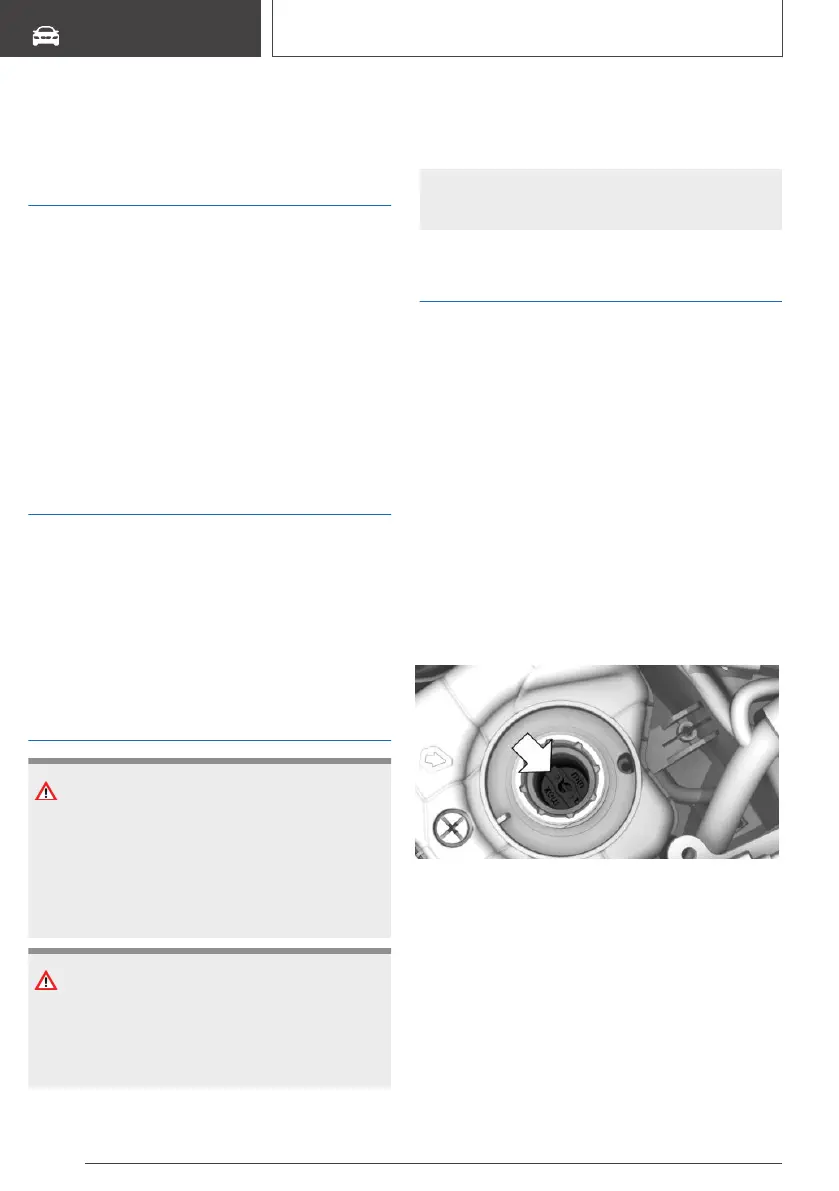
Checking the coolant level in the
filler neck
1.
Allow the engine to cool down.
2. Turn cap on coolant tank slightly anticlock‐
wise, then allow the pressure to escape.
3. Open cap on coolant tank.
4. The coolant level is correct if it is between
the Min. and Max. marks in the filler neck.
Topping up
1.
Allow the engine to cool down.
2. Turn cap on coolant tank slightly anticlock‐
wise, then allow the pressure to escape.
3. Open cap on coolant tank.
4. If necessary, slowly top up to the correct
level; do not overfill.
Seite 336
MOBILITY
Coolant
336
Online Edition for Part no. 01402989787 - II/18



 To Next Page