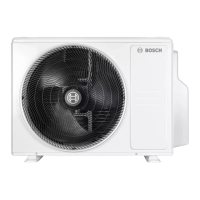
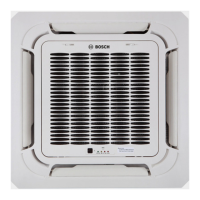
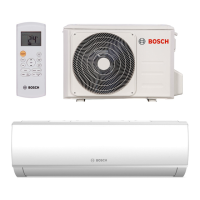
This document is a user manual for the Bosch Split-Type Ductless Air Conditioner / Heat Pump, specifically the Climate 5000 AA Series. It provides comprehensive instructions for operating, maintaining, and troubleshooting the unit.
The device functions as an air conditioner and heat pump, designed for split-type ductless installations. It offers various modes of operation including COOL, HEAT, and DRY, with optimal performance achieved within specific temperature ranges. The unit features an Auto-Restart function, which automatically restores prior settings after a power loss. An Anti-mildew feature helps prevent mildew growth by drying condensed water when the unit is turned off from COOL, AUTO (COOL), or DRY modes. The Louver Angle Memory ensures the louver automatically resumes its former angle upon startup. Additionally, the unit includes Refrigerant Leakage Detection, displaying "EC" on the indoor unit if a leak or internal error is detected, requiring professional service.
For usage, the unit can be controlled via a remote control, offering advanced functionalities like TURBO mode and self-cleaning functions. In the absence of a remote, manual operation is possible through a button on the indoor unit, allowing for FORCED AUTO mode, FORCED COOLING mode, and unit shutdown. The manual emphasizes that manual operation is for testing and emergency use only, recommending remote control for regular operation. Users can adjust the vertical angle of the airflow using the SWING/DIRECT button on the remote, either in increments or continuously. The horizontal angle of the airflow is adjusted manually by gripping the deflector rod. The manual warns against setting the louver at too vertical an angle in COOL or DRY modes to prevent water condensation and dripping, and in COOL or HEAT modes to avoid reduced performance due to restricted airflow. It also advises against moving the louver by hand to prevent it from going out of sync.
The device also features a SLEEP operation function, activated via the remote control, designed to decrease energy consumption during sleep. In COOL mode, the temperature increases by 1°C (2°F) after one hour and another 1°C (2°F) after a second hour. In HEAT mode, the temperature decreases by 1°C (2°F) after one hour and another 1°C (2°F) after a second hour. The unit maintains this new temperature for seven hours before automatically turning off. This function is not available in FAN or DRY modes.
Maintenance features are detailed to ensure optimal performance and longevity of the unit. Regular cleaning of the air filter is crucial, recommended every two weeks. The air filter is located under the top air inlet grill and can be removed by lifting a tab and pulling it out. If the unit has a small air freshening filter, it should be unclipped from its holder and cleaned with a hand-held vacuum. The manual provides instructions for cleaning the large air filter with warm, soapy water, rinsing, and drying it in a cool, dry place away from direct sunlight. The unit includes Air Filter Cleaning Reminders, flashing "CL" on the display after 240 hours of use, and Air Filter Replacement Reminders, flashing "nF" after 2,880 hours of use. These reminders can be reset using the LED button on the remote or the MANUAL CONTROL button.
For long periods of non-use, the manual advises cleaning all filters, running the FAN function until the unit dries out completely, turning off the unit, disconnecting power, and removing batteries from the remote control. Before periods of frequent use (pre-season inspection), users should check for damaged wires, clean all filters, check for leaks, replace batteries, and ensure nothing is blocking air inlets and outlets.
Safety precautions are highlighted throughout the manual. Installation and repairs must be performed by qualified personnel to avoid risks like water leakage, electric shock, or fire. Users are warned against inserting fingers or objects into air inlets or outlets, using flammable sprays near the unit, operating it near combustible gases, or in wet rooms. Electrical safety includes using the specified power cord, keeping the power plug clean, unplugging by holding the plug firmly, and avoiding extension cords or connecting other appliances to the same outlet. Cleaning and maintenance require turning off the device and disconnecting power. Harsh chemicals, paint thinner, polishing powder, or solvents should not be used for cleaning, nor should water hotter than 40°C (104°F). The manual also warns against touching metal parts when removing filters due to sharp edges and exposing filters to direct sunlight during drying to prevent shrinkage.
Troubleshooting common issues is also covered. The manual clarifies that some issues, such as the unit not turning on immediately after pressing the ON/OFF button (due to a 3-minute protection feature), changes from COOL/HEAT to FAN mode (to prevent frost or when set temperature is reached), or white mist emission (in humid regions or during defrosting), are not malfunctions. Various noises like rushing air, squeaking, or hissing sounds are explained as normal operational sounds related to louver movement, expansion/contraction of parts, or refrigerant flow. Dust emission upon startup after long periods of inactivity is also addressed. Bad odors can result from the unit absorbing environmental odors or moldy filters. The fan of the outdoor unit may operate at controlled speeds to optimize product operation. Erratic operation can be caused by interference from cell phone towers or remote boosters, with solutions provided to restart the unit. For persistent problems, users are advised to contact a local dealer or qualified service provider with detailed information about the malfunction and unit serial number.
Finally, disposal guidelines state that many parts of the air conditioner are recyclable. Refrigerant must be recovered by a qualified person before environmental disposal, and improper disposal is warned against due to health and environmental risks.



 To Next Page

 General