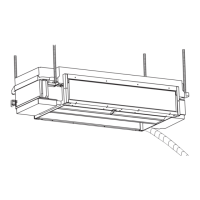
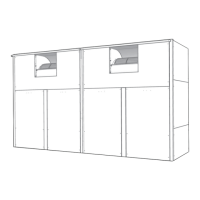
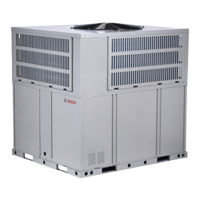
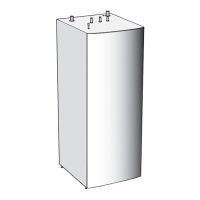
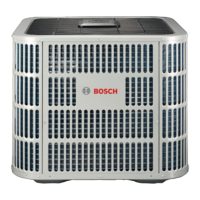
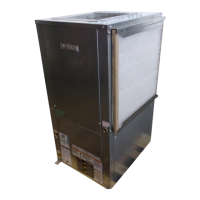
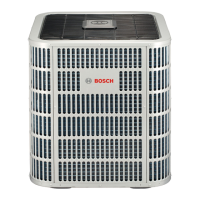
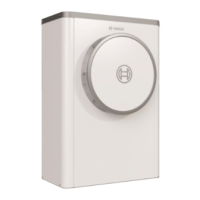
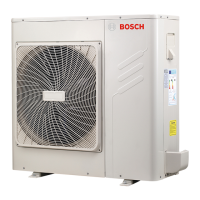
The Bosch Heat Pump Mini VRF Outdoor Unit, Climate 5000 VRF, MDCI series, is an air conditioning system designed for both monophase and three-phase applications. This owner's manual provides essential information for safe operation, maintenance, and troubleshooting of the unit.
Function Description
The Heat Pump Mini VRF Outdoor Unit is a core component of an air conditioning system that includes indoor units, connective pipework, and a remote controller. It functions as a heat pump, capable of both cooling and heating operations. The unit manages refrigerant flow and heat exchange to provide climate control within a building.
A key feature is the "Force Cooling Control," activated by a button (sw1) on the main board of the outdoor unit. When pressed during test running, the unit initiates cooling mode, and once the outdoor unit reaches 44 Hz, the indoor units operate at high speed. Pressing the button again exits this mode. The display control button (sw2) is also located on the main board for display-related functions.
The unit incorporates protection devices that automatically stop operation when an error is detected, indicated by a flashing running indicator. These devices activate under various conditions, such as blocked air inlets/outlets on the outdoor unit during cooling, strong winds, blocked indoor unit filters, or blocked indoor unit air outlets during heating.
Important Technical Specifications
The MDCI series includes several models: MDCI8-1, MDCI10-1, MDCI12-1, MDCI14-1, MDCI16-1 (monophase), and MDCI12-3, MDCI14-3, MDCI16-3, MDCI18-3 (three-phase).
Operating conditions specify safe and effective temperature ranges:
- Cooling operation: Outdoor temperature -15°C to 43°C, Room temperature -17°C to 32°C.
- Heating operation: Outdoor temperature -15°C to 27°C, Room temperature ≤27°C.
Operating outside these conditions may lead to abnormal unit function. The unit can produce condensate when humidity is high, and optimum performance is achieved within the specified temperatures.
The unit's display function provides real-time operational data. In normal display mode, it shows the operating mode (Standby, Cooling, Heating, Forced cooling), operating fan speed, total capacity requirements of interior units, total quantity of interior units, capacity requirements of the external unit, T2 average temperature, T3 pipework temperature, T4 ambient temperature, actual voltage AD value, actual current value, PMV opening, T5 actual discharge temperature (rounded down if over 100 degrees), and the surface temperature of the cooling fin. For 8/10.5/18 kW models, it also displays the last fault or protection code, program version, priority mode (reserved), and model (8 KW: 8, 10 KW: 10, 18 KW: 18).
Error codes are displayed to indicate specific malfunctions or protection activations. For 12/14/16 kW models, codes range from H0 (M_Home unmatching) to P8 (Wind protection), covering issues like EEPROM faults, communication errors, sensor faults, voltage protection, fan faults, compressor current protection, and various temperature protections. For 8/10.5/18 kW models, codes range from E2 (Communication malfunction between indoor/outdoor units) to L9 (Protection should the required speed fluctuate by more than 15Hz), including power voltage protection, inverter module protection, and DC generatrix voltage protection.
Usage Features
The unit incorporates a "three-minute protection feature" that prevents immediate restart after operation, ensuring a delay of approximately 3 minutes to protect the air conditioning unit.
For cooling and heating operation, all indoor units must run in the same mode to avoid conflicting errors. If different modes are selected, heating mode takes priority unless a specific priority mode (e.g., 'first unit turned on in the morning is the master', 'heating priority', 'cooling priority', or 'a single unit as priority') has been set. If a running mode is selected, the unit cannot run in other modes, and 'Standby' or 'No Priority' will be displayed.
Features of heating operation include periodic stopping of indoor unit fans to prevent discharging incorrect air temperatures until the unit reaches a sufficient temperature. The outdoor unit fan motor may also stop under high temperatures. If one unit is in fan mode while others are heating, the fan may stop to prevent hot air circulation.
Defrost in heating operation is an automatic process. Frost can accumulate on the outdoor unit, and to increase efficiency, the unit will initiate defrosting for 2-10 minutes, depending on the amount of accumulated frost. During defrosting, both outdoor and indoor unit fans will periodically stop.
Maintenance Features
The manual emphasizes the importance of proper grounding for all equipment. It warns against removing the fan guard until the unit is switched off and electrical power is safely isolated. Hands should be clean and dry before performing any electrical maintenance. Touching the sharp heat exchanger fins should be avoided as it can cause injury and affect performance.
Upon installation, the electrical power supply must be on for a minimum of 12 hours before operation to prevent product failure. If the electrical power supply is interrupted for more than 24 hours, this 12-hour pre-operation period must be repeated.
Regular maintenance is crucial for the outdoor unit to ensure a long lifespan. The manual advises against blocking the air inlet and outlet, as this can decrease efficiency or trigger protection devices.
Troubleshooting guidance is provided for common issues. If the system does not operate, potential causes include power failure, the power switch being off, a blown fuse, or dead remote controller batteries. Solutions involve re-establishing power, switching on the unit, replacing fuses by competent personnel, and replacing batteries.
For air discharging but not cold enough, causes include incorrect temperature settings or the compressor being in its 3-minute protection period. Solutions are to set the correct temperature and wait.
If the unit stops and starts frequently, issues could be too much/too little refrigerant, air/contaminants in the system, compressor malfunction, voltage issues, or a blocked system circuit. Solutions involve checking refrigerant leaks and pressure, vacuuming and recharging refrigerant, maintaining/changing the compressor, installing a manostat, and investigation by qualified personnel.
Low cooling effect can be due to dirty heat exchangers/air filters, blocked inlets/outlets, open doors/windows, direct sunlight on the outdoor unit, too much heat in the room, high outdoor temperature, or refrigerant leakage. Solutions include cleaning, closing doors/windows, avoiding direct sunlight, reducing heat sources, and checking for refrigerant leaks.
Low heating effect can be caused by outdoor temperatures below 7°C, open doors/windows, or refrigerant leakage. Solutions include using a heating device, closing doors/windows, and checking for refrigerant leaks.
For remote controller problems, the manual addresses issues like inability to change fan speed (if in AUTO or DRY mode), signal transmission failure (due to dead batteries or power off), TEMP. indicator not coming on (if in FAN ONLY mode), display disappearing after time (if timer operation ended), TIMER ON indicator going off (if timer operation started), and no receiving tone (if the remote controller is not properly directed or the ON/OFF button is not pressed correctly). Solutions involve understanding automatic fan speed changes in AUTO/DRY modes, checking power supply, recognizing that temperature cannot be set in FAN mode, and correctly operating the remote controller.
The manual strongly advises against undertaking any service or maintenance personally and recommends contacting qualified personnel or Bosch. Before servicing, the electricity supply must be isolated. It also warns against allowing the indoor unit or remote controller to get wet, pressing remote controller buttons with hard objects, replacing fuses with incorrect sizes or copper wire, prolonged exposure to airflow, keeping hands away from operating fans, using flammable/corrosive products near electrical components, putting objects into air inlets/outlets, and improper disposal. In case of refrigerant leaks, a competent person should be contacted, and leak detection equipment installed in small rooms. If refrigerant contacts a naked flame, it can be harmful. If a leak occurs, power should be switched off, heating devices turned off, the room ventilated, and a competent person contacted before using the unit again.


 To Next Page

 General