6 | English
1 619 PA1 892 | (8.3.11) Bosch Power Tools
Assembly
Replacing/Inserting the Saw Blade
f Before any work on the machine itself, pull the mains
plug.
f When mounting the saw blade, wear protective gloves.
Danger of injury when touching the saw blade.
f When changing the saw blade, take care that the saw
blade holder is free of material residue, e. g. wood or
metal shavings.
Selecting a Saw Blade
An overview of recommended saw blades can be found at the
end of these instructions. Use only ½" universal shank saw
blades. The saw blade should not be longer than required for
the intended cut.
The shank thickness of the saw blade must be 0.8–1.6 mm.
Use a thin saw blade for narrow curve cuts.
Inserting the Saw Blade (see figure A)
Press the SDS clamping lever 4 forward and guide the saw
blade 1 behind the clamping plate 10 into the saw blade hold-
er 3. Release the SDS clamping lever 4.
f Check the tight seating by pulling on the saw blade. A
loose saw blade can fall out and cause injury.
For certain work, the saw blade 1 can also be turned through
180° (with the teeth pointed upwards) and re-inserted again.
Removing the Saw Blade (see figure A)
f Before removing, allow the saw blade to cool down.
Danger of injury when touching the hot saw blade.
Press the SDS clamping lever 4 forward and pull out the saw
blade 1. Release the SDS clamping lever 4.
Dust/Chip Extraction
f Dusts from materials such as lead-containing coatings,
some wood types, minerals and metal can be harmful to
one’s health. Touching or breathing-in the dusts can cause
allergic reactions and/or lead to respiratory infections of
the user or bystanders.
Certain dusts, such as oak or beech dust, are considered
as carcinogenic, especially in connection with wood-treat-
ment additives (chromate, wood preservative). Materials
containing asbestos may only be worked by specialists.
– Provide for good ventilation of the working place.
– It is recommended to wear a P2 filter-class respirator.
Observe the relevant regulations in your country for the
materials to be worked.
f Prevent dust accumulation at the workplace. Dusts can
easily ignite.
Operation
Operating Modes
f Before any work on the machine itself, pull the mains
plug.
Orbital Action Settings
The adjustable orbital action allows for optimal adaptation of
cutting speed, cutting capacity and cutting pattern to the ma-
terial being worked.
The level of orbital action can be set with rotary switch 6, even
during operation.
Pivoting and Retractable Footplate (see figure B–C)
Due to its movability, the adjustable footplate 2 adapts to the
required angular position of the surface.
Depending on the application and the saw blade being used,
the footplate 2 can be moved variably in length direction.
Loosen the screws 11 with Allen key and move the footplate
2 to the requested position. Tighten the screws 11 again and
check if the footplate 2 is tightly seated.
Starting Operation
f Observe correct mains voltage! The voltage of the pow-
er source must agree with the voltage specified on the
nameplate of the machine. Power tools marked with
230 V can also be operated with 220 V.
The stand by indicator 8 lights up when the mains plug is
plugged in and mains voltage is available. When the machine
cannot be started even though the stand by indicator is lit, it
must be taken to an authorized after-sales service agent for
Bosch power tools.
Switching On and Off
To start the machine, press the On/Off switch 7 and keep it
pressed.
To switch off the machine, release the On/Off switch 7.
Note: For safety reasons, the On/Off switch 7 cannot be
locked; it must remain pressed during the entire operation.
Controling the Stroke Rate
Increasing or reducing the pressure on the On/Off switch 7
enables stepless stroke-rate control of the switched-on ma-
chine.
Light pressure on the On/Off switch 7 results in a low stroke
rate. Increasing the pressure also increases the stroke rate.
The required stroke rate is dependent on the material and the
working conditions and can be determined by a practical trial.
Reducing the stroke rate is recommended when the saw
blade engages in the material as well as when sawing plastic
and aluminium.
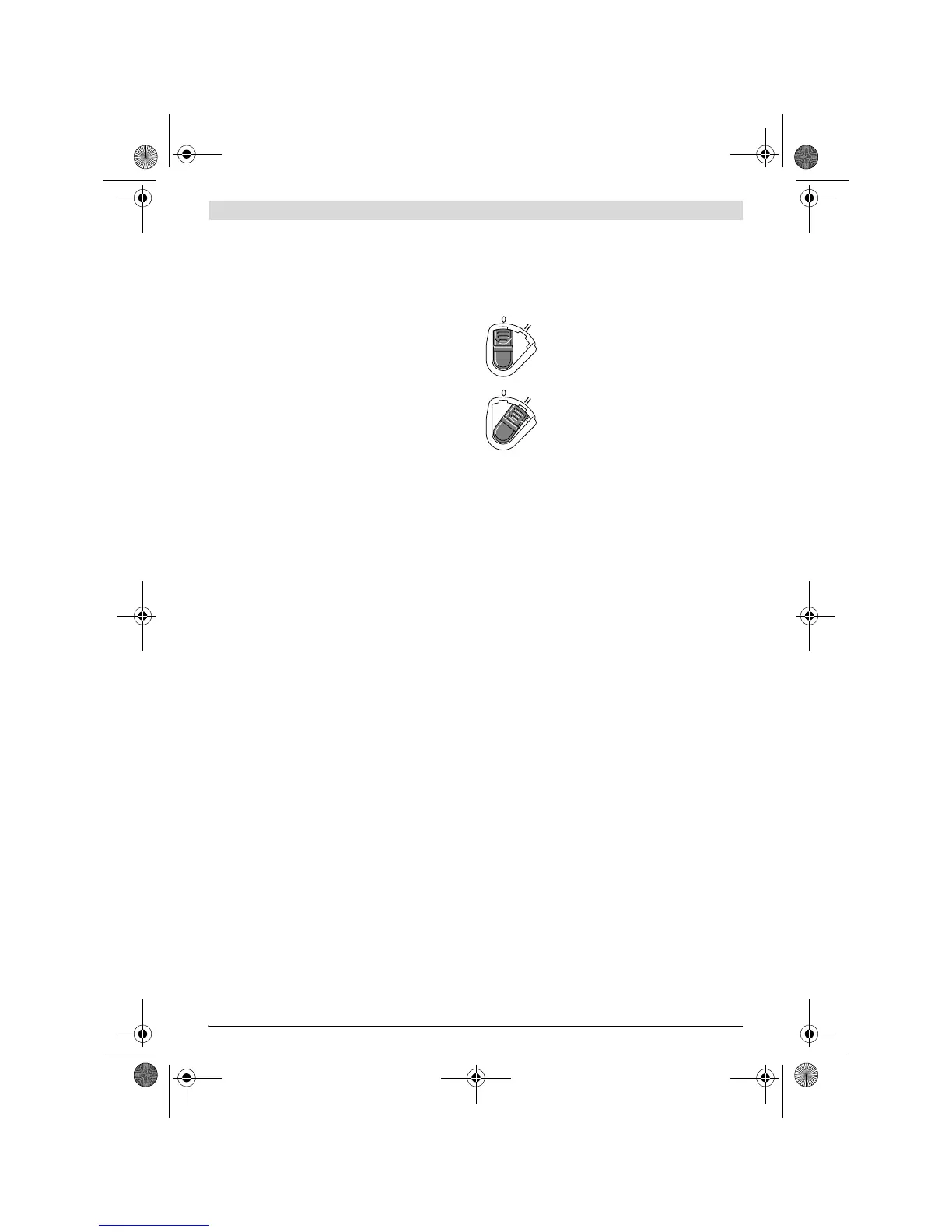
Orbital action switched off:
For working thin or hard material such as
sheet metal or steel.
For achieving clean cutting edges.
Orbital action switched on:
For working non-ferrous metals, hardwood,
plastics or materials of medium density.
For working soft materials, e. g., soft building
materials, insulation material, softwood, tree
wood.
OBJ_BUCH-1399-001.book Page 6 Tuesday, March 8, 2011 2:27 PM


 To Next Page
 Loading...