EasyManua.ls Logo

Bosch TR2000T Series - User Manual

Bosch TR2000T Series
20 pages
Print Icon
To Next Page IconTo Next Page
Loading...
User and Installation manual
Electrical storage water tank
TR2000T
TR2000T 10 | 15
6 720 885 113 (2018/04) DIV
Question and Answer IconNeed help?

Do you have a question about the Bosch TR2000T Series and is the answer not in the manual?

Summary

Safety and Symbol Guidance

Warning Symbol Definitions

Explains warning triangle symbols and keywords like NOTICE, CAUTION, WARNING, DANGER.

Installation and Electrical Safety Rules

Covers general safety measures, installation by authorized personnel, and electrical standards.

Customer Instruction and Appliance Usage Safety

Customer Instruction and Appliance Usage Safety

Installer's role in instructing customers and safety guidelines for appliance use by children.

Technical Specifications and Components

Intended Use and Corrosion Protection

Defines the appliance's purpose and its internal anticorrosion features.

Included Accessories

Lists the standard accessories provided with the appliance.

Appliance Performance Specifications

Appliance Performance Specifications

Details technical specifications, including capacity, weight, power, and electrical data.

Physical Dimensions and Measurements

Physical Dimensions and Measurements

Provides the physical measurements (A, B, C, D) for different models.

Regulations, Layout, and Wiring

Appliance Components and Electrical Diagram

Details the components of the appliance and its electrical circuit diagram.

Installation Regulatory Compliance

Compliance with country-specific regulations for electrical appliance installation.

Transport and Installation Procedures

Transport, Storage, and Recycling Guidelines

Recommendations for transporting, storing, and recycling the appliance.

Installation Requirements and Location Choice

Important notes before installation and guidelines for choosing the installation location.

Water Inlet and Outlet Connections

Water Inlet and Outlet Connections

Step-by-step instructions for connecting the water inlet and outlet, including safety.

Electrical Connections and Initial Startup

Electrical Connections and Initial Startup

Procedures for electrical connection, safety precautions, and initial appliance startup.

Appliance Operation and Maintenance

Powering On;Off and Temperature Adjustment

Instructions for turning the appliance on/off and setting the DHW temperature.

Anti-Frost Mode and Draining Procedure

Explanation of the anti-frost feature and the procedure for emptying the appliance.

Environmental Impact and User Maintenance

Disposal, Recycling, and Cleaning

Guidelines for recycling packaging, disposing of old appliances, and user cleaning.

Safety Valve Verification and Maintenance Tasks

User responsibilities for safety valve verification and general maintenance.

Periodic Checks and Magnesium Anode

Periodic Checks and Magnesium Anode

Verifying functionality, information on the magnesium anode, and its maintenance.

Long Stoppages, Safety Thermostat, Post-Maintenance

Long Stoppages, Safety Thermostat, Post-Maintenance

Procedures for long non-working periods, safety thermostat, and actions after maintenance.

Troubleshooting and Problem Resolution

Problem Identification, Causes, and Solutions

A comprehensive table to diagnose and resolve common issues with the appliance.

Summary

Safety and Symbol Guidance

Warning Symbol Definitions

Explains warning triangle symbols and keywords like NOTICE, CAUTION, WARNING, DANGER.

Installation and Electrical Safety Rules

Covers general safety measures, installation by authorized personnel, and electrical standards.

Customer Instruction and Appliance Usage Safety

Customer Instruction and Appliance Usage Safety

Installer's role in instructing customers and safety guidelines for appliance use by children.

Technical Specifications and Components

Intended Use and Corrosion Protection

Defines the appliance's purpose and its internal anticorrosion features.

Included Accessories

Lists the standard accessories provided with the appliance.

Appliance Performance Specifications

Appliance Performance Specifications

Details technical specifications, including capacity, weight, power, and electrical data.

Physical Dimensions and Measurements

Physical Dimensions and Measurements

Provides the physical measurements (A, B, C, D) for different models.

Regulations, Layout, and Wiring

Appliance Components and Electrical Diagram

Details the components of the appliance and its electrical circuit diagram.

Installation Regulatory Compliance

Compliance with country-specific regulations for electrical appliance installation.

Transport and Installation Procedures

Transport, Storage, and Recycling Guidelines

Recommendations for transporting, storing, and recycling the appliance.

Installation Requirements and Location Choice

Important notes before installation and guidelines for choosing the installation location.

Water Inlet and Outlet Connections

Water Inlet and Outlet Connections

Step-by-step instructions for connecting the water inlet and outlet, including safety.

Electrical Connections and Initial Startup

Electrical Connections and Initial Startup

Procedures for electrical connection, safety precautions, and initial appliance startup.

Appliance Operation and Maintenance

Powering On;Off and Temperature Adjustment

Instructions for turning the appliance on/off and setting the DHW temperature.

Anti-Frost Mode and Draining Procedure

Explanation of the anti-frost feature and the procedure for emptying the appliance.

Environmental Impact and User Maintenance

Disposal, Recycling, and Cleaning

Guidelines for recycling packaging, disposing of old appliances, and user cleaning.

Safety Valve Verification and Maintenance Tasks

User responsibilities for safety valve verification and general maintenance.

Periodic Checks and Magnesium Anode

Periodic Checks and Magnesium Anode

Verifying functionality, information on the magnesium anode, and its maintenance.

Long Stoppages, Safety Thermostat, Post-Maintenance

Long Stoppages, Safety Thermostat, Post-Maintenance

Procedures for long non-working periods, safety thermostat, and actions after maintenance.

Troubleshooting and Problem Resolution

Problem Identification, Causes, and Solutions

A comprehensive table to diagnose and resolve common issues with the appliance.

Overview

This document serves as the User and Installation Manual for the Bosch TR2000T Electrical Storage Water Tank, covering models TR2000T 10 and TR2000T 15. It provides comprehensive instructions for the installation, operation, and maintenance of the appliance, emphasizing safety and proper usage.

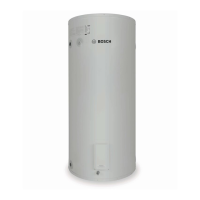
The Bosch TR2000T is designed to heat and store domestic hot water (DHW) in closed systems. Its primary function is to provide a reliable supply of hot water for household use. The tank's interior is lined with homogeneous glass enamel, ensuring neutrality with potable water and providing anticorrosion protection. This protection is further enhanced by the presence of a magnesium anode inside the tank. The appliance is intended for use in areas where the ambient temperature does not fall below 0 °C, and it should be installed in a room free from the risk of frost.

Installation and Setup

Installation of the TR2000T must be carried out exclusively by an authorized service technician, adhering to IEC 60364-7-701 standards for electrical installations and accessories. Before connecting the appliance to the power supply, it must first be hydraulically connected and filled with water. It is crucial to isolate the appliance from the power supply during installation. The safety valve outlet must never be obstructed, as water may be expelled from it during the heating process.

The manual provides detailed guidance on siting the appliance. It must be installed on a sufficiently robust wall capable of supporting the appliance when the tank is full. The appliance should not be installed above a heat source or in rooms where the ambient temperature can drop below 0 °C. To minimize energy losses and waiting times, it is recommended to install the appliance near the most frequently used draw-off point. Furthermore, the installation location must allow for easy replacement of the magnesium anode and facilitate necessary maintenance procedures. The appliance should be installed outside protection areas 1 and 2, at a distance greater than 60 cm from the bath.

For water connections, it is essential to use galvanized insulators to prevent galvanic electric currents between hydraulic link metals, which could lead to corrosion. In areas where water contains particles or sediments, a filter should be installed at the water inlet. Before installation, the system should be purged to prevent sand from causing flow reduction or total obstruction. The piping for hot and cold water must be correctly identified to avoid swapping connections. If the cold water inlet pressure exceeds 80% of the maximum appliance pressure (i.e., 6.4 bar), a reducing valve must be installed. The safety valve will trigger if the water pressure exceeds 6.4 bar, and a facility for draining the expelled water must be provided. A non-return valve is recommended at the appliance to prevent problems caused by sudden pressure changes.

Electrical connections must also be performed by authorized personnel, in accordance with current country laws. The appliance requires an independent connection to the electrical board, protected by a 30 mA differential circuit breaker and earthing. It should be connected via a socket with an earth connection.

Before start-up, the installation and assembly must be verified. All water inlet valves should be opened, and all hot water taps opened to ensure air is purged from the connections. The tightness of all connections must be checked, and the appliance filled to its full capacity before connecting it to the electric current. The customer should be informed about the appliance's user information and handling.

Usage Features

The TR2000T features a user-friendly interface with an operating light, an On/Off switch, and a temperature selector. To turn the appliance on, the switch should be set to "I," and to turn it off, set to "0." The hot water temperature can be regulated up to 70 °C using the temperature selector. Turning the selector to the right increases the temperature, while turning it to the left decreases it. Once the selected temperature is reached, the appliance stops heating, and the indicator light switches off. It will restart the heating cycle when the water temperature falls below the desired value.

The appliance also includes an "Anti-Frost" mode, activated by setting the temperature selector to "-". In this mode, the hot water tank automatically starts heating if the internal temperature drops to 5 °C, preventing freezing.

Maintenance Features

Regular inspection and maintenance are crucial for the longevity and safe operation of the TR2000T. All maintenance work must be performed by an authorized technician. Before any maintenance, the appliance must be isolated from the power supply. Customers are responsible for ensuring regular maintenance and inspections, with annual servicing recommended. Only original spare parts should be used.

User Information for Maintenance:

  • Cleaning: The exterior of the appliance should be cleaned with a soft cloth. Abrasive, corrosive, or solvent cleaning detergents must not be used.
  • Safety Valve Verification: Users should periodically verify that water is expelled through the safety purge valve during the heating process. The safety purge valve outlet must never be obstructed. The safety valve should be manually opened at least once a month.
  • Magnesium Anode: The appliance contains an anti-corrosion magnesium anode. This anode needs to be annually tested and replaced if necessary. Failure to do so will void the warranty, as operating the appliance without an installed magnesium anode is forbidden. The enamel interior of the appliance should never be cleaned with decalcifying agents, as the magnesium anode provides sufficient anti-corrosion protection.

Periodic Maintenance Work (by authorized technicians):

  • Functionality Verification: All elements of the appliance should be checked for good working order.
  • Long Standing - Non-Working (more than 3 months): After extended periods of inactivity (more than 3 months), the water inside the appliance should be changed. This involves switching off the electric current, completely draining the appliance, refilling it until water comes out of all hot water taps, and then turning the appliance back on.
  • Safety Thermostat: The appliance is equipped with an automatic safety thermostat that cuts off the electric current if the water temperature exceeds safety limits. Reactivation of the appliance after a safety thermostat trigger must only be done by an authorized technician, after identifying and rectifying the cause. The device can be reactivated by firmly pressing a button on the safety thermostat.
  • Periodic Cleaning: This process involves draining and cleaning the appliance. It should be carried out outside working hours due to the risk of burns from hot water. All hot water taps should be turned off, and residents informed of the danger. The thermostat should be set to the maximum position until the indicator turns off. Then, all hot water taps should be opened, starting from the nearest to the furthest, to purge hot water for at least 3 minutes. Finally, all taps should be turned off, and the thermostat returned to its normal position.
  • Magnesium Anode Replacement: To access the magnesium anode, the appliance's lid must be removed. This involves switching off the circuit breaker, disconnecting cables to the thermostat, loosening flange screws, and removing the flange. The magnesium anode should then be verified and replaced if necessary.
  • Actions After Maintenance: After any maintenance work, all water connections must be refastened and checked for tightness, and the appliance turned on.

Emptying the Appliance:

To empty the appliance, first turn off the electric supply. Open a hot water tap and verify the water temperature to avoid burns before opening the safety valve. Wait until the water temperature decreases. Then, switch off the water cutting valve, open a hot water tap, and open the safety valve. Wait until the appliance is completely empty. In case of freezing, the appliance should be switched off and purged.

The manual also addresses environmental considerations, emphasizing Bosch Group's commitment to environmental protection. It highlights the use of recyclable packaging materials and provides instructions for the environmentally compatible recycling of old electrical and electronic appliances in accordance with the European Waste Electrical and Electronic Equipment Directive.

Bosch TR2000T Series Specifications

General IconGeneral
Voltage240V
Power SourceElectric
CapacityNA
Temperature Range85-140°F
TypeTankless
Warranty5 years

Related product manuals