6
VH0165
A
B
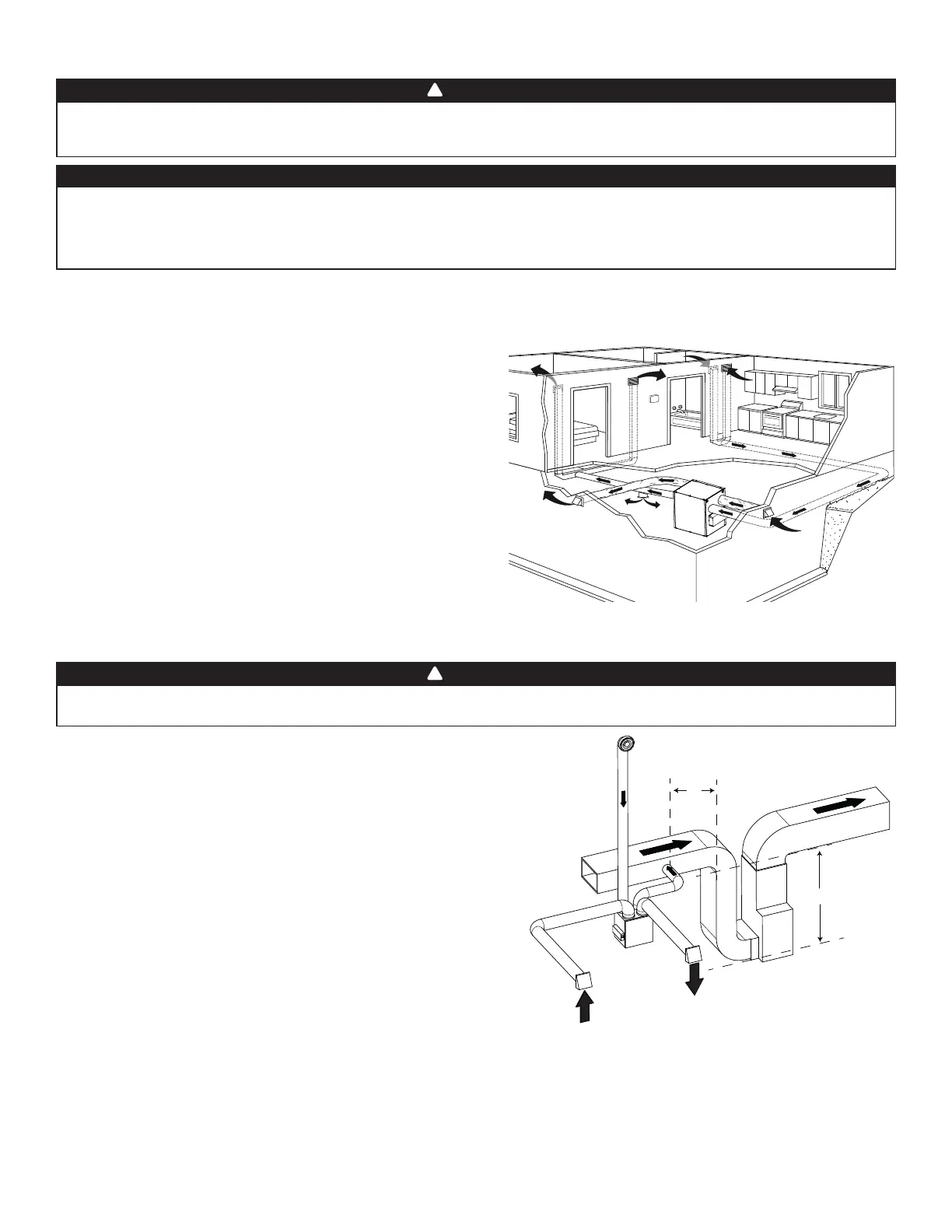
STALE AIR FROM BUILDING:
• Install registers in areas where contaminants and humidity are
produced: kitchen, bathrooms, laundry room, etc.
• Install registers on an interior wall, 6 to 12 inches away from the
ceiling OR in the ceiling.
• Install the kitchen register at least 4 feet away from the range.
• Bathroom fans and range hoods can be used to better exhaust stale
air.
• Homes with more than one level require at least one exhaust register
at the highest level.
FRESH AIR TO BUILDING:
• Install registers in bedrooms, dining room, living room and
basement.
• Install registers in the ceiling OR high on the walls with the airfl ow
directed towards the ceiling.
• If a register must be installed in the fl oor, direct the airfl ow up the
wall.
2.2.1 FULLY DUCTED SYSTEM (T-1) (THIS CONFIGURATION ALLOWS RECIRCULATION MODE TO OPERATE.)
2.2 INSTALLING THE DUCTWORK AND THE REGISTERS
Never install a stale air exhaust register in a room where there is a combustion device, such as a furnace, gas water heater, fi replace or
any appliance or equipment that can generate gaseous contaminants, or pollutants. The negative pressure this could create in the room
may impair proper evacuation of the gas or pollutants, which may have severe health consequences.
WARNING
!
STALE AIR FROM BUILDING:
Same as for Fully Ducted System, described on point 2.2.1.
FRESH AIR TO BUILDING:
• Connect the fresh air distribution duct of the unit to the central forced-
air system return duct at least 10 feet away from the central forced-air
system (A+B)*.
* This 10-ft. distance applies only in areas where the outside temperature
falls below the freezing point (32°F).
NOTE: The central forced-air system blower operation can be synchronized
with the unit (see Section 3.3). It is recommended, but not essential that the
central forced-air system blower runs when the unit is in operation.
2.2.2 EXHAUST DUCTED SYSTEM (T-2) (THIS CONFIGURATION DOES NOT ALLOW RECIRCULATION MODE TO OPERATE.)
Duct connection to the central forced-air system can be regulated by some codes and standards. It is your responsibility to consider and
comply with your local requirements to avoid any non-compliance.
WARNING
!
NOTE: For this type of con guration, the T-1 option must be selected on the LCD screen when auto-balancing the unit.
NOTE: For this type of con guration, the T-2 option must be selected
on the LCD screen when auto-balancing the unit.
A+B= MIN 10’
Stale air from
bathroom
Fresh air to
building
Stale air to
outdoors
Fresh air from
outdoors
If ducts have to go through an unconditioned space (e.g.: attic), always use insulated ducts to prevent condensation formation inside
and outside ducts, which could cause material damage and/or mold growth. Moreover, if fresh air to building duct and/or stale air
from building duct goes/go through an unconditioned space, the unit must be set to operate continuously in cold conditions (below
10°C/50°F). Continuous air movement inside ducts will prevent condensation formation. The unit can be stopped temporarily for
maintenance and/or repair purposes in such conditions.
CAUTION


 To Next Page