10
PART 3
MAINTENANCE
3.1) GENERAL
Preventive Maintenance
Preventive maintenance is the best way to avoid unnecessary
expense and inconvenience. Have your heating system and
burner inspected at regular intervals by a qualified service man.
After inspection, a complete combustion test must be performed after
each annual service of the unit to maintain optimum performance and
reliability.
WARNING
Electrical shock hazard.
Turn OFF power to furnace before any disassembly
or servicing.
Failure to do so can result in property damage,
bodily injury and/or death.
Do not alter the unit or its controls. Call a qualified service
technician.
Before calling for service, check the following:
a. Check oil tank gauge and check if the oil tank valve is open;
b. Check fuse or circuit breaker;
c. Check if shut-off switch is “ON”;
d. Reset thermostat above room temperature;
e. If ignition does not occur turn off the disconnect switch and call a
qualified service technician.
When ordering replacement parts, specify the complete furnace
model number and serial number.
3.1.1) Heat exchanger
The entire heat exchanger should be inspected annually for soot
accumulation. If the burner is operating normally, there should very
little accumulation. If the heat exchanger requires scale removal, use a
wire brush first to loosen the scale and then vacuum the soot and
scale that has fallen into the secondary heat exchanger (radiator)
section. You will find that a 36 inch long flexible hose attachment will
be helpful to reach into the back of the radiator; a piece of 1/2” flexible
gas connector, or a piece of 1/2” liquid-tight vinyl jacket metallic
electrical conduit works well as a makeshift device.
Cleaning the heat exchanger
Remove the 3-bolt flange from the front of the furnace to expose the
clean-out port and check for soot deposits. If there is very little soot in
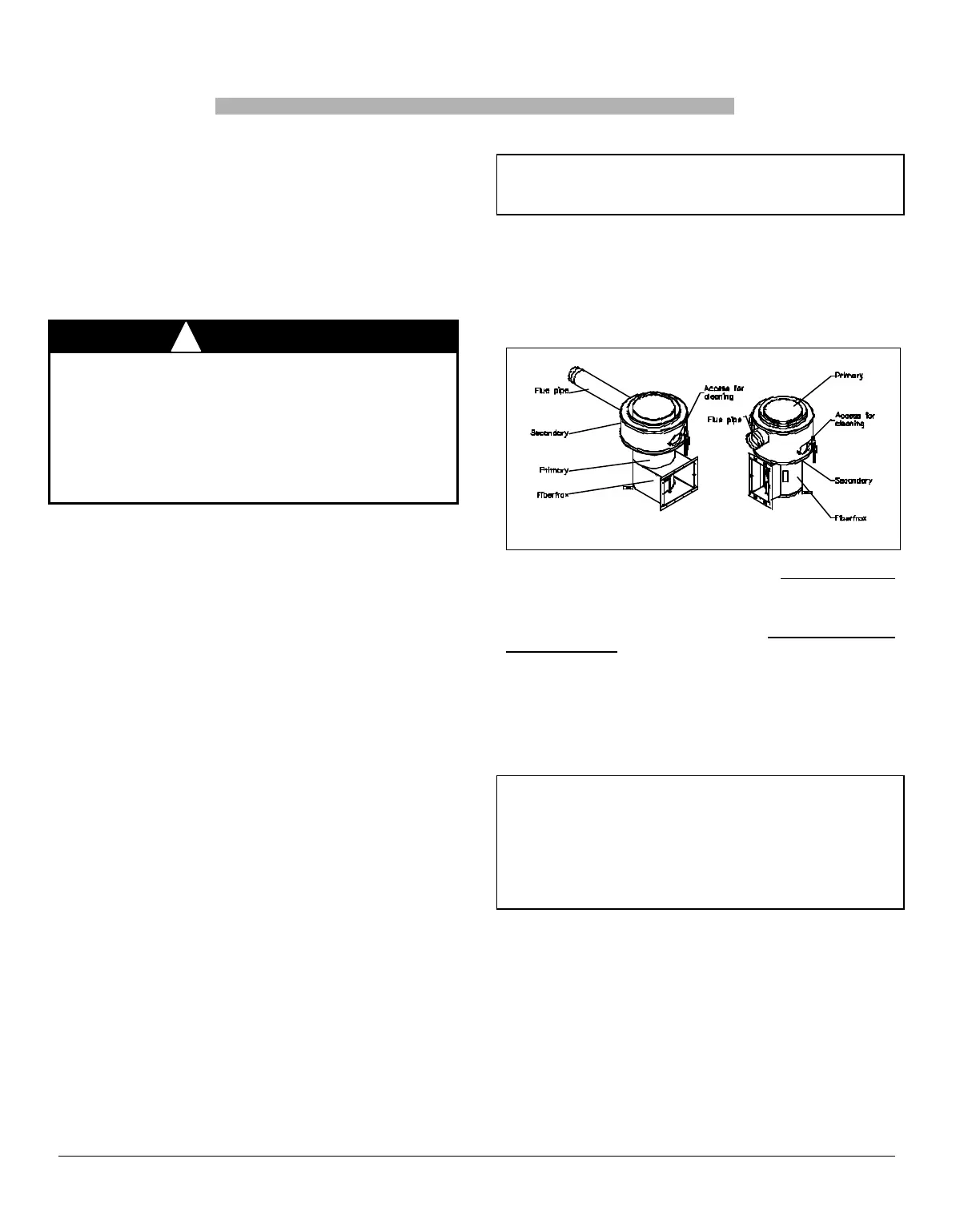
the secondary section visible from the clean-out port (see Figure 2),
you will not need to clean it. However, if you notice scaling, you should
remove the scale.
The wrap-around radiator can now be cleaned entirely from the front
inspection port. Also, the new furnace has external clean-out ports so
the soot does not fall into the fan compartment during the cleaning
operation.
IMPORTANT
Do not vacuum the ceramic chamber—it is easily
damage.
Soot will have collected in the first sections of the heat exchangers
only if the burner was started after the combustion chamber was
flooded with oil, or if the burner has been operating in a severely
fouled condition.
FIGURE 2
The use of a brush, vacuum cleaner or scraper is not recommended
for cleaning the primary. The primary has a fiberfrax liner and will be
damaged.
If you have to clean the interior of the primary, do not strike or scratch
the fiberfrax surf ace. Debris must be removed by hand. If the fiberfrax
lining is damaged in any way, such as through basement flooding, the
chamber must be replaced before the furnace is fired.
3.1.2) Refractory fire pot
Remove the burner and check the firepot.
IMPORTANT
Use extreme care if cleaning of the pot is required. After
firing, the pot becomes very fragile. Do not use any
commercially available soot remover. This furnace has
a fibre type refractory combustion chamber. Normal
servicing of this unit does not require cleaning of the
combustion chamber.
If the pot is damaged, it must be replaced. A damaged pot could lead
to premature heat exchanger failure. Cracking of the fire pot is normal,
however, replace the pot only if the cracks have propagated more
than 2/3 the way through the wall thickness. The average wall
thickness of the firepot is ½”.
Flooding of the fire pot
Flooding can occur when the oil primary control has been reset a
number of times in a no-heat situation. Each time oil is fired into the
pot and does not ignite, it is absorbed into the pot. Even if the burner is
removed and the pot is felt for wetness, it is difficult to assess the
degree of oil absorption by the pot.
DNS-0486 Rev. B
MBP1-A, MBP2-
MBP-U
Model MBPF-A



 To Next Page