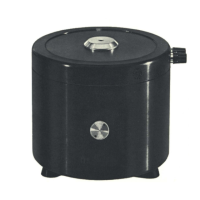
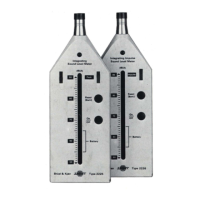
The Brüel & Kjær Calibration Exciter, available as Types 4294 and 4294-002, is a portable, battery-driven device designed for the precise field calibration and checking of vibration transducers and complete vibration measurement and recording systems. It offers a quick and easy method for ensuring the accuracy of vibration instrumentation.
Function Description:
The calibrator utilizes an electromagnetic exciter driven by a crystal oscillator, operating at a frequency of 159.15 Hz (1000 rad s⁻¹). A small accelerometer integrated on the underside of the vibration table provides servo feedback to maintain a constant, accurate vibration level. This servo control ensures that the vibration level remains independent of the mass of the transducer under test, within specified limits.
Type 4294 provides a standard acceleration level of 10 ms⁻² RMS (14.14 ms⁻² peak) for loads up to 70 grams. This reference signal can also be used for velocity calibration at 10 mms⁻¹ RMS (14.14 mms⁻¹ peak) and displacement calibration at 10 µm RMS (14.14 µm peak).
Type 4294-002 offers a standard acceleration level of 3.16 ms⁻² RMS (4.47 ms⁻² peak) for heavier loads, up to 200 grams. Similarly, its reference signal can be used for velocity calibration at 3.16 mms⁻¹ RMS (4.47 mms⁻¹ peak) and displacement calibration at 3.16 µm RMS (4.47 µm peak).
The calibrator is designed to prevent overload; power is automatically disconnected if a transducer mass exceeding the specified limit (70 g for Type 4294, 200 g for Type 4294-002) is mounted on the vibration table.
Important Technical Specifications:
- Dynamic Characteristics:
- Frequency: 159.15 Hz ± 0.02%
- Acceleration (RMS):
- Type 4294: 10 ms⁻² ± 3%
- Type 4294-002: 3.16 ms⁻² ± 3%
- Velocity (RMS):
- Type 4294: 10 mms⁻¹ ± 3%
- Type 4294-002: 3.16 mms⁻¹ ± 3%
- Displacement:
- Type 4294: 10 µm ± 3%
- Type 4294-002: 3.16 µm ± 3%
- Transverse Amplitude: < 5% of main axis amplitude
- Distortion:
- Type 4294: < 2% for 10 to 70 gram load
- Type 4294-002: < 2% for 10 to 200 g load
- Typical < 7% for 0 to 10 g. Using DB-2996 (10 g) with very light accelerometers can achieve 2% distortion.
- Power Requirements:
- Built-in Battery: One 9 V Alkaline Battery QB-0016 (IEC type 6LR61)
- Battery Life: Approximately 200 calibrations, each lasting 100 s with automatic switching off.
- Physical Characteristics:
- Length (bottom to top of calibrator table): 135 mm (5.3 in)
- Diameter: With case: 46 mm (1.8 in); without case: 43.5 mm (1.7 in)
- Weight: 500 g (17.6 oz) including battery and leather case
- Transducer Mounting Thread: 10-32 UNF
- Mounting Torque: Max. 0.5 Nm
- Environmental Specifications:
- Operating Temperature:
- 10 to 40°C (50 to 104°F) for 10 ms⁻² and 3.16 ms⁻² reference within ± 3%
- -10 to +55°C (14 to 131°F) for 10 ms⁻² and 3.16 ms⁻² reference within ± 5%
- Storage Temperature: -25 to +70°C (-13 to +158°F)
- Humidity: 90% RH (non-condensing at 30°C (86°F))
- Enclosure Protection: IP 54 (splash-proof according to IEC 60529)
- Mechanical Robustness (Non-operating):
- Vibration: 0.3 mm, 20 ms⁻², 10–500 Hz (IEC 60068-2-6)
- Shock: 1000 ms⁻² (IEC 60068-2-27)
- Bump: 1000 bumps at 400 ms⁻² (IEC 60068-2-29)
- Compliance: Designed and tested in accordance with IEC 61010-1 and EN 61010-1 Safety Requirements. CE, RCM, China RoHS, and WEEE marked.
Usage Features:
- Ease of Use: The calibrator is straightforward to operate. It is switched on and off by pressing a small button on the side of its housing.
- Automatic Shut-off: To prolong battery life, the exciter automatically switches off after approximately 100 seconds of operation.
- Transducer Mounting: Transducers can be attached to the vibration table using a 10-32 UNF Steel Stud YQ-2962 (finger-tight mounting torque of ~0.3 Nm, max. 0.5 Nm). For transducers weighing less than 10 grams, a Mounting Disc DB-2996 (supplied) can be used. The mounting disc allows for various attachment methods, including 3 mm Steel Stud YQ-2007 for 3 mm threaded transducers, Mounting Magnet UA-0642, or Beeswax YJ-0216. Mounting with adhesive is not recommended.
- System Calibration Procedure:
- Attach the system transducer to the vibration table.
- Connect the transducer to the vibration measurement system using a suitable low-noise cable.
- Switch on the preamplifier and indicating instrument, selecting acceleration mode and the highest indicating range.
- Press the calibrator button to start vibration.
- Adjust range controls to obtain an on-scale meter indication without overload. The instrument should indicate the reference acceleration level (10 ms⁻² RMS for Type 4294, 3.16 ms⁻² RMS for Type 4294-002). If not, adjust the sensitivity potentiometer.
- For velocity or displacement calibration, integrate the signal using appropriate networks and select the corresponding measurement mode before switching on the calibrator.
- Transducer Sensitivity Check: A procedure is provided to determine the approximate sensitivity of transducers, useful for verifying correct function and detecting damage. This involves measuring the transducer output (A₀) and comparing it to the nominal sensitivity (S₀) and reference acceleration (A₀) using the formula: S_c = (A_i * S₀) / A₀. If a voltmeter is used with a fixed sensitivity preamplifier, the formula is S_c = V₀ / (A₀ * P_s).
Maintenance Features:
- Battery Replacement: The calibrator uses a long-life alkaline 9 V battery (QB-0016). The battery holder is accessible by unscrewing the base of the calibrator. Care should be taken not to cross the screw thread during reassembly. The exciter can operate until the battery is fully depleted without affecting accuracy.
- Durability: Designed for everyday use in harsh environments, it comes with a leather case for impact protection and is drop- and environment-tested according to IEC 60068.
- Service and Repair: The devices are built for reliable operation. In case of a fault, the battery should be removed to prevent further damage. Repairs should only be performed by qualified service personnel or a local Brüel & Kjær representative.
- Recalibration: Periodic recalibration every 1–3 years is recommended to maintain high accuracy and traceability.

 Need help?
 General




 To Next Page