EasyManua.ls Logo

Bryant 264A - User Manual

Bryant 264A
12 pages
Print Icon
To Next Page IconTo Next Page
Loading...
Installation Instructions
264A / 265A
PR EFERRED SERIES HEAT PUMP
WITH PUR ON REFRIGERANT
SIZES 018 TO 060
1--1/2 TO 5 NOMINAL TONS
SAFETY CONSIDERATIONS
Improper installation, adjustment, alteration, service,
maintenance, or use can cause explosion, fire, electrical shock, or
other conditions which may cause death, personal injury, or
property damage. Consult a qualified installer, service agency, or
your distributor or branch for information or assistance. The
qualified installer or agency must use factory--authorized kits or
accessories when modifying this product. Refer to the individual
instructions packaged with the kits or accessories when installing.
Follow all safety codes. Wear safety glasses, protective clothing,
and work gloves. Use quenching cloth for brazing operations.
Have fire extinguisher available. Read these instructions
thoroughly and follow all warnings or cautions included in
literature and attached to the unit. Consult local building codes
and National Electrical Code (NEC) for special requirements.
Recognize safety information. This is the safety-- alert symbol
!
!
When you see this symbol on the unit and in instructions or
manuals, be alert to the potential for personal injury.
Understand these signal words: DANGER, WARNING, an d
CAUTION. These words are used with the safety--alert symbol.
DANGER identifies the most serious h azards which will result in
severe personal injury or death. WARNING signifies hazards
which could result in personal injury or death. CAUTION is
used to identify unsafe practices which may result in minor
personal injury or product and property damage. NOTE is used to
highlight suggestions which will result in enhanced installation,
reliability, or operation.
!
WARNING
ELECTRICAL SHOCK HAZARD
Failure to follow this warning could result in personal injury
or death.
Before installing, modifying, or servicing system, main
electrical disconnect switch must be in the OFF position.
There may be more than 1 disconnect switch. Lock out and
tag switch with a suitable warning label.
IMPORTANT: Maximum liquid--line size is 3/8--in. OD for all
residential applications including long line.
IMPORTANT: Always install the factory--supplied liquid--line
filter drier. Obtain replacement filter driers from your distributor
or branch.
INSTALLATION RECOMMENDATIONS
NOTE: In some cases noise in the living area has been traced
to gas pulsations from improper installation of equipment.
1. Locate unit away from windows, patios, decks, etc. where
unit operation sound may disturb customer.
2. Ensure that vapor and liquid tube diameters are appropri-
ate for unit capacity .
3. Run refrigerant tubes as directly as possible by avoiding
unnecessary turns and bends.
4. Leave some slack between structure and unit to absorb vi-
bration.
5. When passing refrigerant tubes through the wall, seal
opening with RTV or other pliable silicon--based caulk.
(See Fig. 1.)
6. Avoid direct tubing contact with water pipes, duct work,
floor joists, wall studs, floors, and walls.
7. Do not suspend refrigerant tubing from joists and studs
with a rigid wire or strap which comes in direct contact
with tubing. (See Fig. 1.)
8. Ensure that tubing insulation is pliable and completely
surrounds vapor tube.
9. When necessary, use hanger straps which are 1 in. (25.4
mm) wide and conform to shape of tubing insulation. (See
Fig. 1.)
10. Isolate hanger straps from insulation by using metal
sleeves bent to conform to shape of insulation.
INSULATION
VAPOR TUBE
LIQUID TUBE
OUTDOOR WALL INDOOR WALL
LIQUID TUBE
VAPOR TUBE
INSULATION
CAULK
Avoid contact between tubing and structureNOTE:
THROUGH THE WALL
HANGER STRAP
(AROUND VAPOR
TUBE ONLY)
JOIST
1 (25.4 mm)MIN.
SUSPENSION
A94028
Fig. 1 --- Connecting Tubing Installation
When outdoor unit is connected to factory--approved indoor unit,
outdoor unit contains system refrigerant charge for operation with
ARI rated indoor unit when connected by 15 ft/4.57 m. of
field--supplied or factory accessory tubing. For proper unit
operation, check refrigerant charge using charging information
located on control box cover and/or in the Check Charge section
of this instruction.

Questions and Answers

Summary

Safety Considerations

Installation Recommendations

Installation

Check Equipment and Job Site

Procedures for inspecting the unit and preparing the installation site.

Clearance Requirements

Specifies minimum clearances for airflow, service, and unit placement.

Elevate Unit

Make Piping Connections

Outdoor Unit Connected to Factory Approved Indoor Unit

Install Adapter Tube

Instructions for installing the adapter tube for the liquid service valve.

Refrigerant Tubing and Sweat Connections

Leak Testing

Evacuate Refrigerant Tubing and Indoor Coil

Make Electrical Connections

Check OAT Thermistor and OCT Thermistor Attachments

Follow these steps to properly start up system:

Start-Up

Check Charge

Heating

Heat Pump System Functions and Sequence of Operation

Sequence of Operation

Overview of the unit's operational sequences for cooling and heating.

Communication and Status Function Lights

Time Delays

Utility Interface

Low Ambient Cooling

Standard Thermostat low ambient cooling mode:

Defrost

Major Components

Troubleshooting

Systems Communication Failure

Diagnosing issues when communication between UI and outdoor unit is lost.

Pressure Switch Protection

How high/low pressure switches affect operation and fault codes.

Compressor Thermal Cutout or Loss of 230 V Power

Diagnosing issues related to compressor thermal protection or power loss.

Temperature Thermistors

Status Codes

Final Checks

Care and Maintenance

Puron (R-410 A) Quick Reference Guide

Overview

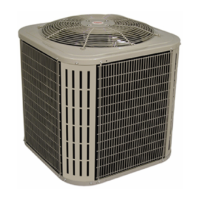
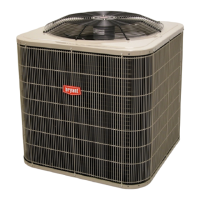
The Bryant Preferred™ Series Heat Pump with Puron® Refrigerant (models 264A/265A) is a residential split-system heat pump designed for cooling and heating applications, available in sizes ranging from 1.5 to 5 nominal tons (018 to 060). It utilizes Puron (R-410A) refrigerant, an environmentally sound alternative to R-22.

Function Description:

The heat pump operates in both cooling and heating modes to provide year-round comfort. In cooling mode, it extracts heat from the indoor air and transfers it outdoors. In heating mode, it reverses the process, extracting heat from the outdoor air and transferring it indoors. The system is designed to work with factory-approved indoor units and can be integrated into a Hybrid Heat® Dual Fuel system.

Important Technical Specifications:

  • Refrigerant: Puron (R-410A).
  • Sizes: 018 to 060 (1.5 to 5 nominal tons).
  • Operating Ambient (Cooling): Minimum 55°F (12.78°C) without low ambient cooling enabled, maximum 125°F (51.67°C).
  • Operating Ambient (Heating): Maximum 66°F (18.89°C).
  • Refrigerant Charge: Factory charged for 15 ft (4.57 m) of lineset. Adjust charge by adding or removing 0.6 oz/ft of 3/8 liquid line above or below 15 ft (4.57 m).
  • Liquid Line Size: Maximum 3/8-in. OD for all residential applications, including long line.
  • Vacuum Requirement: Evacuate to 500 microns to eliminate contamination and moisture.
  • Control Voltage: 24 VAC, with a minimum of 40 VA transformer capacity.
  • Thermistors: Outdoor Air Temperature (OAT) and Outdoor Coil Temperature (OCT) thermistors are factory-installed for temperature sensing.
  • Pressure Switches: Equipped with high- and low-pressure switches for system protection.
  • Crankcase Heater: Required for refrigerant tubing longer than 80 ft (24.38 m) or when operating below 65°F (18.33°C) during the off cycle.
  • Filter Drier: A factory-supplied liquid-line filter drier is required on every unit, with a rated working pressure of at least 600 psig.

Usage Features:

  • Installation:
    • Requires a solid, level mounting pad. Tiedown bolts can be used with provided knockouts in the basepan.
    • Clearance requirements: 30 in. (762 mm) to service end, 48 in. (1219.2 mm) above unit, 6 in. (152.4 mm) on one side, and 12 in. (304.8 mm) on remaining sides.
    • Refrigerant tubing should be run as directly as possible, avoiding direct contact with other structures, and sealed with RTV or silicon-based caulk where it passes through walls. Hanger straps (1 in. wide) should be used for support, isolated from insulation with metal sleeves.
    • The unit must be level to within ±2° (±3/8 in./ft.).
    • A liquid line filter drier must be installed indoors, brazed to the liquid tube.
    • Leak testing is required for all joints after piping connections.
    • Deep vacuum method (500 microns) is recommended for evacuation.
    • Electrical wiring must comply with local and national codes, using copper wire only. A branch circuit disconnect of adequate size is required, located within sight and readily accessible.
    • Grounding is essential for safety, using electrical wire or metal conduit.
    • Control wiring uses No. 18 AWG color-coded insulated wire (No. 16 AWG for runs over 100 ft/30.48 m).
  • Control System:
    • Evolution Control (Communicating): Offers advanced features like auto defrost, low ambient cooling without a kit, and a utility interface for compressor operation interruption during peak loads. A green LED (COMM light) indicates successful communication.
    • Standard Thermostat (Non-Communicating): Supports basic cooling and heating operations. Low ambient cooling requires a Low Ambient Pressure Switch kit, Evaporator Freeze Thermostat, and Isolation Relay.
    • Time Delays: Includes 5-minute delays for cooling/heating start-up and compressor recycle, 2-minute delay for standby return (Evolution only), 1-minute outdoor fan off delay (if OAT ≥ 100°F/37.78°C), 15-second auxiliary heat de-energization delay, 20-second outdoor fan energization delay, and 30-second compressor delay (Quiet Shift enabled).
    • Defrost: Offers 4 selectable intervals (30, 60, 90, 120 minutes) via dip switches or Evolution control. Auto defrost (Evolution only) adjusts intervals based on previous defrost times. Forced defrost can be initiated manually or via User Interface.
    • Quiet Shift: Field-selectable defrost mode that minimizes compressor sound during defrost and heating restarts by temporarily turning off the compressor and fan.
    • Liquid Line Solenoid Accessory: Required for long line applications to control refrigerant migration in heating mode. Connects to LS output on Evolution control or Y and C terminals on standard thermostats.
  • Troubleshooting:
    • An amber STATUS light on the control board displays fault codes (short and long flashes) for system communication failure, pressure switch trips, control faults, 24V brown out, compressor voltage sensing issues, thermal cutouts, contactor problems, and thermistor failures.
    • Thermistor resistance vs. temperature chart (Fig. 13) is provided for checking OAT and OCT sensor functionality.

Maintenance Features:

  • Periodic Maintenance: Required for continuing high performance and to minimize equipment failure. Frequency may vary based on geographic areas (e.g., coastal applications). Refer to the User's Manual for detailed information.
  • Refrigerant Handling (Puron R-410A):
    • Operates at 50-70% higher pressures than R-22; equipment and components must be designed for Puron.
    • Puron cylinders are rose colored, and recovery cylinders must be rated 400 psig (DOT 4BA400 or BW400).
    • Charge with liquid refrigerant using a commercial metering device in the manifold hose when charging into the suction line.
    • Manifold sets should be 700 psig high side and 180 psig low side with 550 psig low-side retard.
    • Use hoses with 700 psig service pressure rating.
    • Leak detectors must be designed for HFC refrigerants.
    • Only compatible with POE oils.
    • Vacuum pumps do not remove moisture from oil.
    • Do not leave Puron suction line filter driers in line longer than 72 hours.
    • Do not install a suction-line filter drier in the liquid line.
    • POE oils absorb moisture rapidly; avoid exposure to atmosphere.
    • Wrap all filter driers and service valves with wet cloth when brazing.
    • Do NOT use an R-22 TXV; if equipped, it must be changed to a hard shutoff Puron TXV.
    • Never open the system to atmosphere while under a vacuum.
    • When opening the system for service, recover refrigerant, evacuate, break vacuum with dry nitrogen, and replace filter driers.
    • Do not vent Puron into the atmosphere.
    • Do not use capillary tube coils.
    • All indoor coils must be installed with a hard shutoff Puron TXV metering device.
  • Final Checks: Before leaving the job, ensure all wiring is routed correctly, secure, and free from rubbing. All panels and covers must be securely fastened. Service valve stem caps must be tightened. Provide the owner with the User's Manual and explain system operation and maintenance. Complete the Dealer Installation Checklist.

Bryant 264A Specifications

General IconGeneral
BrandBryant
Model264A
CategoryHeat Pump
LanguageEnglish

Related product manuals