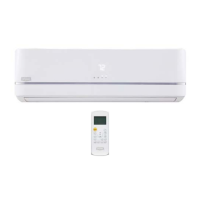
615AHAQ: Owner’s Manual
Manufacturer reserves the right to change, at any time, specifications and designs without notice and without obligations.
4
3. Qualification of Workers
Any maintenance, service and repair operations must be performed
by skilled and authorized personnel. Every working procedure that
affects safety means shall only be carried out by competent persons
that joined the training and achieved competence should be
documented by a certificate. The training of these procedures is
carried out by national training organizations or manufacturers that
are accredited to teach the relevant national competency standards
that may be set in legislation. Examples for such working procedures
are:
- breaking into the refrigerating circuit;
- opening of sealed components;
- opening of ventilated enclosures.
4. Ventilated Area
Ensure that the area is in the open or that it is adequately ventilated
before breaking into the system or conducting any hot work. A
degree of ventilation shall continue during the period that the work is
carried out. The ventilation should safely disperse any released
refrigerant and preferably expel it externally into the atmosphere.
5. Cabling
Check that cabling is not subjected to wear, corrosion, excessive
pressure, vibration, sharp edges or any other adverse environmental
effects. The check shall also take into account the effects of aging or
continual vibration from sources such as compressors or fans.
6. Detection of Flammable Refrigerants
Under no circumstances shall potential sources of ignition be used in
the searching for or detection of refrigerant leaks. A halide torch (or
any other detector using a naked flame) shall not be used.
The following leak detection methods are deemed acceptable for
refrigerant systems. Electronic leak detectors that have a sensitivity
of 1/8 Oz (5g)/year may be used to detect leaks of flammable
refrigerants. (Detection equipment shall be calibrated in a refrigerant
free area.) Ensure that the detector is not a potential source of
ignition and is suitable for the refrigerant used. Leak detection
equipment shall be set at a percentage of the LFL of the refrigerant
and shall be calibrated to the refrigerant employed, and the
appropriate percentage of gas (25% maximum) is confirmed.
Leak detection fluids are also suitable for use in external leak
detection.
NOTE: Examples of leak detection fluids are
- bubble method,
- fluorescent method agents.
If a leak is suspected, all open flames shall be removed/
extinguished. If a leakage of refrigerant is found which
requires brazing, all of the refrigerant shall be recovered
from the system, or isolated (by means of shut off valves) in a
part of the system remote from the leak. See the following
instructions of removal of refrigerant.
7. Evacuation
When breaking into the refrigerant circuit to make repairs - or for
any other purpose conventional procedures shall be used. However,
for flammable refrigerants it is important that best practice be
followed, since flammability is a consideration. The following
procedure shall be adhered to:
- safely recover refrigerant following local and national regulations;
evacuate;
- purge the circuit with NITROGEN;
- evacuate (requirement);
- continuously flush or purge with NITROGEN when using flame to
open circuit; and
- open the circuit
The refrigerant charge shall be recovered into the correct recovery
cylinders. Charging must be performed by the liquid charging
method. For appliances containing flammable refrigerants, the
system shall be purged with oxygen-free nitrogen to render the
appliance safe for flammable refrigerants. This process might need
to be repeated several times. Compressed air or oxygen shall not be
used for purging refrigerant systems.
For appliances containing flammable refrigerants, refrigerants
purging shall be achieved by breaking the vacuum in the system with
oxygen-free nitrogen and continuing to fill until the working
pressure is achieved, then venting to atmosphere, and finally pulling
down to a vacuum (requirement). This process shall be repeated
until no refrigerant is within the system (requirement). When the
final oxygen-free nitrogen charge is used, the system shall be vented
down to atmospheric pressure to enable work to take place. The
outlet for the vacuum pump shall not be close to any potential
ignition sources, and ventilation shall be available.
Recovery: When removing refrigerant from a system, either for
servicing or decommissioning, it is recommended good practice that
all refrigerants are removed safely.
When transferring refrigerant into cylinders, ensure that only
appropriate refrigerant recovery cylinders are employed. Ensure that
the correct number of cylinders for holding the total system charge is
available. All cylinders to be used are designated.
8. Charging Procedures
In addition to conventional charging procedures, the following
requirements shall be followed:
Works shall be undertaken with appropriate tools only (in case of
uncertainty, consult the manufacturer of the tools for use with
flammable refrigerants)
Ensure that contamination of different refrigerants does not occur
when using charging equipment. Hoses or lines shall be as short as
possible to minimize the amount of refrigerant contained in them.
Charging must be performed by the liquid charging method.
Ensure that the refrigeration system is grounded prior to charging the
system with refrigerant.
Label the system when charging is complete (if not already).
Extreme care shall be taken not to overfill the refrigeration system.
Prior to recharging the system it shall be pressure tested with oxygen free
nitrogen (OFN). The system shall be leak tested on completion of
charging but prior to commissioning. A follow up leak test shall be
carried out prior to leaving the site.


 To Next Page
 Loading...