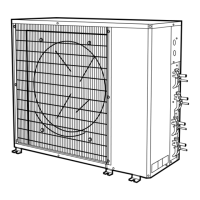
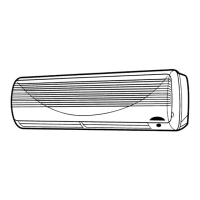
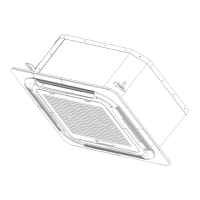
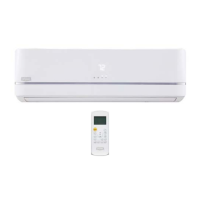
615AHAQ: Owner’s Manual
Manufacturer reserves the right to change, at any time, specifications and designs without notice and without obligations.
3
FAN Only
In the FAN Only mode, the system filters and circulates the room air
without changing room air temperature.
AUTO
In the AUTO mode, the system automatically cools or heats the room
according to the user-selected set point.
NOTE: AUTO mode is recommended for use on single zone
applications ONLY. Using AUTO CHANGEOVER on multi-
zone applications could set an indoor unit to STANDBY
mode, indicated with two dashes (--) on the display, which
turns off the indoor unit until all the indoor units are in the
same mode (COOLING or HEATING). HEATING is the
system's priority mode. Simultaneous HEATING and
COOLING is not allowed.
HEATING (Heat Pump models only)
In the HEATING mode, the system heats and filters the room air.
COOLING
In the COOLING mode, the system cools, dries and filters the room air.
DEHUMIDIFICATION (DRY)
In the DEHUMIDIFICATION mode, the system dries, filters and
slightly cools the room air temperature. This mode prioritizes air
dehumidification but it does not take the place of a dehumidifier.
Wireless Remote Control
The remote control transmits commands to set up and operate the system.
The control has a window display panel that displays the current system
status. The control can be secured to a surface when used with the
mounting bracket provided.
Wired Remote Control (Optional)
Refer to the Wired Controller manual.
24V Interface (Optional)
Allows the control of the Ductless System with a third party thermostat.
1. Installation (where refrigerant pipes are allowed)
Any person who is involved with working on or breaking into a
refrigerant circuit should hold a current valid certificate from an
industry-accredited assessment authority, which authorizes their
competence to handle refrigerants safely in accordance with an
industry recognized assessment specification.
Maintenance and repair requiring the assistance of other skilled
personnel shall be carried out under the supervision of the person
competent in the use of flammable refrigerants.
The installation of pipe-work shall be kept to a minimum.
Pipe-work shall be protected from physical damage.
Where refrigerant pipes shall be compliance with national gas
regulations. That mechanical connections shall be accessible for
maintenance purposes.
Be more careful that foreign matter (oil, water, etc.) does not enter
the piping. When storing the piping, securely seal the opening by
pinching, taping, etc. All working procedure that affects safety
means shall only be carried by competent persons.
Appliance shall be stored in a well ventilated area where the room
size corresponds to the room area as specific for operation.
Joints shall be tested with detection equipment with a capability of
1/8 oz (5g)/year of refrigerant or better, with the equipment in
standstill and under operation or under a pressure of at least these
standstill or operation conditions after installation. In cases that
require mechanical ventilation, ventilation openings shall be kept
clear of obstruction.
LEAK DETECTION SYSTEM installed. Unit must be powered
except for service.For the unit with refrigerant sensor, when the
refrigerant sensor detects refrigerant leakage, the indoor unit
displays a error code and emit a buzzing sound, the compressor of
outdoor unit immediately stops, and the indoor fan starts running.
The service life of the refrigerant sensor is 15 years. When the
refrigerant sensor malfunctions, the indoor unit displays the error
code FHCC. Refer to the error code table in the unit’s service
manual for details. The refrigerant sensor can not be repaired and
can only be replaced by the manufacturer. It shall only be replaced
with the sensor specified by the manufacturer.
2. Because a FLAMMABLE REFRIGERANT is used, the
requirements for installation space of appliance and/or ventilation
requirements are determined according to:
- the refrigerant charge used in the appliance,
- the installation location,
- the type of ventilation of the location or of the appliance.
- piping material, pipe routing, and installation shall include
protection from physical damage in operation and service, and be in
compliance with national and local codes and standards, such as
ASHRAE 15, IAPMO Uniform Mechanical Code, ICC International
Mechanical Code, or CSA B52. All field joints shall be accessible
for inspection prior to being covered or enclosed.
- that protection devices, piping, and fittings shall be protected as far
as possible against adverse environmental effects, for example, the
danger of water collecting and freezing in relief pipes or the
accumulation of dirt and debris;
- that piping in refrigeration systems is designed and installed to
minimize the likelihood of hydraulic shock damaging the system;
- that steel pipes and components shall be protected against
corrosion with a rustproof coating before applying any insulation;
- that precautions shall be taken to avoid excessive vibration or
pulsation;
- the minimum floor area of the room shall be mentioned in the form
of a table or a single figure without reference to a formula;
- after completion of field piping for split systems, the field pipe-
work shall be pressure tested with an inert gas and then vacuum
tested prior to refrigerant charging, according to the following
requirements:
a. The required nitrogen test pressure is 500 PSI.
b. The test pressure after removal of pressure source shall be
maintained for at least 1 hour with no decrease of pressure
indicated by the test gauge, with test gauge resolution not
exceeding 5% of the test pressure.
c. During the evacuation test, after achieving a vacuum level
specified in the manual or less, the refrigeration system shall
be isolated from the vacuum pump and the pressure shall not
rise above 1500 microns within 10 min. The vacuum pressure
level shall be specified in the manual, and shall be the lessor of
500 microns or the value required for compliance with national
and local codes and standards, which may vary between
residential, commercial, and industrial buildings.
- Field-made refrigerant joints indoors shall be tightness tested
according to the following requirements: The test method shall have
a sensitivity of 1/8 oz (5 g) per year of refrigerant or better under a
pressure of at least 125% of the maximum allowable pressure. No
leak shall be detected.


 To Next Page
 Loading...