986TC: Installation, Start-up, Operating, Service and Maintenance Instructions
Manufacturer reserves the right to change, at any time, specifications and designs without notice and without obligations.
31
General
If this furnace replaces a furnace that was connected to a vent system or
chimney, the vent or vent connectors of other remaining appliances may
need to be re-sized. Vent systems or vent connectors of other appliances
must be sized to the minimum size as determined using appropriate table
found in the current edition of National Fuel Gas Code NFPA 54/ANSI
Z-223.1. In Canada, refer to CAN/CSA-B149.1.
An abandoned masonry chimney may be used as a raceway for properly
insulated and supported combustion-air (when applicable) and vent
pipes. Each furnace must have its own set of combustion-air and vent
pipes and be terminated individually, as shown in Fig. 42 for Direct Vent
(2-Pipe) system, or Fig. 43 for single-pipe or ventilated combustion air
option.
A furnace shall not be connected to a chimney flue serving a separate
appliance designed to burn solid fuel.
Other gas appliances with their own venting system may also use the
abandoned chimney as a raceway providing it is permitted by local code,
the current edition of the National Fuel Gas Code, and the vent or liner
manufacturer’s installation instructions. Care must be taken to prevent
the exhaust gases from one appliance from contaminating the
combustion air of other gas appliances.
Do not take combustion air from inside the chimney when using
ventilated combustion air or single-pipe vent option.
These furnaces can be vented as direct-vent (two-pipe), ventilated
combustion air or non-direct (single-pipe) vent system. Each type of
venting system is described below. Common venting between these
furnaces or other appliances is prohibited.
Materials
U.S.A.
Combustion air and vent pipe, fittings, primers, and solvents must
conform to American National Standards Institute (ANSI) standards and
American Society for Testing and Materials (ASTM) standards. See
Table 16 for approved materials for use in the U.S.A. This furnace is also
CSA approved for venting with M&G DuraVentRPolyProR or
Centrotherm InnoFlueR polypropylene venting systems using single
wall straight and flex, and required fittings (elbows, reducers, increasers,
connectors, adapters) only.
Canada
Special Venting Requirements for Installations in Canada, Installation in
Canada must conform to the requirements of CAN/CSA B149 code.
Vent systems must be composed of pipe, fittings, cements, and primers
listed to ULC S636. M&G DuraVentRPolyProR or Centrotherm
InnoFlueR polypropylene venting systems are ULC S636 listed.
NOTE: When using polypropylene venting systems, all venting
materials used, including the vent terminations must be from the same
manufacturer.
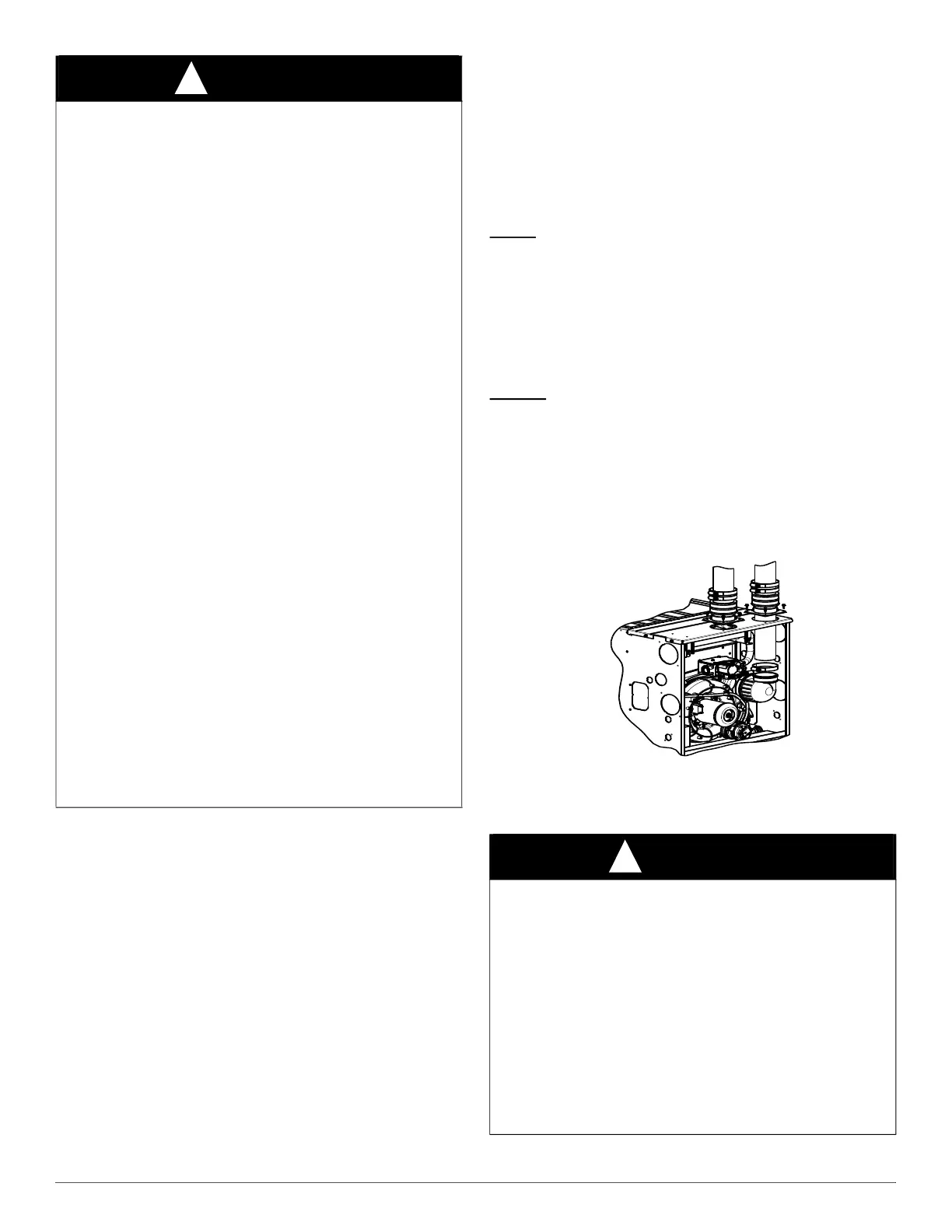
A12220
Fig. 41 – Sample Inlet Air Pipe Connection for Polypropylene
Venting Systems
Venting Systems
WARNING
!
CARBON MONOXIDE POISONING HAZARD
Failure to follow the steps outlined below for each appliance connected
to the venting system being placed into operation could result in carbon
monoxide poisoning or death.
The following steps shall be followed for each appliance connected to
the venting system being placed into operation, while all other
appliances connected to the venting system are not in operation:
1. Seal any unused openings in venting system.
2. Inspect the venting system for proper size and horizontal pitch,
as required in the National Fuel Gas Code, ANSI Z223.1/NFPA
54 or the CSA B149 Natural Gas and Propane Installation Code
and these instructions. Determine that there is no blockage or
restriction, leakage, corrosion and other deficiencies, which
could cause an unsafe condition.
3. As far as practical, close all building doors and windows and all
doors between the space in which the appliance(s) connected to
the venting system are located and other spaces of the building.
4. Close fireplace dampers.
5. Turn on clothes dryers and any appliance not connected to the
venting system. Turn on any exhaust fans, such as range hoods
and bathroom exhausts, so they are operating at maximum
speed. Do not operate a summer exhaust fan.
6. Follow the lighting instructions. Place the appliance being
inspected into operation. Adjust the thermostat so appliance is
operating continuously.
7. Test for spillage from draft hood equipped appliances at the
draft hood relief opening after 5 minutes of main burner
operation. Use the flame of a match or candle.
8. If improper venting is observed during any of the above tests,
the venting system must be corrected in accordance with the
National Fuel Gas Code, ANSI Z223.1/NFPA 54 and/or CSA
B149.1 Natural Gas and Propane Installation Code.
9. After it has been determined that each appliance connected to
the venting system properly vents when tested as outlined
above, return doors, windows, exhaust fans, fireplace dampers
and any other gas-fired burning appliance to their previous
conditions of use.
WARNING
!
CARBON MONOXIDE POISONING HAZARD
Failure to follow the instructions outlined below for each appliance
being placed into operation could result in carbon monoxide poisoning
or death.
For all venting configurations for this appliance and other gas
appliances placed into operation for this structure, provisions for
adequate combustion, ventilation, and dilution air must be provided in
accordance with:
U.S.A. Installations: Section 9.3 of the current edition of NFPA
54/ANSI Z223.1, Air for Combustion and Ventilation and applicable
provisions of the local building codes.
Canadian Installations: Part 8 of the current edition of
CAN/CSA-B149.1. Venting Systems and Air Supply for Appliances
and all authorities having jurisdiction.
EXAMPLE FOR
UPFLOW INSTALLATIONS.
MAY BE APPLIED TO
OTHER CONFIGURATIONS.


 To Next Page