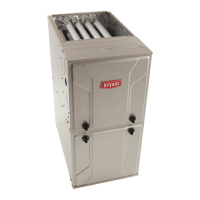
987MB: Installation, Start-up, Operating and Service and Maintenance Instructions
Manufacturer reserves the right to change, at any time, specifications and designs without notice and without obligations.
49
Cut the required number of holes in the roof or sidewall for vent and
(when used) combustion air pipes. Sidewall holes for two-pipe vent
terminations should be side-by-side, allowing space between the pipes
for the elbows to fit on the pipes.
Holes in the roof for direct-vent (two pipe) terminations should be
spaced no more than 18 in. (457 mm) apart to help avoid vent gas
recirculation into combustion air intake.
Termination elbows will be installed after the vent and (if used)
combustion air pipe is installed.
Sidewall Terminations
Concentric Vent Termination
NOTE: Follow the instructions of the vent terminal manufacturer. These
instructions are provided as a reference only.
Determine an appropriate location for termination kit using the
guidelines provided in section “Locating The Vent Termination” in
this instruction.
1. Cut one 4-in. diameter hole for 2-in. kit, or one 5-in. diameter hole
for 3-in. kit.
2. Loosely assemble concentric vent/combustion air termination
components together using instructions in kit.
3. Slide assembled kit with rain shield REMOVED through hole.
NOTE: Do not allow insulation or other materials to accumulate inside
of pipe assembly when installing it through hole.
4. Locate assembly through sidewall with rain shield positioned no
more than 1-in. (25 mm) from wall as shown in Fig. 40.
5. Disassemble loose pipe fittings. Clean and cement using same
procedures as used for system piping. DO NOT CEMENT
POLYPROPYLENE FITTINGS.
2-Pipe (Direct Vent) and 1-Pipe (Ventilated Combustion
Air) Vent Termination
NOTE: Follow the instructions of the vent terminal manufacturer. These
instructions are provided as a reference, only.
Determine an appropriate location for termination kit using the
guidelines provided in section “Locating The Vent Termination” in
this instruction.
1. Cut two holes, one for each pipe, of appropriate size for pipe size
being used.
2. Loosely install elbow in bracket (if used) and place assembly on
combustion-air pipe.
3. Install bracket as shown in Fig. 40 and 50.
NOTE: For applications using vent pipe option indicated by dashed
lines in Fig. 40 and 41, rotate vent elbow 90_ from position.
4. Disassemble loose pipe fittings. Clean and cement using same
procedures as used for system piping. DO NOT CEMENT
POLYPROPYLENE FITTINGS.
For Ventilated Combustion Air Terminations, terminate as shown in
Fig. 41.
(Direct Vent / 2-Pipe System ONLY)
When two or more furnaces are vented near each other, two vent
terminations may be installed as shown in Fig. 40, but next vent
termination, or pair of vent terminations, must be at least 36 in. (914
mm) away from the first two terminations. It is important that vent
terminations be made as shown in Fig. 40 to avoid recirculation of vent
gases.
Inducer Outlet Restrictor
The loose parts bag may contain an inducer outlet restrictor. The outlet
restrictor is NOT used on these furnaces. Discard restrictor.
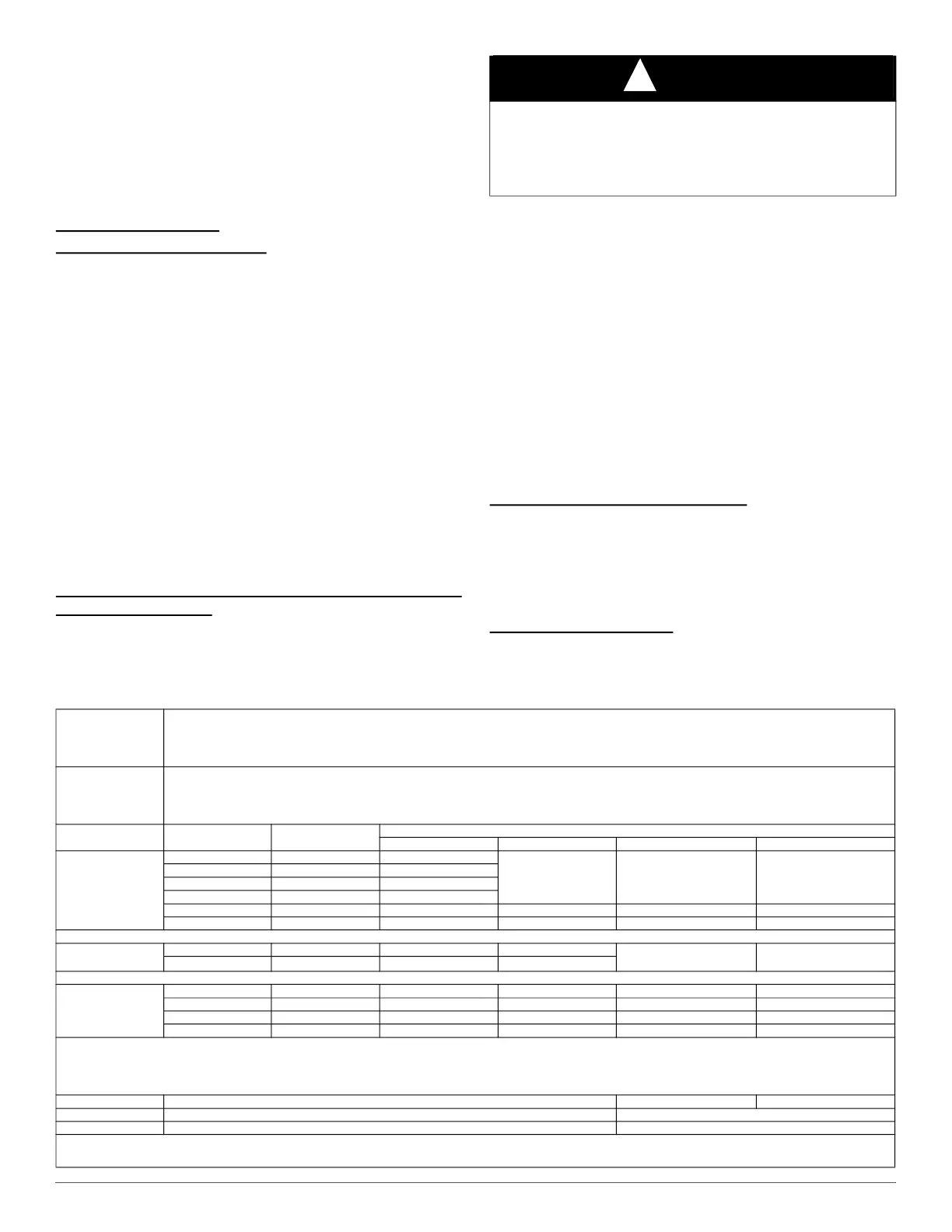
Table 15 – Approved Combustion-Air and Vent Pipe, Fitting and Cement Materials
NOTICE
!
RECOMMENDED SUPPORT FOR VENT TERMINATIONS
It is recommended that sidewall vent terminations in excess of 24
inches (0.6 M) in vertical length be supported by EITHER the Direct
Vent Termination Kit shown in Table 10 or by field-supplied brackets
or supports fastened to the structure.
MATERIALS
USA
1. All pipe*, fittings*, primers**, and solvents** must conform to American National Standards Institute (ANSI) standards and
American Society for Testing and Materials (ASTM) standards
2. See Table below for approved materials for use in the U.S.A.
3. UL 1738 vent systems must be composed of pipe*, fittings**, cements, and primers** from the same supplier.
CANADA
1. Installation in Canada must conform to the requirements of CAN/CSA B149 code.
2. Vent systems must be composed of pipe*, fittings*, cements, and primers from the same supplier and listed to ULC S636.
3. Not all materials below may be approved or listed to ULC S636.
4. Factory accessory concentric vent kits are ULC S636 listed.
Material Description Type
ASTM / ULC / UL Specification
Pipe* Fittings* Solvents/Primers** Cements
PVC
Pressure Pipe Schedule 40 D1785 / UL 1738
D2466 or D2665 F656 D2564
DWV Schedule 40 D1785 / D2665
SDR 26 N/A D2241
SDR 21 N/A D2241
IPEX Schedule 40 ULC S636 ULC S636 ULC S636 ULC S636
Royal Pipe Schedule 40 ULC S636 ULC S636 ULC S636 ULC S636
ABS
ABS Schedule 40 D2661 D2468 Clear Cleaner For
ABS†
D2235
DWV-IPS Sizes Schedule 40 D2661 D2661
CPVC
Pressure Pipe Schedule 40 F441 F438 F656 F493
SDR N/A F442 N/A
IPEX Schedule 40 ULC S636 ULC S636 ULC S636 ULC S636
Royal Pipe Schedule 40 ULC S636 ULC S636 ULC S636 ULC S636
* PVC and ABS pipe may use either DWV or pressure rated fittings.
** Colored or tinted solvents or primers must be used where required by code in the USA
† ABS plastic does not require a primer before solvent cementing. A cleaner for ABS is recommended to remove any surface residue. ABS cleaners are not
subject to ASTM standards.
Polypropylene Approved Manufacturer Solvents Primers Cements
Poly Pro® M & G Dura Vent Not Permitted
Innoflue® Centrotherm Not Permitted
NOTE: Polypropylene vent systems are UL−1738 and ULC S636 listed and assembled using mechanical fastening systems supplied by the vent
manufacturer.



 To Next Page