EasyManua.ls Logo

Bryant CNPHP - User Manual

Bryant CNPHP
6 pages
Print Icon
To Next Page IconTo Next Page
Loading...
CNPHP
Installation Instructions
Cased N Coils
Horizontal
Heating --- Cooling
NOTE: Read the entire instruction manual before starting the
installation.
TABLE OF CONTENTS
PAGE
SAFETY CONSIDERATIONS 1.........................
INTRODUCTION 1...................................
INSTALLATION 2....................................
Horizontal Right and Left with Pan Extension 2.........
Furnace Attachment 4..............................
Horizontal Attic 4................................
Horizontal Crawl Space 4...........................
Refrigerant Lines 4................................
Connect Refrigerant Liquid and Suction Lines 4.........
Condensate Drain Line Connection 5..................
Waste Line Connection 6...........................
SAFETY CONSIDERATIONS
Improper installation, adjustment, alteration, service, maintenance,
or use can cause explosion, fire, electrical shock or other conditions
which may cause death, personal injury or property damage.
Consult a qualified installer, service agency, or your distributor or
branch for information or assistance. The qualified installer or
agency must use factory--authorized kits or accessories when
modifying this product. Refer to the individual instructions
packaged with the kits or accessories when installing.
Follow all safety codes. Wear safety glasses, protective clothing
and work gloves. Use quenching cloths for brazing operations.
Have fire extinguisher available. Read these instructions
thoroughly and follow all warnings or cautions attached to the unit.
Consult local building codes and the current editions of the
National Electrical Codes (NEC) NFPA 70.
In Canada, refer to the current editions of the Canadian Electrical
Code CSA C22.1.
Recognize safety information. This is the safety--alert symbol
.
When you see this symbol on the unit and in instructions or
manuals, be alert to the potential for personal injury.
Understand the signal words DANGER, WARNING and
CAUTION. These words are used with the safety--alert symbol.
DANGER identifies the most serious hazards which will result in
severe personal injury or death. WARNING signifies hazards
which could result in personal injury or death. CAUTION is used
to identify unsafe practices, which may result in minor personal
injury or product and property damage. NOTE is used to highlight
suggestions which will result in enhanced installation, reliability, or
operation.
NOTE: Nitrogen can leak out through the needle pierce hole in
the plugs. This does not indicate a leaking coil nor warrant return
of the coil.
ELECTRICAL SHOCK HAZARD
Failure to follow this warning could result in personal injury
or death.
Before installing, modifying or servicing system, always turn
off main power to system. There may be more than one
disconnect switch. Lock out and tag switch with a suitable
warning label.
!
WARNING
PERSONAL INJURY HAZARD
Failure to follow this caution may result in personal injury.
This coil contains Nitrogen precharge of 15 PSIG. Release of
this pressure through the center of the rubber plugs is required
before removing the plugs.
CAUTION
!
CUT HAZARD
Failure to follow this caution may result in personal injury.
Sheet metal parts may have sharp edges or burrs. Use care and
wear appropriate protective clothing and gloves when
handling parts.
CAUTION
!
UNIT OR PROPERTY DAMAGE HAZARD
Failure to follow this caution may result in property damage.
Take precautions to ensure Aluminum tubes do not come in
direct contact or allow for condensate run off with a dissimilar
metal. Dissimilar metals can cause galvanic corrosion and
possible premature failure.
CAUTION
!
INTRODUCTION
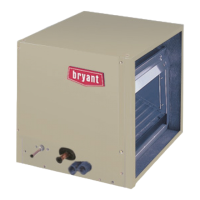
The CNPHP is a horizontal, multi--use furnace coil (see Fig. 1).
With the use of field--supplied transition duct, these furnace coils
can also be applied to other similar horizontal furnaces on the
market. The CNPHP is available in sizes 024 through 060. All
models are equipped with a factory--installed TXV and are used
with Puron refrigerant (R--410A) systems.

Question and Answer IconNeed help?

Do you have a question about the Bryant CNPHP and is the answer not in the manual?

Summary

Safety Considerations

Electrical Shock Hazard

Warning about turning off main power before servicing to prevent injury or death.

Personal Injury Hazard

Caution regarding Nitrogen precharge and pressure release before removing plugs.

Cut Hazard

Warning about sharp edges on sheet metal parts requiring protective gear.

Unit or Property Damage Hazard

Caution to prevent galvanic corrosion from contact with dissimilar metals.

Introduction

Installation

Cabinet Sweating

Guidance on insulating the coil casing and supply duct to prevent sweating in unconditioned spaces.

Condensate Management

Instructions for managing condensate to prevent blow-off, including pan extensions for 60 size coils.

TXV

Details on the thermal expansion valve, including handling during brazing and bulb placement.

Horizontal-Right and Horizontal-Left with Pan Extension

Steps for installing pan extensions for 5-ton coils in horizontal configurations.

Furnace Attachment

Horizontal Attic Installation

Horizontal Crawl Space Installation

Refrigerant Lines

Connect Refrigerant Liquid and Suction Lines

Unit Damage Hazard

Caution to wrap TXV and tubing with heat-sinking material during brazing to prevent damage.

Condensate Drain Line Connection

Instructions for connecting the condensate drain line, including trap requirements and pitch.

Waste Line Connection

Summary

Safety Considerations

Electrical Shock Hazard

Warning about turning off main power before servicing to prevent injury or death.

Personal Injury Hazard

Caution regarding Nitrogen precharge and pressure release before removing plugs.

Cut Hazard

Warning about sharp edges on sheet metal parts requiring protective gear.

Unit or Property Damage Hazard

Caution to prevent galvanic corrosion from contact with dissimilar metals.

Introduction

Installation

Cabinet Sweating

Guidance on insulating the coil casing and supply duct to prevent sweating in unconditioned spaces.

Condensate Management

Instructions for managing condensate to prevent blow-off, including pan extensions for 60 size coils.

TXV

Details on the thermal expansion valve, including handling during brazing and bulb placement.

Horizontal-Right and Horizontal-Left with Pan Extension

Steps for installing pan extensions for 5-ton coils in horizontal configurations.

Furnace Attachment

Horizontal Attic Installation

Horizontal Crawl Space Installation

Refrigerant Lines

Connect Refrigerant Liquid and Suction Lines

Unit Damage Hazard

Caution to wrap TXV and tubing with heat-sinking material during brazing to prevent damage.

Condensate Drain Line Connection

Instructions for connecting the condensate drain line, including trap requirements and pitch.

Waste Line Connection

Overview

The CNPHP is a horizontal, multi-use furnace coil designed for heating and cooling applications, specifically for use with Puron® refrigerant (R-410A) systems. It is available in sizes ranging from 024 to 060, and all models come equipped with a factory-installed TXV (Thermal Expansion Valve). While primarily intended for use with CNPHP furnaces, these coils can also be adapted to other similar horizontal furnaces on the market through the use of a field-supplied transition duct.

Function Description:

The primary function of the CNPHP coil is to facilitate heat exchange within a heating and cooling system. In cooling mode, the coil absorbs heat from the indoor air, transferring it to the refrigerant. In heating mode (when used with a heat pump), the process is reversed, and the coil releases heat into the indoor air. The integrated TXV plays a crucial role in optimizing system performance and comfort by regulating the flow of refrigerant through the coil across the system's operating range.

Important Technical Specifications:

  • Refrigerant Type: Puron® (R-410A) only.
  • Sizes: Available in sizes 024 through 060.
  • TXV: Factory-installed, hard-shutoff TXV with preset, non-field-adjustable superheat settings.
  • Coil Connection Tube Sizes (Liquid/Suction):
    • CNPHP2417A: 3/8 (10) / 5/8 (16)
    • CNPHP3017A: 3/8 (10) / 3/4 (19)
    • CNPHP3617A: 3/8 (10) / 3/4 (19)
    • CNPHP4221A: 3/8 (10) / 7/8 (22)
    • CNPHP4821A: 3/8 (10) / 7/8 (22)
    • CNPHP6024A: 3/8 (10) / 7/8 (22)
    • CNPHP6124A: 3/8 (10) / 7/8 (22)
  • Condensate Drain: Two 3/4-inch female threaded pipe connections are provided in each coil condensate pan for PVC fittings.
  • Airflow: Generally, 350 to 400 cfm/ton during normal cooling operation is recommended. Heat pump applications require specific airflow direction.

Usage Features:

  • Installation Configurations: The CNPHP coil offers versatile installation options, including:
    • Work Platform: Secured to roof trusses in the attic.
    • Suspended: From hangers on floor joists in a crawl space.
    • Blocks/Pads: Mounted on suitable blocks or pads in a crawl space.
    • Horizontal Right/Left: With pan extension (5-ton size only) for proper condensate management.
  • Condensate Management: The coil is designed to manage condensate without blow-off into the ductwork. For 5-ton units, a pan extension is supplied for both horizontal left and right installations to ensure proper drainage. In installations over a finished ceiling or living area, a field-fabricated secondary condensate pan is required.
  • Airflow Considerations: Proper airflow amount and distribution are critical for optimal system performance, preventing issues like low system performance, restricted TXV, frosted coil, poor humidity control, and water blow-off.
  • Furnace Compatibility: While designed for CNPHP furnaces, the coil can be adapted to other horizontal furnaces using a field-supplied transition duct. It is important to note that CNPHP furnace coils are not designed for furnaces wider than the coil itself.
  • Safety Features: The manual emphasizes several safety considerations, including:
    • Electrical Shock Hazard: Always turn off main power and lock out/tag switches before installation or servicing.
    • Personal Injury Hazard: Nitrogen precharge of 15 PSIG must be released before removing rubber plugs. Sheet metal parts may have sharp edges, requiring protective clothing and gloves.
    • Property Damage Hazard: Precautions are needed to prevent galvanic corrosion between aluminum tubes and dissimilar metals from condensate runoff. A secondary condensate pan is required when installing over finished living areas.
    • Explosion Hazard: When connecting to a waste (sewer) line, an open trap with an air gap is necessary to prevent sewer gases from escaping.

Maintenance Features:

  • Refrigerant Line Connections:
    • Use accessory refrigerant line sets or field-supplied refrigerant-grade lines.
    • A filter dryer should be placed just before the indoor unit.
    • When brazing, wrap the TXV and nearby tubing with a wet cloth or heat sink to prevent overheating (temperatures exceeding 212°F/100°C can harm valve performance).
    • Use 1/2 psig Nitrogen purge during brazing with Sil-Fos or Phos-copper alloy.
    • After brazing, allow joints to cool, slide rubber grommets over joints, and position tubing for an air seal.
    • Always evacuate lines and reclaim refrigerant when making connections or flaring. Leak check connections before insulating the suction line.
    • If the outdoor unit is not immediately installed, braze liquid and suction lines closed outside and add a Schraeder port test fitting to the suction line.
  • Condensate Drain Line Maintenance:
    • PVC fittings are recommended for condensate pan connections; finger tighten plus 1-1/2 turns.
    • Install a plastic plug in any unused condensate drain fitting.
    • While a trap is not always necessary on the condensate line, local codes may require one. If so, install it as close to the coil as possible, at least 3 inches (76 mm) deep, and no higher than the bottom of the unit's drain opening.
    • Pitch the condensate line 1 inch (25.4 mm) for every 10 feet of length.
    • Prime all traps and test for leaks. Insulate traps and lines if located above a living area.
    • Test the primary drain line by slowly pouring water into the pan to check for leaks and proper drainage.
    • A float switch is recommended in the secondary pan to shut off the unit if water levels become too high, preventing water damage.
  • Cabinet Sweating: If installed in an unconditioned space (garage, attic), wrap a 6-inch (152 mm) wide piece of insulation around the coil casing and supply duct connection point to prevent cabinet sweating.

Bryant CNPHP Specifications

General IconGeneral
BrandBryant
ModelCNPHP
CategoryHeat Pump
LanguageEnglish

Related product manuals