12
IMPORTANT: The outdoor air thermistor and coil thermistor
are factory mounted in the correct locations. Do not re--locate
thermistor sensors.
THERMISTOR SENSOR COMP
ARISON
The control continuously monitors and compares the outdoor air
temperature sensor and outdoor coil temperature sensor to ensure
proper operating conditions. The comparison is, if the outdoor air
sensor indicates ≥10 _F warmer than the coil sensor (or) the
outdoor air sensor indicates ≥20_F cooler than the coil sensor, the
sensors are out of range.
If the sensors are out of range, the control will flash the
appropriate fault code. (See Table 3)
The thermistor comparison is not performed during low ambient
cooling.
FAILED THERMISTOR DEFAULT OPERA
TION
Factory defaults have been provided in the event of failure of
outdoor air thermistor and/or coil thermistor.
If the OAT sensor should fail, low ambient cooling will not be
allowed, and the one minute outdoor fan off delay will not occur.
If the OCT sensor should fail, low ambient cooling will not be
allowed.
Thermistor Curve: The resistance vs. temperature chart shown in
Figure 12 enables the technician to check the outdoor air and
outdoor coil thermistors for proper resistance. Unplug the
thermistor assembly from the circuit board and measure resistance
across each thermistor. For example, if the outdoor temperature is
60ºF, the resistance reading across the outdoor air thermistor
should be around 16,000 Ohms.
STATUS
CODES
Table 3 shows the status codes flashed by the amber status light.
Most system problems can be diagnosed by reading the status
code as flashed by the amber status light on the control board.
The codes are flashed by a series of short and long flashes of the
status light. The short flashes indicate the first digit in the status
code, followed by long flashes indicating the second digit of the
error code. The short flash is 0.25 second ON and the long flash
is 1.0 second ON. Time between flashes is 0.25 second. Time
between short flash and first long flash is 1.0 second. Time
between code repeating is 2.5 seconds with LED OFF.
Count the number of short and long flashes to determine the
appropriate flash code. Table 3 gives possible causes and actions
related to each error.
Example: 3 short flashes followed by 2 long flashes indicates a
32 code. Table 3 shows this to be low pressure switch open.
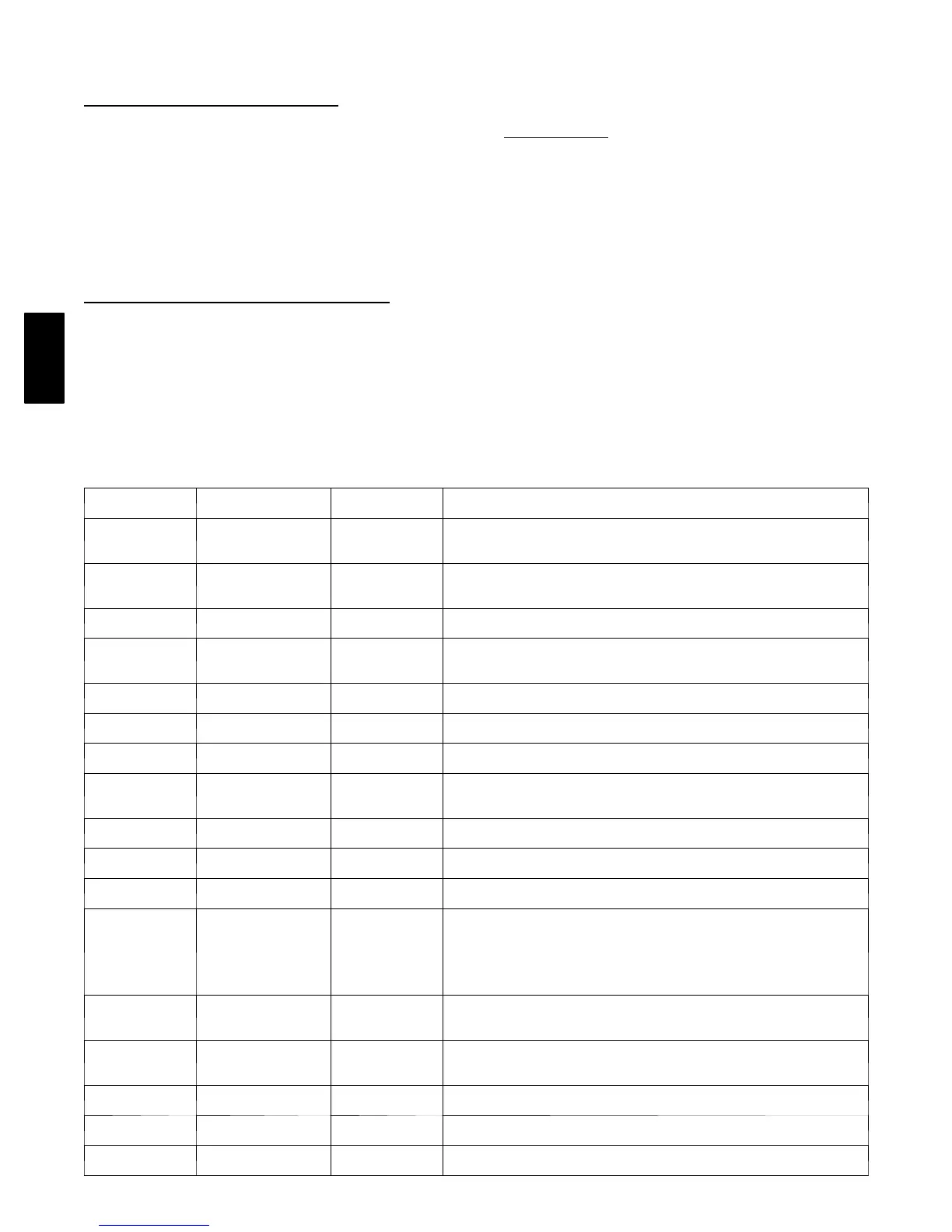
Table 3— Status Codes
OPERATION FAUL T
AMBER LED
FLASH CODE
Possible Cause and Action
Standby – no
call for unit
operation
None On solid, no flash Normal operation --- 3 thermostat wires or 4 wire Evolution Control
Standby – no
call for unit
operation
None Off
Normal operation --- No call for cooling with 2--- wire connection or indoor
unit not powered.
Cooling
Operation
None
1, pause
Normal operation
System
Communications
Failure
16 Communication with user interface lost. Check wiring to UI, indoor and
outdoor units
High Pressure Switch
Open
31
High pressure switch trip. Check refrigerant charge, outdoor fan opera-
tion and coils for airflow restrictions.
Low Pressure Switch
Open
32
Low pressure switch trip. Check refrigerant charge a nd indoor air flow
Control Fault 45
Outdoor unit control board has failed. Control board needs to be re-
placed.
Brown Out
(24 v)
46
The control voltage is less than 15.5v for at least 4 seconds. Compressor
and fan operation not allowed until control voltage is a minimum of 17.5v.
Verify control voltage.
Outdoor Air Temp
Sensor Fault
53 Outdoor air sensor not reading or out of range. Ohm out sensor and
check wiring
Outdoor Coil Sensor
Fault
55
Coil sensor not reading or out of range. Ohm out sensor and check wiring
Thermistors out of
range
56 Improper relationship between coil sensor and outdoor air sensor. Ohm
out sensors and check wiring.
Thermal Cutout 72
Compressor voltage sensed after start---up, then absent for 10 consecu-
tive seconds while cooling demand exists. Possible causes are internal
compressor overload trip or loss of high voltage to compressor without
loss of control voltage. The control will continue fan operation and wait
15 minutes to attempt a restart. Fault will clear when restart is successful,
or low voltage power is cycled.
Contactor Shorted
73 Compressor voltage sensed when no demand for compressor operation
exists. Contactor may be stuck closed or there is a wiring error.
No 230V at Compres-
sor
74
Compressor voltage not sensed when compressor should be starting.
Disconnect may be open or contactor may be stuck open or there is a
wiring error.
Thermal Lockout
82 Thermal cutout occurs in three consecutive cycles. Unit operation locked
out for 4 hours or until 24v power recycled.
Low Pressure Lockout 83
Low pressure switch trip has occurred during 5 consecutive cycles. Unit
operation locked out for 4 hours or until 24v power recycled.
High Pressure Lock-
out
84
High pressure switch trip has occurred during 5 consecutive cycles. Unit
operation locked out for 4 hours or until 24v power recycled.
163A / 165A




 To Next Page