General guide to equalising
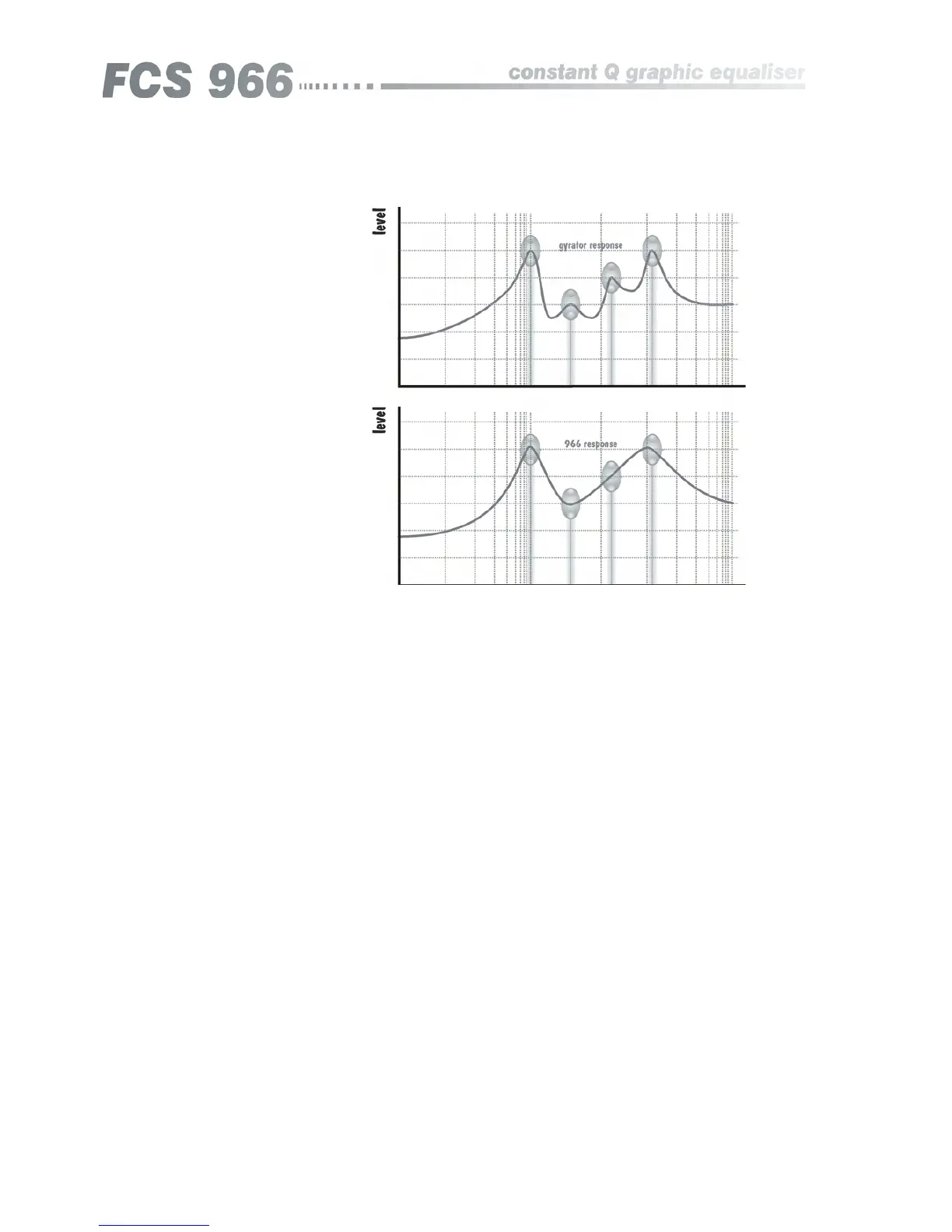
Fig 7.4 constant Q response
Fig 7.3 gyrator type
response
In line with it’s other graphic equalizers, BSS have chosen a ‘constant Q’
topology for the FCS 966, as this gives the best correlation between the actual
slider positions and the measured response of the unit. Figure 7.4 shows how
the response of the FCS 966 follows much more closely the curve depicted by
the sliders than a gyrator based graphic (figure 7.3). Note that the illustration is
a guide only.
With the increasing use of acoustic analysis equipment for setting up sound
systems, it is important that the graphic equalizer is as ‘what you see is what
you get’ as possible. With other equalizer topologies, moving one slider can
have a surprising effect on frequencies that are far from those being adjusted.
This is also why some non constant Q equalizers can sound ‘phasey’ when
they are being adjusted.


 To Next Page