4 Description of function
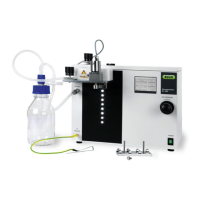
This chapter explains the basic working principle of the Encapsulator B-390. It also shows how the
instrument is structured and provides a general functional description of its assembly.
4.1 Functional principle
The instrument provides the following key functions:
Reproducible bead size from one production to the next
– Adjustable parameters (nozzle size, liquid flow rate and vibration frequency) determine bead
size.
Reproducible bead formation
– In the range of 0.15 mm to 2.0 mm.
High bead size uniformity
– Due to the integrated Electrostatic Dispersion Unit (EDU); approximately 5 % relative standard
deviation of bead size using pure alginate.
Immediate process control
– Visual monitoring in the light of a stroboscope lamp.
High cell viability
– Bead formation technique is at low shear stress and under physiological conditions, thus
resulting in high cell survival.
Batch size
– T
he batch size is of 5 mL to 1’000 mL and the dead volume is approximately 2 mL.
Set of 8 single nozzles
– The 8 nozzle sizes of 0.08, 0.12, 0.15, 0.20, 0.30, 0.45, 0.75 and 1.0 mm cover the bead size
range of approximately 0.15 mm to 2.0 mm.
Delivery of the polymer mixture
– By air pressure with flow rates from 70 mL/h (0.08 mm nozzle) to 2’500 mL/h (1.0 mm nozzle).
High bead production
– Up to 6000 beads are produced per second depending on encapsulation conditions and
polymer mixture.



 To Next Page