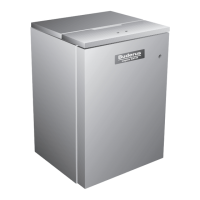
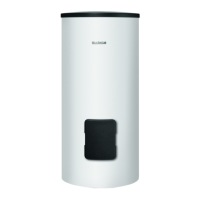
The Buderus SU500-1000.5, SM500-1000.5E, and SMH400-500.5E series are enamelled domestic hot water (DHW) cylinders designed for heating and storing potable water. These cylinders are intended for use in closed systems and must adhere to country-specific regulations, guidelines, and standards for potable water. The SM500-1000.5E and SMH400-500.5E models can also be heated via a solar circuit using a heat transfer medium and can be operated with an optional immersion heater. Any use outside of these specified purposes is considered incorrect and voids the warranty.
Function Description:
The DHW cylinders are designed to efficiently heat and store potable water. Models with two heat exchangers (SM500-1000.5E, SMH400-500.5E) feature an upper heat exchanger for connection to a primary heat source (e.g., boiler or heat pump) and a lower heat exchanger for connection to a solar system. The single heat exchanger models (SU500-1000.5) connect to a single heat source. An immersion heater accessory can be installed for additional heating.
Important Technical Specifications:
The cylinders come in various capacities and energy efficiency classes.
- Available Capacity (Total): Ranging from 378 liters (SMH400.5E-B/C) to 987 liters (SU1000.5-C/E, SM1000.5E-C/E).
- Usable DHW Volume (at 45°C outlet, 10°C cold water inlet): Varies from 257 liters (SMH400.5E-B/C) to 1410 liters (SU1000.5-C/E).
- Maximum DHW Temperature: 95 °C for all models.
- Maximum Operating Pressure (Potable Water Side): 10 bar for all models.
- Maximum Design Pressure (Cold Water): 7.8 bar for all models.
- Maximum DHW Test Pressure: 10 bar for all models.
- Heat Exchanger (for heat source):
- Performance Factor NL: Ranges from 4.5 (SMH400.5E-B/C) to 30.4 (SU1000.5-C/E).
- Continuous Output (at 80°C flow, 45°C DHW outlet, 10°C cold water): Ranges from 38.3 kW (16 l/min) to 111.8 kW (46 l/min).
- Maximum Heating Water Temperature: 160 °C for all models.
- Maximum Heating Water Operating Pressure: 16 bar for all models.
- Heat Exchanger (for solar thermal heating, where applicable):
- Maximum Heating Water Temperature: 160 °C.
- Maximum Heating Water Operating Pressure: 16 bar.
- Heat Retention Loss (S): Varies from 74 W (SMH400.5E-B) to 210 W (SM1000.5E-E).
- Energy Efficiency Class for DHW Treatment: Ranging from B to E, depending on the model.
Usage Features:
The cylinders are designed for straightforward installation and operation. They require a stable, level surface with sufficient load-bearing capacity and should be placed in dry, frost-protected indoor areas. Minimum room heights and wall clearances must be observed. For models with separate thermal insulation, the insulation is fitted around the tank and secured with a zipper. For models with PU rigid foam halves, these are fitted around the tank.
Hydraulic connection requires heat-resistant materials (up to 160 °C) and metal threaded fittings for plastic pipes in potable water heating systems. Open expansion vessels are not permitted. A pressure relief valve (DN20) approved for potable water must be installed in the cold water pipe, with its discharge pipe freely visible and protected from frost. If static pressure exceeds 80% of the relief valve's activation pressure, a pressure reducer should be installed upstream. A DHW temperature sensor is fitted to measure and monitor the water temperature. During filling, the highest positioned tap should be opened.
Maintenance Features:
Regular inspection and maintenance are crucial for ensuring proper and safe operation.
- Inspections: DHW cylinders should be inspected every 2 months, checking the set temperature against the actual heated water temperature.
- Annual Maintenance: Includes functional checks of the pressure relief valve, leak tests of all connections, cleaning of the cylinder, and checking the magnesium anode.
- Service Intervals: Maintenance frequency depends on flow rate, operating temperature, and water hardness. Intervals range from 6 to 24 months, with shorter intervals recommended for chlorinated potable water or softened water.
- Pressure Relief Valve: Must be checked annually.
- Descaling/Cleaning: The cylinder should be disconnected from the potable water mains, drained, and the inspection port opened. The interior should be checked for contamination (limescale deposits). For hard water or severe contamination, chemical descaling (e.g., with citric acid-based descaling agent) is recommended, followed by flushing with a water jet and removing residues with a wet/dry vacuum.
- Magnesium Anode: This is a sacrificial anode that consumes over time. Its protection current should be measured annually with an anode tester. If the anode current is below 0.3 mA or its diameter is less than 15 mm, the magnesium anode must be replaced. Proper maintenance of the anode is essential to maintain the cylinder's warranty.
- Shutdown: For decommissioning, the immersion heater (if installed) should be disconnected from the power supply, the temperature controller switched off, and the cylinder drained. All heating system components should be shut down according to manufacturer instructions. To prevent corrosion, the inspection port cover should be left open to allow the interior to dry thoroughly.

 Need help?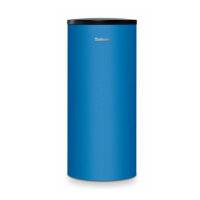


 To Next Page
 General