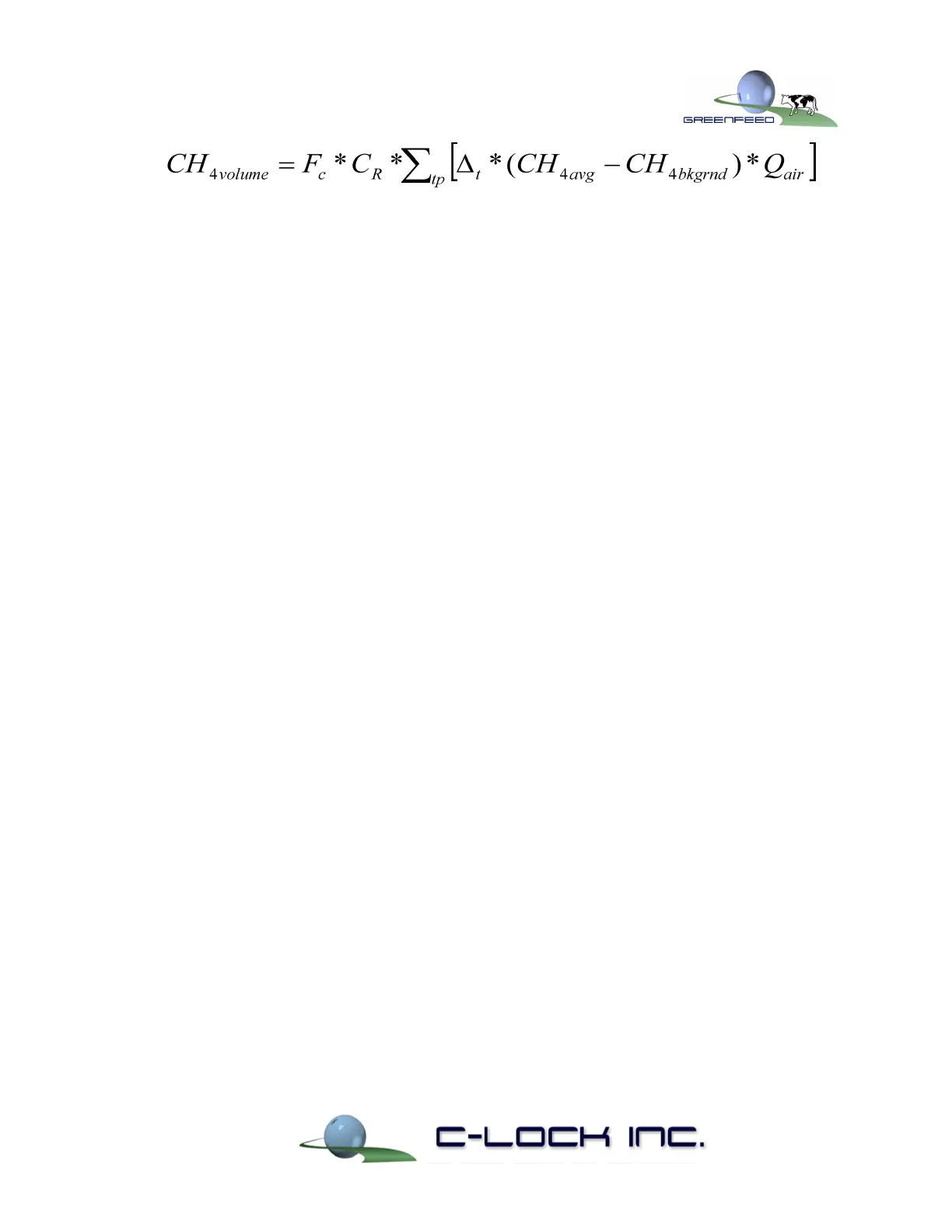
Where:
C
R
= Capture rate of emissions into collection pipe, determined using the tracer (%)
Δt = Time period over which emissions are measured (1 second)
CH
4avg
= Average concentrations during the measurement period (%)
CH
4bkgrnd
= Background concentrations of CH
4
(%)
Q
air
= Airflow rate during the measurement period (flow per unit time)
F
c
= Dimensional factor
Once the volume of CH
4
is calculated, the number of CH
4
molecules per unit time can be
calculated using the ideal gas law. Then, the mass of CH
4
emitted per unit time can be
calculated by multiplying by the molecular weight of CH
4
.
With ever-changing wind currents and movement of the animal’s head, it is important to
collect additional data to characterize the “catch” rate of the animal’s breath that is pulled
into the feeder. To do this, multiple techniques have been implemented to help understand
the catch rates and mixing conditions inside the feeder, these techniques include:
- Incorporating a “head” position sensor inside the unit.
- Monitoring the wind speed and direction to ensure 100% capture of emissions
- Including wind-shielding “wings” on the GreenFeed that block wind currents
The aerodynamics of the feeder have also been designed to capture as much of the emitted
gas from the animal as possible under a wide range of environmental conditions. C-Lock has
found that even in 55 km/hour head-on winds, it is possible to capture approximately 70%
of the animal’s breath into the sample pipe.
Figure 1 includes a typical 20-minute snap shot of “Head/Nose Position”, “CH
4
”, and “CO
2
”
concentrations from a GreenFeed stand-alone feeder. This data represents a series of
different animals. In the data, it is possible to see each eructation event (typically every
30-45 seconds), the metabolic CO
2
rates, and CO
2
spike that is emitted with each associated
eructation.


 To Next Page