EasyManua.ls Logo

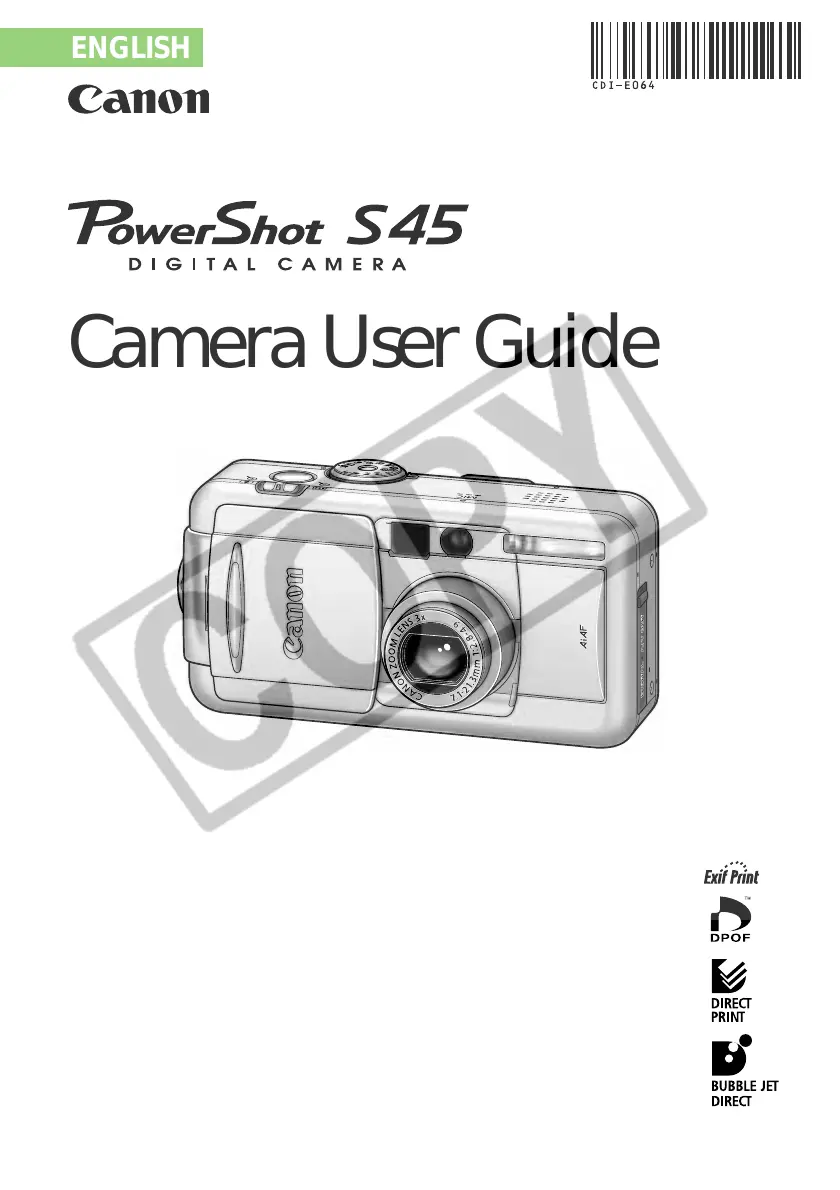
Canon PowerShot S45 - User Manual

Canon PowerShot S45
188 pages
Print Icon
To Next Page IconTo Next Page
Loading...
Camera User Guide
ENGLISH
Please start by reading the Precautions on page 4 of this manual.
Please refer to the Software Starter Guide for information on installing the
software and downloading images.
Please also read the printer user guide included with your Canon printer.

Table of Contents

Other manuals for Canon PowerShot S45

Questions and Answers

  • L
    lee18Aug 17, 2025
    Why won't my Canon PowerShot S45 turn on?
    • S
      sarah74Aug 17, 2025
      Your Canon Digital Camera might not be turning on due to several reasons: the power isn't turned on, so ensure the camera is switched on. The CF card slot or battery cover might be open, so check that they are securely closed. The battery voltage could be insufficient, so fully charge the battery or use a household power source. There might be poor contact between the camera and battery terminals, so wipe the terminals with a clean, dry cloth.
  • K
    kevinshermanAug 20, 2025
    What to do if my Canon PowerShot S45 Digital Camera won't record?
    • A
      arogersAug 20, 2025
      If your Canon Digital Camera won't record, it might be because the camera is in Replay or computer/printer mode, so switch the camera to Shooting mode. The flash might be charging, indicated by a blinking orange light, so wait until the orange indicator stops blinking and lights steadily, then press the shutter button. The CF card could be full, so insert a new CF card, or download the images to a computer and erase them from the CF card to make space. The CF card might not be formatted correctly, so format the CF card; if reformatting doesn't work, the CF card logic circuits may be damaged.
  • E
    Erin KellyAug 22, 2025
    Why won't the battery pack charge on my Canon PowerShot S45 Digital Camera?
    • T
      thomasbrentAug 23, 2025
      The battery pack on your Canon Digital Camera might not charge because the battery life has exceeded its limit, so replace the battery pack with a new one. There could also be poor contact between the battery charger and battery, so clean the battery terminals with a clean dry cloth and ensure the charger plug is firmly inserted into the power outlet.
  • D
    donna11Aug 26, 2025
    Why is my Canon PowerShot S45 Digital Camera image blurred?
    • Z
      zramirezAug 26, 2025
      If your Canon Digital Camera image is blurred, it could be due to: camera movement when pressing the shutter, so be careful not to move the camera and use a tripod at slow shutter speeds if the camera shake warning appears. An obstruction to the AF auxiliary light emitter can hamper the autofocus function, so ensure that your finger or other items aren't blocking it. The AF-assist Beam may be set to off, so set it to [On]. The subject may be out of focal range, so ensure there is at least 50 cm (1.6 ft.) between the camera lens and subject; use macro mode for close-ups between 10 and 50 cm (3.9 in. and 1.6 ft.) at maximum wide angle and 30 and 50 cm (12 in. and 1.6 ft.) at maximum telephoto.
  • V
    Vickie CantrellAug 27, 2025
    How to fix a Canon PowerShot S45 Digital Camera image that is too dark?
    • C
      courtneygonzalesAug 27, 2025
      If a subject in a recorded image from your Canon Digital Camera is too dark, it could be due to insufficient light for shooting, so set the flash to [On]. It may be that the subject is dark compared to the background, so set the exposure compensation to a positive (+) setting. The subject might also be too far for the flash to reach, so shoot within the flash range or raise the ISO sensitivity.
  • J
    James MoodyAug 30, 2025
    How to fix a Canon Digital Camera image that is too bright?
    • M
      Mark MurrayAug 30, 2025
      If the subject in your recorded Canon Digital Camera image is too bright, it could be because the subject is too close, so adjust the flash output with the flash exposure compensation function. The subject may be bright in comparison to the background, so set the exposure compensation to a negative (-) setting. There might be light shining directly on the subject or reflected off the subject into the camera, so change the shooting angle. The flash may be set to On, so set the flash to Auto or Off.
  • M
    Michaela LongSep 2, 2025
    Why isn't the flash firing on my Canon PowerShot S45 Digital Camera?
    • C
      Cynthia RobertsSep 2, 2025
      The flash on your Canon Digital Camera might not be firing because it is set to Off. To resolve this, set the flash to Auto or On.
  • M
    michael38Sep 4, 2025
    Why is my Canon PowerShot S45 image not showing on TV?
    • R
      rsantosSep 4, 2025
      Your Canon Digital Camera image might not be showing on the TV due to an incorrect video system setting, so set the video system to the appropriate setting, NTSC or PAL, for your TV. It could also be because the shooting mode is set to (Stitch Assist), so shoot in a different mode.
  • N
    Nicole MorganSep 6, 2025
    Why won't the lens retract on my Canon PowerShot S45 Digital Camera?
    • D
      David ParkSep 7, 2025
      The lens on your Canon Digital Camera might not retract if the CF card slot or battery cover was opened with the camera on, so close the CF card slot/battery cover, then turn off the camera. It could also be that the CF card slot/battery cover was opened while the camera was recording to the CF card, so close the CF card slot/battery cover, then close the lens cover. If you switched to Replaying mode from Shooting mode, the lens does not retract in this case; to make the lens retract, close the lens cover.
  • P
    pwilliamsSep 9, 2025
    Why does the battery pack on my Canon PowerShot S45 drain so quickly?
    • R
      rileyjosephSep 9, 2025
      The battery pack on your Canon Digital Camera might be consumed quickly because its capacity has reduced due to disuse for one year or more after being fully charged; in this case, replace the battery pack with a new one. It could also be that the battery life has exceeded its limit, so replace the battery pack with a new one.

Summary

Precautions

Camera Body Temperature

About the LCD Monitor

Video Format

Language Setting

Charging the Date;Time Battery

Disclaimer

Trademark Acknowledgements

About this Camera User Guide

Symbols Used

Read This First

Test Shots

Recommends trial shots to confirm camera operation and avoid potential damages.

Warning Against Copyright Infringement

Warns against using the camera in ways that infringe copyright laws and regulations.

Warranty Limitations

States that the camera's warranty is effective only in the country of sale.

Safety Precautions

Instructs to read and understand safety precautions for correct and safe camera operation.

Cautions

Preventing Malfunctions

Avoid Strong Magnetic Fields

Advises keeping the camera away from strong electromagnetic fields to prevent malfunctions.

Avoid Condensation Related Problems

Explains how to prevent condensation by gradual temperature adjustment.

If Condensation Forms Inside the Camera

Instructs to stop using the camera if condensation is detected to prevent damage.

Quick Start

Components Guide

Front View

Identifies and describes the external parts and terminals of the camera's front.

Components Guide

Back; Bottom View

Identifies and describes the external parts and terminals of the camera's back and bottom.

Controls

Upper Indicator

Explains the meaning of the camera's upper indicator lights and their states.

Lower Indicator

Explains the meaning of the camera's lower indicator lights and their states.

Shooting Mode Dial

Preparing the Camera

Charging the Battery Pack

Guides on how to charge the camera's battery pack using the supplied charger.

Preparing the Camera

Installing the Battery Pack

Details the procedure for installing the battery pack into the camera.

Preparing the Camera

Installing a CF Card

Provides instructions on how to insert the CF card into the camera.

Preparing the Camera

Setting the Date; Time

Guides on setting the camera's date and time.

Preparing the Camera

Setting the Language

Explains how to change the camera's menu language.

Basic Functions

Turning the Power On; Off

Explains how to turn the camera's power on and off in different modes.

Basic Functions

Switching between Shooting and Replaying

Describes how to quickly switch between shooting and replaying modes.

Basic Functions

Using the LCD Monitor

Explains how to use the LCD monitor for shooting, replaying, and menu adjustments.

Basic Functions

Information Displayed on the LCD Monitor

Details the various information displayed on the LCD monitor during shooting and replaying.

Selecting Menus and Settings

Menu Settings and Factory Defaults

Provides a chart of menu items and their default settings.

Menu Items Selectable with the Button

Lists menu items accessible via the FUNC. button.

Customizing the Camera (My Camera Settings)

Changing My Camera Settings

Guides on customizing startup images, sounds, and other camera preferences.

Customizing the Camera (My Camera Settings)

Registering My Camera Settings

Describes how to save custom images and sounds to the camera's settings.

Shooting - Letting the Camera Select Settings

AUTO Auto Mode

Explains how to use the Auto mode for automatic camera settings and shooting.

Shooting - Letting the Camera Select Settings

Reviewing an Image Right after Shooting

Describes how to view images immediately after taking them for longer durations.

Shooting - Letting the Camera Select Settings

Changing the Resolution and Compression

Guides on adjusting image resolution and compression settings for desired output.

Shooting - Letting the Camera Select Settings

Changing the File Format

Explains how to switch between JPEG and RAW file formats for image recording.

Shooting - Letting the Camera Select Settings

Using the Flash

Details various flash modes and their usage, including red-eye reduction.

Shooting - Letting the Camera Select Settings

Portrait Mode

Explains how to use Portrait mode for sharp subjects and blurred backgrounds.

Landscape Mode

Describes using Landscape mode for expansive scenic shots.

Shooting - Letting the Camera Select Settings

Night Scene Mode

Guides on using Night Scene mode for low-light shooting with flash and slow shutter.

Fast Shutter

Explains how to use Fast Shutter mode for capturing fast-moving objects.

Shooting - Letting the Camera Select Settings

Slow Shutter

Details using Slow Shutter mode to create motion blur effects, like on rivers.

Shooting - Letting the Camera Select Settings

Stitch Assist Mode

Explains how to shoot multiple frames for creating panoramic images with software.

Shooting - Letting the Camera Select Settings

Movie Mode

Guides on shooting video clips with the camera, including resolution settings.

Shooting - Letting the Camera Select Settings

Macro Mode

Explains how to use Macro mode for close-up photography.

Shooting - Letting the Camera Select Settings

Self-Timer

Details how to use the self-timer for delayed shots.

Shooting - Letting the Camera Select Settings

Digital Zoom

Explains the use and limitations of the camera's digital zoom function.

Shooting - Letting the Camera Select Settings

Continuous Shooting

Describes modes for shooting a sequence of frames with a single press.

Shooting - Selecting Particular Effects

Program AE

Explains how to use Program AE mode for automatic shutter speed and aperture.

Shooting - Selecting Particular Effects

Tv Setting the Shutter Speed

Guides on setting shutter speed in Shutter-Priority AE mode for motion control.

Shooting - Selecting Particular Effects

Av Setting the Aperture

Explains how to set aperture in Aperture-Priority AE mode for depth of field control.

Shooting - Selecting Particular Effects

M Manually Setting the Shutter Speed and Aperture

Details how to manually control shutter speed and aperture for creative effects.

Shooting - Selecting Particular Effects

Selecting an AF Frame

Explains how to choose the autofocus area for precise focusing.

Shooting - Selecting Particular Effects

Switching between Light Metering Modes

Describes how to change light metering modes for optimal exposure in different scenes.

Shooting - Selecting Particular Effects

Adjusting the Exposure

Guides on using exposure compensation to correct brightness in backlit or high-contrast scenes.

Shooting - Selecting Particular Effects

WB Setting the White Balance

Explains how to adjust white balance to match light sources for accurate colors.

Shooting - Selecting Particular Effects

Setting a Custom White Balance

Details how to set a custom white balance based on a reference subject.

Shooting - Selecting Particular Effects

Changing the Photo Effect

Explains how to apply various photo effects like Vivid, Sepia, or custom adjustments.

Shooting - Selecting Particular Effects

ISO Changing the ISO Speed

Guides on adjusting ISO sensitivity for shooting in dark places or with faster shutter speeds.

Shooting - Selecting Particular Effects

Auto Exposure Bracketing (AEB Mode)

Explains AEB mode for taking multiple shots with varied exposures automatically.

Shooting - Selecting Particular Effects

Focus Bracketing (Focus-BKT Mode)

Details Focus Bracketing for shooting images with automatic focus changes.

Shooting - Selecting Particular Effects

Locking the Exposure Setting (AE Lock)

Describes how to lock exposure and focus settings independently, useful for backlit subjects.

Shooting - Selecting Particular Effects

Locking the Flash Exposure Setting (FE Lock)

Explains FE lock for obtaining correct flash exposure regardless of subject position.

Shooting - Selecting Particular Effects

Switching between the Built-in Flash Adjustment Settings

Covers adjusting flash output and synchronization timing.

Shooting - Selecting Particular Effects

Switching the Timing at which the Flash Fires

Explains the difference between 1st-curtain and 2nd-curtain flash synchronization.

Shooting - Selecting Particular Effects

Shooting Images at Set Intervals (Intervalometer)

Details how to set intervals for automatic shooting, useful for time-lapse photography.

Shooting - Selecting Particular Effects

Shooting Problem Subjects for the Autofocus

Provides tips for focusing on difficult subjects, including focus lock methods.

Shooting - Selecting Particular Effects

C Saving Custom Settings

Explains how to save frequently used settings to the custom mode dial.

Shooting - Selecting Particular Effects

Setting the Auto Rotate Function

Describes the function that automatically rotates images based on camera orientation.

Shooting - Selecting Particular Effects

Resetting the File Numbers

Explains how to manage file numbering and folder organization.

Replaying

Displaying Images Individually

Details how to view recorded images one by one on the LCD monitor.

Replaying

Magnifying Images

Explains how to zoom in on images to check details.

Replaying

Viewing Images in Sets of Nine (Index Replay)

Describes how to view multiple images simultaneously in an index display.

Replaying

JUMP Jumping Between Images

Explains how to quickly jump through images in replay mode.

Replaying

Viewing Movies

Guides on how to play back recorded movie clips.

Replaying

Editing Movies

Details how to delete unwanted parts from movie clips.

Replaying

Rotating Images in the Display

Explains how to rotate images 90 or 270 degrees on the LCD monitor.

Replaying

Attaching Sound Annotations to Images

Describes how to add voice annotations to still images.

Replaying

Automated Playback (Slide Show)

Guides on setting up and viewing automatic slide shows of images.

Replaying

Selecting Images for Slide Shows

Explains how to choose specific images for inclusion in slide shows.

Replaying

Protecting Images

Guides on how to protect important images from accidental erasure.

Erasing

Erasing Images Individually

Details the process of deleting single images from the CF card.

Erasing

Erasing All Images

Explains how to erase all images from the CF card, excluding protected ones.

Erasing

Formatting a CF Card

Guides on formatting the CF card to erase all data and prepare it for use.

Printing

About Printing

Introduces direct printing via compatible printers or photo labs using DPOF.

Printing

Print Settings for Direct Print Function

Explains how to set print options like copies, style, and trimming for direct printing.

DPOF Print Settings

Guides on selecting images and setting print preferences for photo labs.

Transfer Settings

Explains how to mark images for transfer, possibly via e-mail.

Printing

Selecting from the Print Order Menu

Shows how to navigate the print order menu for setting print options.

Printing

Connecting the Camera to a Printer

Details how to connect the camera to direct print function compatible printers.

Printing

Printing with DPOF Print Settings

Explains how to use DPOF settings for printing via compatible printers or photo labs.

Printing

Setting the Print Settings (Direct Print Function)

Guides on setting print options like copies, style, and trimming for direct printing.

Printing

Setting the Printing Area (Trimming)

Explains how to specify the portion of an image to be printed.

Printing

Print Settings (DPOF Print Settings)

Guides on selecting images and setting print preferences for photo labs.

Printing

Setting the Print Style

Explains how to select print styles like Standard, Index, Borderless, and Date.

Printing

Setting the Print Settings (Direct Print Function) (continued)

Continues setting print options, including trimming the image and rotating the frame.

Printing

Print Settings (DPOF Print Settings) (continued)

Continues DPOF settings, including date, file number, and restarting printing.

Printing

Image Transfer Settings (DPOF Transfer Order)

Explains how to mark images for transfer, possibly via e-mail.

Printing

Viewing Images on a TV Set

Guides on connecting the camera to a TV to view images.

Downloading Images to a Computer

Downloading Directly from a CF Card

Explains how to transfer images by removing the CF card and using a reader.

Downloading Images to a Computer

Connecting the Camera to a Computer Via the USB Cable

Details connecting the camera to a computer using a USB cable.

Downloading Images to a Computer

Setting the Communication Mode

Explains how to set communication modes (Normal, PTP) for image transfer.

List of Menu Options and Messages

Rec. Menu

Lists and describes options available in the Record menu.

List of Menu Options and Messages

Replay Menu

Lists and describes options available in the Replay menu.

List of Menu Options and Messages

Set up Menu

Lists and describes options available in the Setup menu.

List of Menu Options and Messages

My Camera Menu

Lists and describes options for customizing camera sounds and images.

List of Menu Options and Messages

Resetting the Settings to Default

Guides on how to restore camera settings to their factory defaults.

List of Menu Options and Messages

List of Messages

Lists common messages that may appear on the camera's LCD monitor.

Appendices

Using an AC Adapter Kit (Optional)

Explains how to use the optional AC adapter kit for continuous power.

Appendices

Using a Car Battery Charger (Optional)

Guides on charging the camera battery using a car's cigarette lighter socket.

Appendices

Using the Waterproof Case (Optional)

Describes how camera operations differ when using the optional waterproof case.

Appendices

Camera Care and Maintenance

Provides instructions on cleaning and maintaining the camera body, lens, and monitor.

Appendices

Troubleshooting

Lists common problems and their solutions for camera operation.

Specifications

Specifications

CF Cards and Estimated Capacities (Recordable Images)

Provides estimated image capacities for different CF card sizes and resolutions.

Specifications

Battery Performance (Battery Pack NB-2 L at full charge)

Details battery life estimates under various shooting and replaying conditions.

Index

Index

Index

FCC Notice

Functions Available in Each Shooting Mode

Functions Available in Each Shooting Mode

Canon PowerShot S45 Specifications

General IconGeneral
Digital SLRNo
Dimensions (WxDxH)112 x 42 x 58 mm
Digital zoom3.6 x
Optical zoom3 x
Focal length range7.1 - 21.3 mm
Megapixel4 MP
Operating relative humidity (H-H)10 - 90 %
Weight and Dimensions IconWeight and Dimensions
Weight260 g

Related product manuals