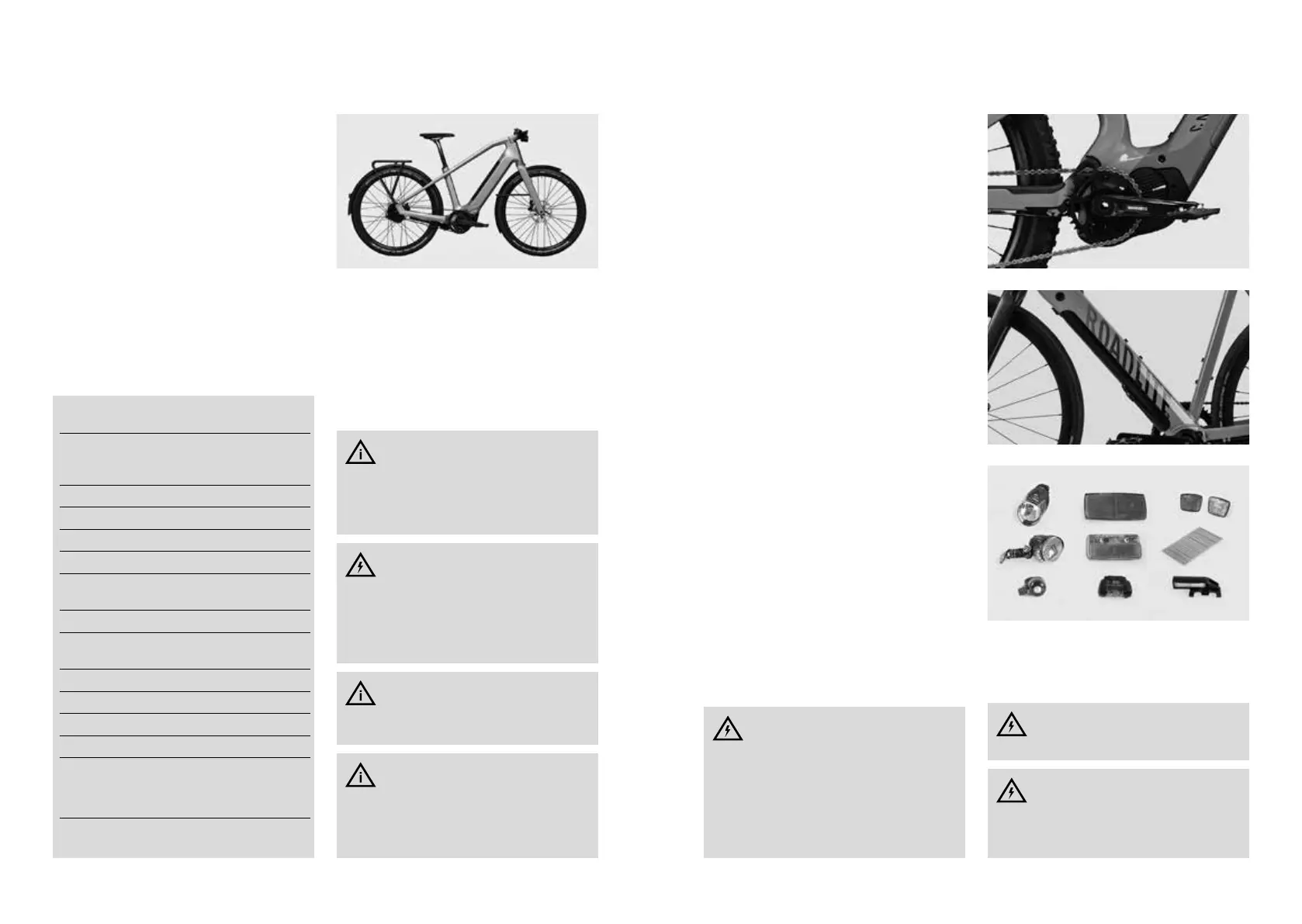
8 9BEFORE YOUR FIRST RIDE
Do not hang any bags, umbrellas or oth-
er heavy or big objects to the handlebar
of your pedelec. Risk of a fall!
The weight distribution on pedelecs dif-
fers markedly from the weight distribu-
tion on bicycles without drive assistance. A
pedelec is clearly heavier than a bicycle with-
out drive assistance. For this reason parking,
pushing, liing and carrying the pedelec is
more dicult. Bear this in mind when loading
your pedelec into a car and unloading it or
when mounting it on a bicycle carrier system.
Do not wear long skirts or ponchos and
do not hang long strings, bands or the
like to your pedelec during the ride. There is
the risk of getting caught in the wheels or in
the drive system. Risk of a fall!
BEFORE YOUR FIRST
RIDE
1. Have you ever ridden a pedelec? Note the par-
ticular riding characteristics of this revolution-
ary hybrid drive concept. Set o for your rst
ride by selecting the lowest level of drive as-
sistance! Make yourself carefully familiar with
the potential of your pedelec in an area free of
trac and try out the terrain you want to ride
on. Attend a riding technique course. For more
information visit www.canyon.com
More information in this regard is given in the
chapter “Riding the pedelec”.
2. Our pedelecs are usually designed for a spe-
cic
maximum permitted overall weight
.
The
permitted overall weight is specied in the CE
marking on your bike.
Make sure not to exceed
this limit.
For more information on the intended use read
the chapter “Intended use” or contact our ser-
vice hotline.
3. If you want to use your bicycle on public roads,
it has to comply with the respective legal re-
quirements. These requirements may vary in
each country. The ttings of your pedelec are,
therefore, not necessarily complete. Inform
yourself about the laws and regulations ap-
plicable in your country or in the country you
intend to use the pedelec. Have your pedelec
equipped accordingly before using it on public
roads.
INTENDED USE
Pedelecs (Pedal Electric Cycles) or EPACs (Elec-
trically Power Assisted Cycles) are bicycles with
an auxiliary motor that only switches on when
the pedals are moved by the rider. When you stop
pedalling, the motor switches o.
The pushing aid provides assistance when pushing
the pedelec or when doing a hill start, even with-
out pedalling, up to a speed of 6kmh (3.7mph).
The amount of the assistance and the speed de-
pend on the gear.
More details on the legal regulations for riding
a pedelec in the UK concerning driving licence,
registration, type approval, requirement to wear a
helmet, insurance, regulations on the use of cycle
lanes etc. are listed in the table:
Do not modify or manipulate (“tune”)
your pedelec. Risk of accident! Modi-
cations and manipulations will render the war-
ranty void and result in a loss of the private
liability insurance cover. The pedelecs are then
possibly no longer approved for use on public
roads and on forest trails.
The regulations and rules for pedelecs
are being revised constantly. Read the
daily press to keep you informed about current
legislative changes.
We recommend that you take out pri-
vate liability insurance. Make sure that
coverage for damage caused during cycling by
bicycle or pedelec is provided by your insur-
ance. Contact your insurance company or
agency.
For more information on the intended
use of your pedelec and the maximum
permitted overall weight (rider, luggage, bicycle
and trailer including load), read the chapter
“Before your rst ride” and visit our website,
www.canyon.com
Pedelec
(also with pushing aid)
Pedal assistance up
to max. km/h (mph)
25 km/h (15.5 mph) MDS
1
without pedal assistance
6km/h (3.7 mph)
Helmet recommended
Rear mirror no
Horn no
Driving licence no
Registration or EU
type approval
no
Insurance mark no
Cycle lane use
permitted
within city limits: yes
outside city limits: yes
Use of forest trails permitted
Vehicle class bicycle
Legal age 14 years
Child seat not permitted for Canyon
Child trailer not permitted for Canyon
(exception: Croozer trailers
on models Pathlite:ON and
Precede:ON)
1
MDS – maximum design speed
Last update 2020/11



 To Next Page