CAP 413 Radiotelephony Manual
Chapter 10 Page 20
3.27 Radar PFL
Initial Call:
In a real flameout situation, the appropriate emergency message will be passed by
the aircraft and a Radar Forced Landing undertaken. Identification should be as
expeditious as possible, taking into account the limitations of an aircraft suffering this
type of emergency.
Homing:
* Ranges to be passed every 1 NM prior to acceleration, then every ½ NM thereafter.
Joining the Visual Circuit:
3.28 Controlled Descent through Cloud (QGH)
Controlled descent through cloud (QGH) procedures are designed to enable a pilot,
with the assistance of a ground-interpreted DF aid, to descend through cloud to a
position in the vicinity of an airfield from which he can make a visual approach and
landing or be positioned within the operational service coverage of an additional
navigation aid for continued recovery. There are two standard controlled-descent
procedures, one for jet aircraft requiring descent from high levels and the other for
aircraft below FL120.
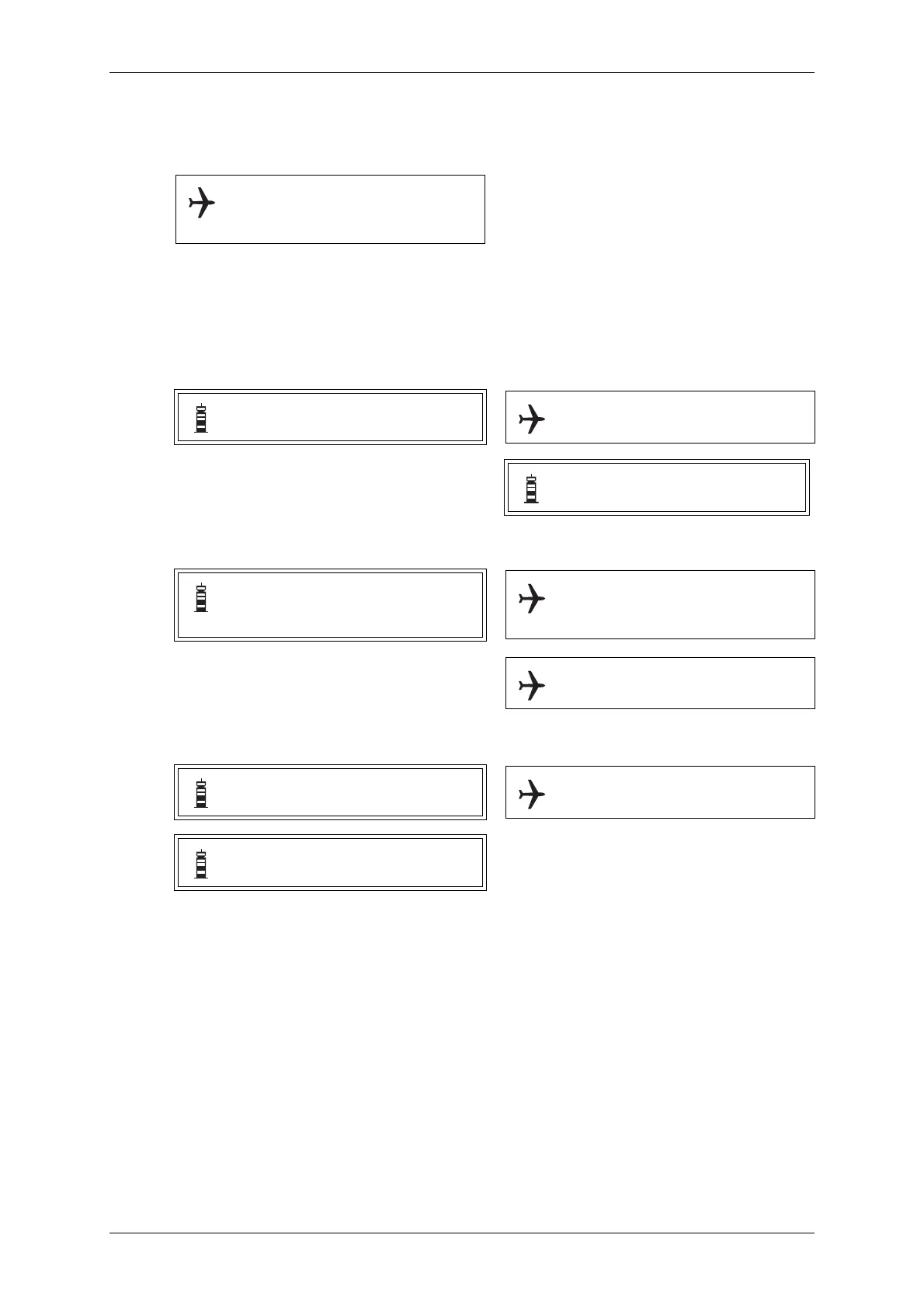
Markston Approach, VYT 21,
(position), FL/Altitude (number),
request Radar PFL
V 21, set heading (number) degrees Heading (number) degrees, V 21
V 21, identified Traffic Service,
report accelerating*
V 21, turn left/right (number)
degrees heading (number) degrees,
range .....
Left/right heading (number) degrees,
V 21
Accelerating, V 21
V 21, report aerodrome in sight Aerodrome in sight, V 21
V 21, continue with Markston
Tower, stud/freq
31 March 2011



 To Next Page