Need help?
Do you have a question about the Caple WC6218 and is the answer not in the manual?
Details of responsibilities Caple is not liable for, including incorrect use or manual errors.
Instructions to prevent child access to discarded appliances, focusing on door and shelf removal.
Ensuring the wine cabinet is perfectly level to minimize vibrations and ensure proper operation.
Crucial waiting period before initial power-on after installation or relocation.
Essential safety advice covering ventilation, placement, electrical connections, and earthing requirements.
Defines the appliance's sole purpose for wine storage and excludes commercial or specific residential environments.
Specifies the optimal ambient temperature range (16-32°C) for efficient cabinet performance.
Explanation of the LCD touch control panel functions, including power, temperature display, and adjustment buttons.
Instructions on how to manually control the internal LED light, including automatic off when the door is closed.
Details on how to turn the wine cabinet on and off using the dedicated button.
Identifies the indicator light that signals an alarm condition within the wine cabinet.
Defines the operational temperature ranges for the upper (5-10°C) and lower (10-18°C) compartments.
Details the default factory-set temperatures for the upper (6°C) and lower (12°C) compartments.
Step-by-step guide on increasing/decreasing temperature settings for both compartments.
How to display the real-time internal temperature of the upper or lower zone.
Explains the meaning of flashing vs. steady text on the display for actual vs. set temperatures.
Information on the required delay before restarting the unit after power loss or shutdown.
Explanation of minor initial temperature fluctuations and their normalization over time.
The cabinet retains previous temperature settings after power interruptions.
An alarm sounds if the door remains open for more than 5 minutes to prevent cold loss.
Alerts for high ('HI') or low ('LO') internal temperatures, indicating potential issues.
Specifies the maximum storage capacity, noting it's for 750ml Bordeaux bottles.
How to set the LED light to remain on continuously or switch off automatically.
Guidelines for safely removing and inserting shelves, including door gasket protection and notch use.
Warning against storing bottles crossways to prevent falling and potential injury or damage.
Step-by-step instructions for reversing the door hinge to change the opening direction.
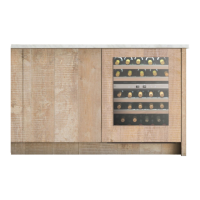
Instructions for integrating the wine cabinet into cabinetry, including alignment and fixing methods.
Detailed steps for cleaning the interior, shelves, control panel, and exterior surfaces.
Advice on managing the appliance during power outages to protect contents.
Guidance for short and long vacations, including cleaning and door positioning.
Steps for safely moving the cabinet, including securing contents and protecting the exterior.
Recommendations for energy efficiency, such as optimal placement away from heat sources.
A guide to common problems and their possible causes, with solutions for operational issues.
Explanation of the auto-cycle defrost system and how defrost water is managed.
How to maintain optimal humidity levels by using a water reservoir.
Recommended temperature range for storing all types of wines.
Specific temperature guidelines for various types of wines for optimal drinking.
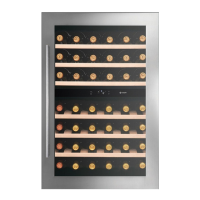
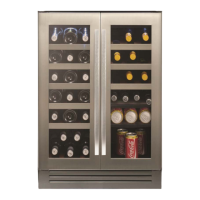
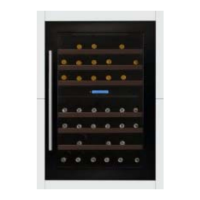
The Caple WC6218 is an in-column wine cabinet designed for the exclusive storage of wine. It is not intended for commercial use or for storing food. This appliance features a dual-zone temperature control system, allowing for different temperature settings in the upper and lower compartments, making it suitable for storing various types of wine at their optimal temperatures.
The primary function of the Caple WC6218 is to provide a stable and controlled environment for wine storage. It maintains specific temperature ranges to preserve the quality and enhance the aging process of wine. The cabinet is equipped with an "Auto-cycle" defrost system, which automatically defrosts the refrigerated surface (interior rear wall) when the RUN cycle is off. The defrost water is then channelled into a drain pan at the back of the wine cellar, near the compressor, where it evaporates. A humidity maintenance system is also integrated; if humidity levels are too low, a small plastic reservoir on the top shelf can be filled with water to increase moisture.
 General
| Brand | Caple |
|---|---|
| Model | WC6218 |
| Category | Wine Cooler |
| Language | English |

 To Next Page