EasyManua.ls Logo

Carrier 48HC - User Manual

Carrier 48HC
12 pages
Print Icon
To Next Page IconTo Next Page
Loading...
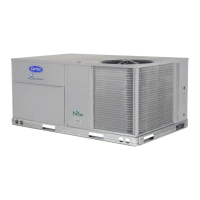
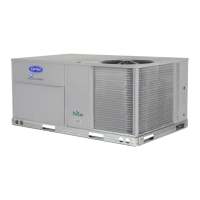
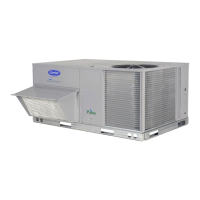
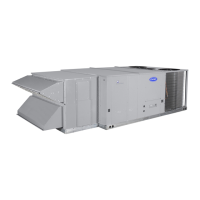
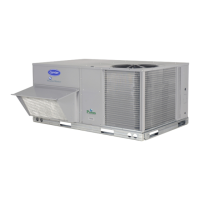
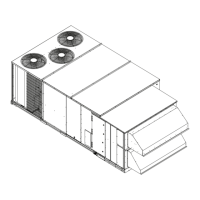
48HC with EnergyX
R
System
Factory Installed Energy Recovery
Single---Package R ooftop Unit ( RTU)
Gas Heating/Elec tric Cooling Units
15 to 25 Nominal Tons
with Puronr (R ---410A) Refrigerant
Use r’s Info rmatio n Manual
NOTE: Read the entire instruction manual before starting
the installation.
ELECTRICAL SHOCK, FIRE OR EXPLOSION
HAZARD
Failure to follow safety warnings exactly could result
in dangerous operation, serious injury, death or
property damage.
Improper servicing could result in dangerous
operation, serious injury, death or property damage.
S Before servicing, disconnect all electrical power to
the unit.
S When servicing controls, label all wires prior to
disconnecting. Reconnect wires correctly.
S Verify proper operation after servicing.
!
WARNING
NOTE TO INSTALLER:
This manual should be left with the equipment owner.
TABLE OF CONTENTS
Page
SAFETY CONSIDERATIONS 1....................
COMFORTLINK CONTROL 3
TO LIGHT UNIT 3..............................
TO SHUT OFF UNIT 4...........................
ROUTINE MAINTENANCE & CARE
FOR THE EQUIPMENT OWNER 6.................
REGULAR DEALER MAINTENANCE 9............
BEFORE YOU CALL FOR SERVICE 10............
SAFETY CONSIDERATIONS
Improper installation, adjustment, alteration, service,
maintenance, or use can cause fire, electrical shock, or
other conditions which may cause personal injury or
property damage. Consult a qualified installer, service
agency or your distributor or branch for information or
assistance. The qualified installer or agency must use
factory--authorized kits or accessories when modifying
this product. Refer to the individual instructions packaged
with the kits or accessories when installing.
Follow all safety codes and wear safety glasses. Have fire
extinguisher available. Read these instructions thoroughly
and follow all warnings or cautions attached to the unit.
Consult local and state building codes and Sheet Metal
and Air Conditioning National Association (SMACNA)
for special installation requirements.
Recognize safety information. This is the safety--alert
symbol
. When you see this symbol on the unit or in
instructions and manuals, be alert to the potential for
personal injury. Understand the signal words DANGER,
WARNING,andCAUTION. These words are used with
the safety--alert symbol. DANGER identifies the most
serious hazards, which will result in severe personal injury
or death. WARNING signifies hazards, which could result
in personal injury or death. CAUTION is used to identify
unsafe practices, which may result in minor personal
injury or product and property damage. NOTE is used to
highlight suggestions which will result in enhanced
installation, reliability, or operation.
Should the gas supply fail to shut off or if overheating
occurs, shut off the gas valve to the furnace (see Figs. 2
and 3) before shutting off the electrical supply.

Other manuals for Carrier 48HC

Question and Answer IconNeed help?

Do you have a question about the Carrier 48HC and is the answer not in the manual?

Summary

Safety Considerations

Electrical, Fire, Explosion, and Operation Hazards

Details electrical shock, fire, explosion, and operation hazards and precautions.

Personal Injury and Cut Hazards

Covers hazards related to personal injury from operation and sharp edges.

Important Facts and Safety Guidelines

Key operational guidelines and safety reminders for users.

ComfortLink Control

To Light Unit

Fire and Explosion Hazard During Ignition

Warns of fire and explosion risks when lighting unit burners.

To Shut Off Unit

Fire and Explosion Hazard During Shutdown

Warns of fire and explosion risks during unit shutdown procedures.

Routine Maintenance & Care for the Equipment Owner

Indoor Air Filter Maintenance

Instructions for checking, cleaning, and replacing indoor air filters.

Unit Component Safety & Operation

Safety warnings and operational checks for unit components and airflow.

Alarm Status and System Alerts

Information on ComfortLink control alarms and Integrated Gas Controller (IGC) codes.

Regular Dealer Maintenance

Heat Exchanger Inspection and Cleaning

Guidance on professional inspection and cleaning of the heat exchanger.

Component Inspections and Checks

Details on inspecting fans, belts, coils, drain lines, and ducts.

Before You Call For Service

Troubleshooting Common Issues

Checks for insufficient heating/cooling and unit non-operation.

In Case of Trouble

Contact information and procedure if performance remains unsatisfactory.

Summary

Safety Considerations

Electrical, Fire, Explosion, and Operation Hazards

Details electrical shock, fire, explosion, and operation hazards and precautions.

Personal Injury and Cut Hazards

Covers hazards related to personal injury from operation and sharp edges.

Important Facts and Safety Guidelines

Key operational guidelines and safety reminders for users.

ComfortLink Control

To Light Unit

Fire and Explosion Hazard During Ignition

Warns of fire and explosion risks when lighting unit burners.

To Shut Off Unit

Fire and Explosion Hazard During Shutdown

Warns of fire and explosion risks during unit shutdown procedures.

Routine Maintenance & Care for the Equipment Owner

Indoor Air Filter Maintenance

Instructions for checking, cleaning, and replacing indoor air filters.

Unit Component Safety & Operation

Safety warnings and operational checks for unit components and airflow.

Alarm Status and System Alerts

Information on ComfortLink control alarms and Integrated Gas Controller (IGC) codes.

Regular Dealer Maintenance

Heat Exchanger Inspection and Cleaning

Guidance on professional inspection and cleaning of the heat exchanger.

Component Inspections and Checks

Details on inspecting fans, belts, coils, drain lines, and ducts.

Before You Call For Service

Troubleshooting Common Issues

Checks for insufficient heating/cooling and unit non-operation.

In Case of Trouble

Contact information and procedure if performance remains unsatisfactory.

Overview

This document is the User's Information Manual for the Carrier 48HC with EnergyX® System, a factory-installed energy recovery single-package rooftop unit (RTU) with gas heating and electric cooling capabilities. These units range from 15 to 25 nominal tons and utilize Puron® (R-410A) refrigerant. The manual emphasizes safety, proper operation, and maintenance procedures for the equipment owner and qualified service technicians.

Function Description

The Carrier 48HC unit is a comprehensive rooftop heating and cooling system designed for commercial applications. It integrates gas heating and electric cooling functions, along with an EnergyX® System for energy recovery, to provide efficient climate control. The unit is equipped with an automatic, direct spark ignitor and an induced-draft combustion blower for reliable heating operation. A key feature is the factory-installed Carrier ComfortLink control, which includes a Scrolling Marquee display located in the unit's control box. This control system allows for monitoring and adjustment of various operational parameters, including temperature, pressures, setpoints, inputs, outputs, configuration, time clock, operating modes, and alarms. The ComfortLink control also incorporates an Alarm Status LED to indicate active alarms or alerts, providing immediate feedback on the unit's condition. Additionally, an Integrated Gas Controller (IGC) board with an LED emits flashing lights to indicate specific alarm codes for the furnace section.

Usage Features

The manual provides detailed instructions for lighting and shutting off the unit, emphasizing safety precautions throughout.

To Light Unit:

  1. Turn off unit demand: Use the Scrolling Marquee display to turn off cooling or heating demand. This involves navigating through the menu using ESCAPE, DOWN arrow, and ENTER keys to reach the "SERVICE TEST" mode and setting the unit to "YES" to lock off heat, cooling, or any operation. A default password "1111" may be required.
  2. Turn off gas supply: Close the external gas supply shut-off valve.
  3. Turn off electrical supply: Switch the RTU main disconnect to OFF and install a lockout tag for personal safety.
  4. Remove gas component access panel: Access the internal gas components.
  5. Move RTU gas valve to OFF: Locate the gas valve on/off switch and move it to the OFF position, waiting 5 minutes.
  6. Move RTU gas valve to ON: After the waiting period, switch the gas valve to the ON position.
  7. Replace gas component access panel: Secure the panel.
  8. Restore electrical power: Remove the lockout tag and switch the RTU main disconnect to ON.
  9. Open gas supply shut-off valve: Open the external gas supply valve.
  10. Enable unit operation: Use the Scrolling Marquee to exit "SERVICE TEST" mode by setting the unit to "NO," returning it to normal operation.
  11. Test gas section: Utilize the Scrolling Marquee test routine to energize gas outputs and turn on the gas section.
  12. Verify set points: Ensure set points are at normal heat settings for proper operation.

To Shut Off Unit:

  1. Turn off unit demand: Similar to lighting, use the Scrolling Marquee display to turn off cooling or heating demand by entering "SERVICE TEST" mode and setting the unit to "YES" to lock off operation.
  2. Turn off gas supply: Close the external gas supply shut-off valve.
  3. Turn off electrical supply: Switch the RTU main disconnect to OFF and install a lockout tag.
  4. Remove gas component access panel: Access the internal gas components.
  5. Move RTU gas valve to OFF: Switch the gas valve on/off switch to the OFF position and wait 5 minutes.
  6. Replace gas component access panel: Secure the panel.
  7. Contact dealer (if malfunction): If shutting down due to a malfunction, contact the dealer immediately.
  8. Restore power (if seasonal shutdown): If shutting down for the season, remove the lockout tag, restore electrical power, and take control out of Service Test mode to ensure cooling system operation for the next season.

The manual strongly advises against manually lighting burners and emphasizes contacting a qualified installer or service agency for any modifications or assistance. It also highlights the importance of following all safety codes, wearing safety glasses, and having a fire extinguisher available.

Maintenance Features

The manual outlines routine maintenance and care procedures for the equipment owner, as well as regular dealer maintenance.

Routine Maintenance & Care for the Equipment Owner:

  • General: While some maintenance can be performed by laymen, most should be handled by skilled personnel. The recommended service maintenance schedule should be modified based on application/environment (e.g., more frequent filter changes in dusty areas). All panels must be securely fastened after any maintenance to prevent rain entry and maintain correct airflow.
  • Compressor: Compressors are factory-supplied with the correct refrigeration-grade oil and generally do not require additional oil.
  • Indoor Air Filter(s): Filters should be checked every 3 or 4 weeks (application dependent) and cleaned or replaced as needed. The manual provides filter access panel locations and a table for replacement filter dimensions and quantities for both the 48HC Base Unit and ERV (Energy Recovery Ventilator) Supply/Exhaust Air Filters. It is crucial to never operate the unit without filters in place to prevent dirt accumulation, which can lead to fire, efficiency loss, and damage to the blower motor and compressors. When replacing filters, use the same size and type as originally supplied. Units with outdoor air capability have cleanable filters that should be checked semi-annually and cleaned with steam or hot water and mild detergent; throwaway filters should not be used.
  • Condenser Fan: Users are warned not to poke objects into revolving fan blades due to personal injury hazard.
  • Electrical Controls and Wiring: Ensure wires do not contact refrigerant tubing or sharp edges. For suspected inadequate cooling, contact a qualified local dealer.
  • Combustion Area and Vent System: Visually inspect before each heating season. This involves:
    • Turning off gas and electrical supply, installing a lockout tag.
    • Removing the gas component access panel.
    • Using a flashlight to inspect burner areas for dirt, soot, or scale. If found, call a service technician and do not operate the heating section.
    • Observing unit heating operation for a bright blue burner flame. If the flame is not bright blue or a malfunction is suspected, shut down the unit and call the dealer.
    • Replacing the gas component access panel.
    • Following start-up procedures to restore operation after inspection.
  • ComfortLink Control Alarm Status: The Scrolling Marquee display's Alarm Status LED indicates active alarms or alerts. These can be viewed via the Scrolling Marquee or other Carrier Comfort Network® (CCN) devices. If the unit won't operate and the Alarm Status LED is on, contact the local dealer.
  • Integrated Gas Controller (IGC): The IGC board's LED flashes codes (1 to 9 flashes) for furnace section alarms. Note the flash code before powering off and contact the dealer.
  • Unit Panels: After any maintenance, ensure all panels are securely fastened to prevent rain entry and maintain correct airflow.

Regular Dealer Maintenance:

  • Heat Exchanger: A qualified maintenance person should check and clean the heat exchanger before each heating season. This involves removing and reinstalling gas controls and the flue collector box cover with "red" RTV for a proper seal.
  • Fans and Belts, and Fan Motor: Quarterly check of fan wheels, housings, belt tension, and fan motor shaft bearings. Lubrication of condenser or evaporator fan bearings or motors is not required.
  • Evaporator and Condenser Coils: Cleaning should be done by qualified service personnel, preferably before cooling operation or more frequently if conditions require.
  • Condensate Drain: The drain pan and condensate drain line should be checked and cleaned when cooling coils are serviced.

Annual Inspection by a Qualified Service Technician (preferably each heating/cooling season):

  • Inspection of all flue product passages (burners, heat exchanger, flue collector box).
  • Inspection of all combustion- and ventilation-air passages and openings.
  • Close inspection of all gas pipes leading to and inside the unit.
  • Inspection and cleaning of condenser and evaporator coils.
  • Inspection and cleaning of the condensate drain pan.
  • Inspection and cleaning of blower wheel housing and motor.
  • Inspection of all supply- and return-air ducts for leaks, obstructions, and insulation integrity.
  • Inspection of the unit base for cracks, gaps, etc.
  • Inspection of the unit casing for signs of deterioration.
  • Inspection of all electrical wiring and components for proper connection.
  • Inspection for leaks in the refrigerant circuit and pressure check for appropriate charge.
  • Inspection of fan wheels, housings, belt tension, and fan motor shaft bearings.
  • Operational check of the unit to determine working conditions, with repairs or adjustments made as needed.

Servicing dealers may offer service contracts for seasonal inspections. The manual also includes a "Before You Call For Service" checklist to help owners troubleshoot common issues before contacting a dealer, and a section to record dealer, telephone, unit model, and serial numbers for quick reference.

Carrier 48HC Specifications

General IconGeneral
RefrigerantR-410A
Net WeightVaries by model
Shipping WeightVaries by model
DimensionsVaries by model
TypeAir Conditioner
Voltage208/230V
Airflow ConfigurationHorizontal
StagesSingle-Stage

Related product manuals