EasyManua.ls Logo

Carrier GA7T - User Manual

Carrier GA7T
8 pages
Print Icon
To Next Page IconTo Next Page
Loading...
Installation Instructions
NOTE: Read the entire instruction manual before starting the installation.
SAFETY CONSIDERATIONS
Improper installation, adjustment, alteration, service, maintenance, or
use can cause explosion, fire, electrical shock, or other conditions which
may cause death, personal injury, or property damage. Consult a
qualified installer, service agency, or your distributor or branch for
information or assistance. The qualified installer or agency must use
factory-authorized kits or accessories when modifying this product.
Refer to the individual instructions packaged with the kits or accessories
when installing.
Follow all safety codes. Wear safety glasses, protective clothing, and
work gloves. Use quenching cloth for brazing operations. Have fire
extinguisher available. Read these instructions thoroughly and follow all
warnings or cautions included in literature and attached to the unit.
Consult local building codes and current editions of the National
Electrical Code (NEC) NFPA 70. In Canada, refer to current editions of
the Canadian Electrical Code CSA 22.1.
Recognize safety information. This is the safety-alert symbol . When
you see this symbol on the unit and in instructions or manuals, be alert to
the potential for personal injury. Understand these signal words;
DANGER, WARNING, and CAUTION. These words are used with the
safety-alert symbol. DANGER identifies the most serious hazards
which will result in severe personal injury or death. WARNING
signifies hazards which could result in personal injury or death.
CAUTION is used to identify unsafe practices which would result in
minor personal injury or product and property damage. NOTE is used to
highlight suggestions which will result in enhanced installation,
reliability, or operation.
Installation Recommendations
NOTE: In some cases noise in the living area has been traced to gas
pulsations from improper installation of equipment.
1. Locate unit away from windows, patios, decks, etc. where unit
operation sound may disturb customer.
2. Ensure that vapor and liquid tube diameters are appropriate for unit
capacity.
3. Run refrigerant tubes as directly as possible by avoiding
unnecessary turns and bends.
4. Leave some slack between structure and unit to absorb vibration.
5. When passing refrigerant tubes through the wall, seal opening with
RTV or other pliable silicon-based caulk. (See Fig. 1.)
6. Avoid direct tubing contact with water pipes, duct work, floor
joists, wall studs, floors, and walls.
7. Do not suspend refrigerant tubing from joists and studs with a rigid
wire or strap which comes in direct contact with tubing.(See Fig. 1.)
8. Ensure that tubing insulation is pliable and completely surrounds
vapor tube.
9. When necessary, use hanger straps which are 1 in. (25.4 mm) wide
and conform to shape of tubing insulation. (See Fig. 1.)
10. Isolate hanger straps from insulation by using metal sleeves bent to
conform to shape of insulation.
A07588
Fig. 1 – Connecting Tubing Installation
The outdoor unit contains system refrigerant charge for operation with
AHRI rated indoor unit when connected by 15 ft. (4.57 m) of
field-supplied or factory accessory tubing. For proper unit operation,
check refrigerant charge using charging information located on control
box cover and/or in the Check Charge section of this instruction.
IMPORTANT: Maximum liquid-line size is 3/8-in. OD for all
residential applications including long line.
IMPORTANT: Always install the factory-supplied liquid-line filter
drier. If replacing the filter drier, refer to Product Data Digest for
appropriate part number. Obtain replacement filter driers from your
distributor or branch.
GA7T
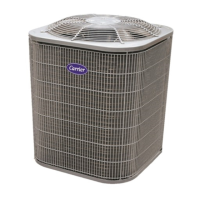
SPLIT-SYSTEM 2-STAGE AIR CONDITIONER
WITH R-410A REFRIGERANT
2 - 5 TONS
WARNING
!
ELECTRICAL SHOCK HAZARD
Failure to follow this warning could result in personal injury or death.
Before installing, modifying, or servicing system, main electrical
disconnect switch must be in the OFF position. There may be more than
1 disconnect switch. Lock out and tag switch with a suitable warning
label.
WARNING
!
EXPLOSION HAZARD
Failure to follow this warning could result in
death, serious personal injury, death, and/or
property damage.
Never use air or any gas containing oxygen for
leak testing or operating refrigerant
compressors. Never allow compressor suction
pressure to operate in a vacuum with service
valves closed. See Service Manual for
pump-down instructions.

ā€œ

Questions and Answers

Summary

Installation Instructions

SAFETY CONSIDERATIONS

Important safety warnings and precautions for installation.

Installation Recommendations

Recommendations for unit placement and tubing installation for optimal operation.

ELECTRICAL SHOCK HAZARD

EXPLOSION HAZARD

CUT HAZARD

Equipment and Job Site Checks

Inspect Equipment

Guidance on inspecting the unit for damage and checking the rating plate.

Installation Requirements

Mounting Pad and Clearances

Requirements for stable mounting, level pad, and proper unit clearances.

Make Piping Connections

Instructions for connecting refrigerant piping.

UNIT DAMAGE HAZARD - Buried Tubing

Brazing Precautions

UNIT DAMAGE HAZARD - Brazing Valves

Caution to protect service valves with heat-sinking material during brazing.

Install Liquid-Line Filter Drier Indoor

Evacuate Refrigerant Tubing and Indoor Coil

Deep Vacuum Method

Detailed method for achieving a deep vacuum in the system.

Make Electrical Connections

Connect Ground and Power Wires

How to connect ground and power wiring to the unit's contactor.

Connect Control Wiring

Guidance on connecting 24-volt control wiring from the thermostat.

ELECTRICAL SHOCK HAZARD - Grounding

Final Wiring Check

Wiring Diagrams

Thermidistat w;Variable Speed Fan Coil

Wiring diagram for Thermidistat with variable speed fan coil.

Thermidistat w;Variable Speed Furnace

Wiring diagram for Thermidistat with variable speed furnace.

Single-Stage Furnace with 2-Stage AC

Wiring diagram for single-stage furnace with 2-stage AC.

Airflow Selections

Airflow Selections (ECM Furnaces)

How to select airflow for ECM furnaces during cooling stages.

Airflow Selection for Variable Speed Furnaces

Adjusting settings for variable speed furnace airflow based on cooling stages.

Start-Up Procedures

UNIT OPERATION AND SAFETY HAZARD

Safety warnings related to system operation and potential hazards.

System Function And Sequence Of Operation

Compressor Operation and Charging

Check Charge

Procedures for checking and adjusting refrigerant charge for optimal performance.

Final Checks

Final checks before leaving the job site for safety and proper operation.

TROUBLESHOOTING

Troubleshooting Stage Switching

Steps to diagnose issues with stage switching based on pressures and current.

Unloader Test Procedure

MAJOR COMPONENTS

2-Stage Compressor

Description of the 2-stage compressor's features and operation.

CARE AND MAINTENANCE

Summary

Installation Instructions

SAFETY CONSIDERATIONS

Important safety warnings and precautions for installation.

Installation Recommendations

Recommendations for unit placement and tubing installation for optimal operation.

ELECTRICAL SHOCK HAZARD

EXPLOSION HAZARD

CUT HAZARD

Equipment and Job Site Checks

Inspect Equipment

Guidance on inspecting the unit for damage and checking the rating plate.

Installation Requirements

Mounting Pad and Clearances

Requirements for stable mounting, level pad, and proper unit clearances.

Make Piping Connections

Instructions for connecting refrigerant piping.

UNIT DAMAGE HAZARD - Buried Tubing

Brazing Precautions

UNIT DAMAGE HAZARD - Brazing Valves

Caution to protect service valves with heat-sinking material during brazing.

Install Liquid-Line Filter Drier Indoor

Evacuate Refrigerant Tubing and Indoor Coil

Deep Vacuum Method

Detailed method for achieving a deep vacuum in the system.

Make Electrical Connections

Connect Ground and Power Wires

How to connect ground and power wiring to the unit's contactor.

Connect Control Wiring

Guidance on connecting 24-volt control wiring from the thermostat.

ELECTRICAL SHOCK HAZARD - Grounding

Final Wiring Check

Wiring Diagrams

Thermidistat w;Variable Speed Fan Coil

Wiring diagram for Thermidistat with variable speed fan coil.

Thermidistat w;Variable Speed Furnace

Wiring diagram for Thermidistat with variable speed furnace.

Single-Stage Furnace with 2-Stage AC

Wiring diagram for single-stage furnace with 2-stage AC.

Airflow Selections

Airflow Selections (ECM Furnaces)

How to select airflow for ECM furnaces during cooling stages.

Airflow Selection for Variable Speed Furnaces

Adjusting settings for variable speed furnace airflow based on cooling stages.

Start-Up Procedures

UNIT OPERATION AND SAFETY HAZARD

Safety warnings related to system operation and potential hazards.

System Function And Sequence Of Operation

Compressor Operation and Charging

Check Charge

Procedures for checking and adjusting refrigerant charge for optimal performance.

Final Checks

Final checks before leaving the job site for safety and proper operation.

TROUBLESHOOTING

Troubleshooting Stage Switching

Steps to diagnose issues with stage switching based on pressures and current.

Unloader Test Procedure

MAJOR COMPONENTS

2-Stage Compressor

Description of the 2-stage compressor's features and operation.

CARE AND MAINTENANCE

Overview

This document provides installation instructions for the GA7T Split-System 2-Stage Air Conditioner with R-410A Refrigerant, available in 2-5 tons.

Function Description:

The GA7T Split-System 2-Stage Air Conditioner is designed to provide cooling for residential and light commercial applications. It utilizes R-410A refrigerant and features a two-stage compressor for enhanced efficiency and comfort. The unit is designed to work with a compatible indoor unit (furnace or fan coil) to create a complete split-system air conditioning system. The two-stage operation allows the unit to run at a lower capacity for most of the time, providing more consistent temperatures and humidity control, and only engaging the second stage during periods of high cooling demand.

Important Technical Specifications:

  • Capacity: 2-5 tons.
  • Refrigerant: R-410A.
  • Compressor: Two-stage, hermetically sealed scroll type.
  • Electrical: Requires a 24-volt control circuit. Specific voltage and amperage requirements will vary based on the unit size and local electrical codes.
  • Dimensions: Tie-down knockout locations vary by unit size. For example, a 31-1/2 in. x 31-1/2 in. (800 x 800 mm) unit has tie-down knockout dimensions of 9-1/8 (231.8) in. (A), 6-9/16 (166.7) in. (B), and 24-11/16 (627.1) in. (C). A 35-3/8 in. x 35-3/8 in. (899 x 899 mm) unit has tie-down knockout dimensions of 9-1/8 (231.8) in. (A), 6-9/16 (166.7) in. (B), and 28-7/16 (722.3) in. (C).
  • Clearances: Minimum clearances are required around the unit for proper operation and maintenance. These include 24 in. (609.6 mm) from the top, 24 in. (609.6 mm) from the service end, 24 in. (609.6 mm) from the front, 12 in. (304.8 mm) on all remaining sides, and 24 in. (609.6 mm) from the roof or eaves if installed on a roof.
  • Refrigerant Line Sizing: Specific liquid and vapor line sizes are recommended based on unit capacity (e.g., 24-30 series: 3/8 liquid, 3/4 vapor; 36-48 series: 3/8 liquid, 7/8 vapor; 60 series: 3/8 liquid, 1-1/8 vapor). These sizes are for standard applications up to 50 ft. (15.24 m) equivalent length. Longer runs or different conditions may require alternative sizing.
  • Thermostat Compatibility: Compatible with 2-stage thermostats. Specific wiring diagrams are provided for various configurations, including single-stage furnace with 2-stage air conditioner, 2-stage furnace with single-stage furnace, and 2-stage furnace with 2-stage air conditioner.

Usage Features:

  • Two-Stage Operation: Provides improved comfort and energy efficiency by operating at a lower capacity for most cooling needs and only engaging the second stage during peak demand.
  • Variable Speed Furnaces/Fan Coils: The unit can be paired with variable speed indoor units to optimize airflow and further enhance comfort and efficiency. The control board of the indoor unit manages the fan speed based on the cooling demand.
  • Easy Installation: Designed for straightforward installation, with clear instructions for refrigerant line connections, electrical wiring, and unit placement.
  • Flexible Placement: Can be installed on a ground-level slab or a rooftop, provided proper clearances and tie-down procedures are followed.
  • Microchannel Coils: The outdoor coil is a microchannel design, which offers improved heat transfer efficiency and reduced refrigerant charge compared to traditional fin-and-tube coils.
  • Compressor Internal Relief (IPR): Protects the compressor from excessive pressure by allowing refrigerant to bypass internally if discharge pressure exceeds a set limit.
  • Compressor Control Contactor: A 24-volt coil and Y1 input from the thermostat control the compressor.

Maintenance Features:

  • Filter Drier: A liquid line filter drier is included and must be installed in the liquid line to protect the system from moisture and contaminants.
  • Service Valves: Equipped with service valves for easy isolation of the refrigerant circuit during maintenance or repair.
  • Access Panels: Designed with removable panels for easy access to internal components for servicing.
  • Cleaning: The outdoor coil should be kept clean to maintain efficiency. Periodically check for debris and clean as needed.
  • Refrigerant Charge Verification: The unit requires precise refrigerant charging. The subcooling method is recommended for verifying the charge. A charging chart is provided based on outdoor ambient temperature and indoor wet bulb temperature.
  • Troubleshooting Guide: A comprehensive troubleshooting section is included to assist technicians in diagnosing common issues, such as winding resistance, compressor current, and refrigerant charge problems.
  • Electrical Connections: All electrical connections should be checked periodically for tightness and integrity.
  • Compressor Crankcase Heater: For units operating in colder climates, a crankcase heater may be required to prevent liquid refrigerant from migrating to the compressor during off cycles. This helps protect the compressor from damage during startup.
  • AHRI Certified: The unit is AHRI certified, indicating it meets industry performance standards.
  • UL Listed: The unit is UL listed, ensuring it meets safety standards.

Carrier GA7T Specifications

General IconGeneral
BrandCarrier
ModelGA7T
CategoryAir Conditioner
LanguageEnglish

Related product manuals