STARTING UP
LUBRICATION
The pump requires no lubrication. Refer to manufacturer’s recommendations.
CLEANING THE STRAINER BASKET
M22904246
3MOC.LOOPNIVRAC.WWW
CAUTION!
Never run the pump without water in
the pump case because lack of water
can damage the shaft seal.
WARNING!
During periods when the pump is not in use,
and always during servicing, switch the
ON/OFF switch to OFF and pull the plug from the receptacle.
NOTE: THE PUMP SHALL BE SERVICED BY QUALIFIED PERSONNEL ONLY.
PIPING
The pump has ma l e / f emale sockets to receive 1-1/2" (38mm)
connecting an elbow directly to the pump inlet (use a length of
straight pipe to allow a proper entry of the water). Keep as much of the
suction pipe as possible below the water level of the pool. This will
reduce the priming time but arrange the pipe to rise continuously
toward the pump to prevent high, spots that could form air pockets.
Support the pipes independently so that they do not place strain on
the pump. Install gate valves in the pump suction and pool return
for convenient ser vicing of the equip-
men t. These valves are essential if the equipment is installed below
water level. Keep the gate valve in the suction line fully open during
operation, and make sure that its gland is kept tight to prevent the
entrance of air around the valve stem. Take care during installation to
keep the pipes clean, and make sure that the suction system is absolutely
INSTALLATION
Locate the pump as close to the pool as possible, but keep at a
a means of access to the pool by young children (See previous
Warning). Locate the pump pre ferably in a dry, shaded, and well-venti-
lated area. Should it be impossible to put the pump at or below
priming, and adds to the press ure developed by the pump. Prepare
a hard, level surface that is large enough to accommodate the associat-
room or pit; Ventilation of t he motor; Access for servicing and winter-
izing the equipment; Protection of the equipment. Make sure the
bearing surface is leveled and straight to reduce vibrations.
This is a self-priming pump, which means that it can raise water to
itself through a dry suction line without using valves, provided the
pump case and strainer body are full of water before the motor is started.
We recommend the use of a swing check valve in the suction pipe, at or
below water level, if the suction lift is more than 5 feet (1.5m) or if the dry
suction line would be more than 10 feet (3.0 m) long. This arrangement
makes the initial priming easy and keep s the suction pipe primed at all
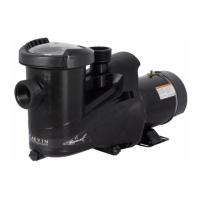
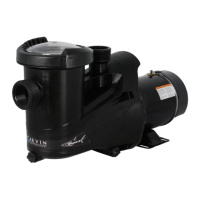
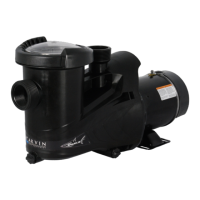
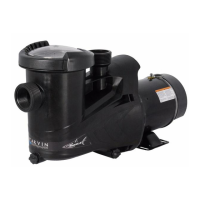
times. The pump is built from glass-reinforced thermoplastic mould-
ings. These eliminate all corrosion problems and insulate the water
passages from the electric motor. A closed impeller, which requires
mple running clearances between impeller and
case promote long life and prevent seizure should sand enter the
pump. The impeller hub forms an insulating sleeve over the motor shaft
and carries the mechanical shaft seal. This seal, which has a pure-car-
bon rotating face working against a ceramic seat, requires no
attention until leakage at the shaft shows that replacement is neces-
sary. For easy routine servicing, the built-in hair and lint strainer
has a transparent cover. For easy access to the working parts, the
removal of four screws allows the motor, bracket, seal, impeller and
for ease of maintenance and repair.
GENERAL
ELECTRICAL CONNECTIONS
Check that the information on the pump nameplate corresponds to
the power supply. Employ a competent electrician to make the wiring
installation in accordance with the local electrical code. Every motor
requires a fused disconnect switch.
For 2-speed pumps, start and prime the pump at HIGH SPEED only. Do
not change to LOW SPEED before the pump is working properly. At HIGH
SPEED (3450 rpm approx.), the motor develops its full horsepower and
the pump generates high capacity and pressure. Use high speed for
maximum
high. At other t imes switch to LOW SPEED (1725 rpm approx.). For
backwashing and vacuuming, HIGH SPEED is required. If the pump
procedure described in the separate instructions for the complete
cases, proceed as follows:
1).Close the gate valves in the suction and return lines. Remove the
cover fr
with water. Replace the cover.
2).Open the gate valves in the suction and return lines and start the
minutes,
fails to work, check for air
leaks at the strainer cover, suction line connec-
tions, and valve stem glands before repeating Step 1.
3).
air bubb
line. Locate and correct any leaks immediately.
CONTROLLING THE OUTPUT
Keep the gate valve in the suction line fully open during opera-
tion. Should it be necessary to control the output, use a valve in the
return line.
DRAINING
There are two drain plugs on the pump case. Note that the valves in the
suction and return lines must be open to allow complete draining of
the pump, but that othe r provisions may be necessary for draining
MAINTENANCE
The pump can be serviced without breaking the pipe connections.
Close the ga te valves, SWITCH THE ON/OFF SWITCH TO OFF AND PULL
THE PLUG FROM THE RECEPTACLE before starting work on the pump.
lines. Remove the Strainer Nut and clear cover and lift out the strainer
basket. Clean and replace the basket. Take care to clean o-ring and make
sure that it is well seated underneath clear cover and place cover back on
Re-open valves. Put pump back into operation.
NOTE: Do not re-tighten Strainer Nut while pump is in operation.
MOTOR SPECIFICATIONS


 To Next Page
 Loading...