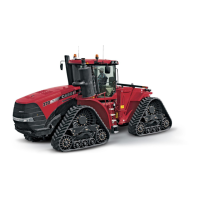
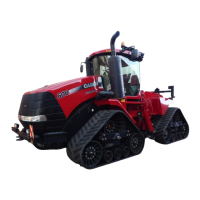
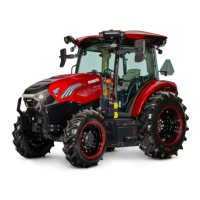
This document is a service manual for Case IH Steiger and Quadtrac tractors, covering models 350, 400, 450, 500, 550, and 600, with PINs ZCF100001 and above, and ZDF100001 and above. The manual provides detailed instructions for the maintenance and repair of various tractor systems.
The manual is structured into several main sections, each addressing a specific system of the tractor:
Introduction:
This section outlines general safety rules and important information for operating and servicing the machine. It emphasizes personal safety, machine safety, and provides definitions for signal words like DANGER, WARNING, CAUTION, NOTICE, and NOTE.
- Personal Safety: Highlights the importance of the safety alert symbol (!) and adhering to DANGER, WARNING, and CAUTION messages to prevent injury or death.
- Machine Safety: Uses the "NOTICE" signal word to indicate situations that could lead to machine or property damage.
- Information: Uses "NOTE" to provide additional clarifying information not related to safety.
- General Safety Rules: Advises caution on slopes, prohibits unauthorized riders, warns against operating under the influence, and stresses the importance of proper seat positioning. It also covers safe driving practices, including avoiding differential lock engagement at high speeds and adhering to implement transport speeds. Specific warnings are given regarding towing weights, hitching practices, and avoiding direct eye contact with HID lamps or radar sensors. It also details precautions for working with hydraulic oil or diesel fuel under pressure, emphasizing the risk of skin penetration and cancer from prolonged contact. Finally, it warns against moving parts and the need to wear protective equipment.
- Operational Safety: Instructs against removing material from the machine while in motion, ensuring guards and shields are in place, and keeping steps and walkways clean. It prohibits anyone from entering the work area and warns against falling equipment. It also advises against operating the engine in enclosed spaces due to harmful exhaust gases.
- Starting and Leaving the Machine: Provides clear instructions for starting the engine only from the operator's seat and the dangers of bypassing safety switches. It emphasizes maintaining clear visibility and operating controls only from the operator's seat, unless otherwise specified. Before leaving the machine, the operator must park on a firm, level surface, place all controls in neutral or park lock, engage the park brake, lower all hydraulic equipment, and turn off the engine, removing the key. If the engine must remain running, it should be at low idle, all drive systems disengaged, and the parking brake applied. A specific WARNING is included about components continuing to run down after disengagement.
Engine (10):
This section covers the engine and its related components.
- [10.001] Engine and crankcase: Details procedures for engine removal and installation. For removal, it includes disconnecting air conditioning hoses and the high-pressure sending unit, cutting harness ties, unplugging harnesses, loosening the fan from the hub (noting left-hand threads), disconnecting heater and DEF/AdBlue® solenoid hoses, disconnecting starter connections, removing the ground strap, removing air-to-air tubes, radiator hoses, and loosening clamps. It also covers disconnecting the alternator cable, fuel line, fuel return line, drive shaft, and removing engine mount brackets. The engine is then lifted from the tractor using a load rotor lifting bale. For installation, it details attaching the lifting bale, installing isomounts, setting the engine into the frame, installing and torquing front and rear engine mount bolts, connecting the drive shaft, fuel return line, upper radiator hose, air-to-air tube, fuel line, alternator cable, and starter connections. It also includes tightening radiator hoses, installing the fan (noting left-hand threads), plugging in harness connectors, and attaching lifting straps to set the hood support frame.
- [10.202] Air cleaners and lines: Focuses on the air intake system.
- [10.400] Engine cooling system: Describes the cooling components.
- [10.414] Fan and drive: Covers the fan and its drive mechanism.
- [10.500] Selective Catalytic Reduction (SCR) exhaust treatment: Addresses the exhaust treatment system.
Transmission (21):
This section details the transmission system.
- [21.113] Powershift transmission: Covers the main powershift transmission unit.
- [21.135] Powershift transmission external controls: Describes the external controls for the powershift transmission.
- [21.145] Gearbox internal components: Focuses on the internal parts of the gearbox.
- [21.155] Powershift transmission internal components: Details the internal components specific to the powershift transmission.
Front axle system (25):
This section covers the front axle.
- [25.100] Powered front axle: Describes the powered front axle assembly.
- [25.102] Front bevel gear set and differential: Details the front differential components.
- [25.310] Final drives: Covers the final drive units for the front axle.
Rear axle system (27):
This section covers the rear axle.
- [27.100] Powered rear axle: Describes the powered rear axle assembly.
- [27.106] Rear bevel gear set and differential: Details the rear differential components.
- [27.120] Planetary and final drives: Covers the planetary and final drive units for the rear axle.
Power Take-Off (PTO) (31):
This section focuses on the PTO system.
- [31.104] Rear electro-hydraulic control: Describes the electronic and hydraulic controls for the rear PTO.
- [31.110] One-speed rear Power Take-Off (PTO): Covers the single-speed rear PTO unit.
- [31.220] Gearbox: Details the PTO gearbox.
Brakes and controls (33):
This section covers the braking system.
- [33.110] Parking brake or parking lock: Describes the parking brake mechanism.
- [33.202] Hydraulic service brakes: Covers the hydraulic service brakes.
Hydraulic systems (35):
This section details the various hydraulic systems.
- [35.000] Hydraulic systems: General overview of the hydraulic systems.
- [35.102] Pump control valves: Describes the control valves for the hydraulic pumps.
- [35.105] Charge pump: Covers the charge pump.
- [35.106] Variable displacement pump: Details the variable displacement pump.
- [35.204] Remote control valves: Describes the remote control valves.
- [35.220] Auxiliary hydraulic pump and lines: Covers auxiliary hydraulic components.
- [35.300] Reservoir, cooler, and filters: Details the hydraulic fluid reservoir, cooler, and filters.
- [35.304] Combination pump units: Describes combination hydraulic pump units.
- [35.600] High flow hydraulics: Covers high-flow hydraulic systems.
Hitches, drawbars, and implement couplings (37):
This section covers implement attachment points.
- [37.100] Drawbars and towing hitches: Describes drawbars and towing hitches.
Frames and ballasting (39):
This section details the tractor's structure and weight distribution.
- [39.100] Frame: Covers the main frame of the tractor.
- [39.110] Drawbar and hitch assembly: Describes the drawbar and hitch assembly.
Steering (41):
This section covers the steering system.
- [41.101] Steering control: Describes the steering control mechanism.
- [41.200] Hydraulic control components: Covers hydraulic components for steering.
- [41.206] Pump: Details the steering pump.
- [41.910] Auxiliary steering: Describes auxiliary steering systems.
Wheels (44):
This section covers the wheels.
- [44.511] Front wheels: Describes the front wheels.
- [44.520] Rear wheels: Describes the rear wheels.
Tracks and track suspension (48):
This section is specific to Quadtrac models.
- [48.100] Tracks: Covers the track assemblies.
- [48.130] Track frame and driving wheels: Details the track frame and driving wheels.
- [48.134] Track tension units: Describes the track tensioning mechanisms.
- [48.138] Track rollers: Covers the track rollers.
Cab climate control (50):
This section details the cab's environmental control system.
- [50.104] Ventilation: Describes the ventilation system.
- [50.200] Air conditioning: Covers the air conditioning system.
- [50.300] Cab pressurizing system: Details the cab pressurization system.
Electrical systems (55):
This section covers the tractor's electrical components.
- [55.010] Fuel injection system: Describes the electrical aspects of the fuel injection system.
- [55.014] Engine intake and exhaust system: Covers electrical components for engine intake and exhaust.
- [55.024] Transmission control system: Details the electrical controls for the transmission.
- [55.035] Remote control valve electric control: Describes electrical controls for remote valves.
- [55.045] Front axle control system: Covers electrical controls for the front axle.
- [55.046] Rear axle control system: Covers electrical controls for the rear axle.
- [55.048] Rear Power Take-Off (PTO) control system: Details electrical controls for the rear PTO.
- [55.050] Heating, Ventilation, and Air-Conditioning (HVAC) control system: Describes electrical controls for the HVAC system.
- [55.051] Cab Heating, Ventilation, and Air-Conditioning (HVAC) controls: Covers specific HVAC controls.
- [55.100] Harnesses and connectors: Details the electrical harnesses and connectors.
- [55.130] Rear three-point hitch electronic control system: Describes the electronic control for the rear three-point hitch.
- [55.301] Alternator: Covers the alternator.
- [55.302] Battery: Details the battery system.
- [55.404] External lighting: Describes the external lighting system.
- [55.522] Cab Power Take-Off (PTO) controls: Covers PTO controls within the cab.
- [55.640] Electronic modules: Details the various electronic control modules.
- [55.988] Selective Catalytic Reduction (SCR) electrical system: Describes the electrical components of the SCR system.
- [55.DTC] FAULT CODES: Provides information on diagnostic trouble codes.
Platform, cab, bodywork, and decals (90):
This section covers the exterior and interior of the tractor.
- [90.100] Engine hood and panels: Describes the engine hood and panels.
- [90.102] Engine shields, hood latches, and trims: Covers engine shields, latches, and trim.
- [90.124] Pneumatically-adjusted operator seat: Details the operator's seat.
- [90.150] Cab: General description of the cab.
- [90.151] Cab interior: Details the interior components of the cab.
The manual includes numerous illustrations to guide technicians through the procedures, such as disconnecting and connecting components, routing hoses and cables, and torquing fasteners to specified values. For instance, during engine installation, specific torque values are provided for engine mount bolts (90 - 107 N·m or 66 - 79 lb ft for lower engine mount to frame bolts, and 160 - 220 N·m or 118 - 162 lb ft for ISO mount nuts) and rear retaining straps (125 - 150 N·m or 92 - 111 lb ft). The drive shaft bolts require torquing to 95 - 108 N·m (70 - 80 lb ft). Special attention is drawn to components with left-hand threads, such as the fan hub. The manual also emphasizes the use of appropriate lifting equipment, like a load rotor lifting bale, to prevent damage during engine removal and installation. It consistently reminds the user to cap and plug disconnected hoses and fittings to prevent contamination. The document is dated March 2013 and has a part number of 47488213.

 Need help?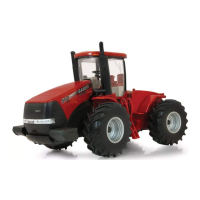

 To Next Page
 General