2000-14
STEP 47
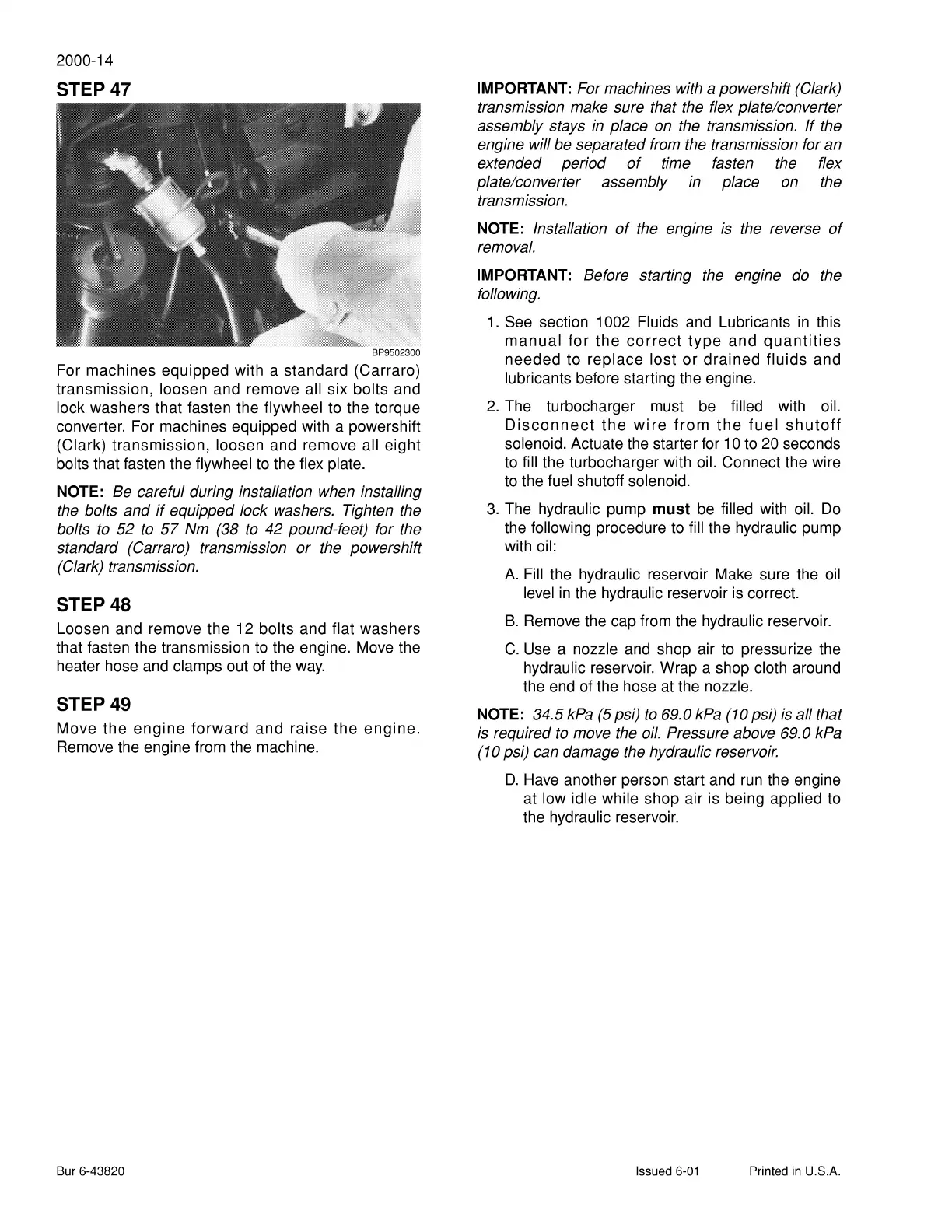
BP9502300
For machines equipped with a standard (Carrara)
transmission, loosen and remove all six bolts and
lock washers that fasten the flywheel to the torque
converter. For machines equipped with a powershift
(Clark) transmission, loosen and remove all eight
bolts that fasten the flywheel to the flex plate.
NOTE: Be careful during installation when installing
the bolts
and
if
equipped lock washers. Tighten the
bolts to
52
to
57
Nm (38 to
42
pound-feet) for the
standard (Carrara) transmission
or
the powershift
(Clark) transmission.
STEP 48
Loosen and remove the 12 bolts and flat washers
that fasten the transmission
to
the engine. Move the
heater hose and clamps out of the
way.
STEP 49
Move the
engine
forward and raise the
engine.
Remove the engine from the machine.
Bur 6-43820
IMPORTANT: For machines with a powershift (Clark)
transmission make sure that the flex plate/converter
assembly stays in place on the transmission.
If
the
engine will be separated from the transmission for
an
extended period
of
time fasten the flex
plate/converter assembly in place on the
transmission.
NOTE: Installation
of
the engine is the reverse
of
removal.
IMPORTANT: Before starting the engine do the
following.
1.
See section 1002 Fluids and Lubricants
in
this
manual
for
the
correct
type
and
quantities
needed to replace lost
or
drained fluids and
lubricants before starting the engine.
2.
The turbocharger must
be
filled with oil.
Disconnect
the
wire
from
the
fuel
shutoff
solenoid. Actuate the starter for 10
to
20
seconds
to fill the turbocharger with oil. Connect the wire
to
the fuel shutoff solenoid.
3.
The hydraulic pump must
be
filled with oil.
Do
the following procedure
to
fill the hydraulic pump
with oil:
A.
Fill the hydraulic reservoir Make sure the
oil
level
in
the hydraulic reservoir is correct.
B.
Remove the cap from the hydraulic reservoir.
C.
Use
a nozzle and shop air
to
pressurize the
hydraulic reservoir. Wrap a shop cloth around
the end of the hose at the nozzle.
NOTE: 34.5 kPa (5 psi) to 69.0 kPa (10 psi) is all that
is required to move the oil. Pressure above
69.
0 kPa
(10 psi) can damage the hydraulic reservoir.
D.
Have another person start and
run
the engine
at low idle while shop air is being applied to
the hydraulic reservoir.
Issued
6-01
Printed
in
U.S.A.


 To Next Page