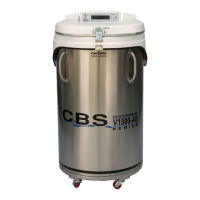
The Custom BioGenic Systems 2301 LN2 Storage Unit is a cryogenic storage system designed for the long-term preservation of biological samples. It operates by maintaining liquid nitrogen levels within specified parameters inside a cryogenic storage vessel, ensuring a stable, extremely low-temperature environment. The unit is available in two primary designs: S Series (Standard) and V Series (Isothermal).
Function Description:
The core function of the 2301 LN2 Storage Unit is to provide a controlled, cryogenic environment for sample storage. This is achieved by measuring the gravitational weight of liquid nitrogen using a pressure sensing unit integrated into the controller. When the liquid nitrogen level falls below a pre-set low level, the controller activates a FILL solenoid valve, allowing liquid nitrogen to flow into the vessel. Once the level reaches the pre-set high level, the solenoid valve deactivates, stopping the fill. This automated fill sequence ensures continuous maintenance of the desired liquid nitrogen level.
The system incorporates a "Bypass Function" in some models, which includes an additional solenoid valve to vent vapor from the transfer lines before the FILL solenoid is activated. This venting continues until the line temperature reaches approximately -150°C to -160°C, optimizing the filling process.
The 2301 LN2 Storage Unit is designed to operate in environmental conditions ranging from 5°C (41°F) to 40°C (104°F) temperature, 80% humidity at ≤ 31°C (decreasing linearly to 50% at 40°C), and altitudes up to 2,000 meters (6,650 feet).
Important Technical Specifications:
- Cooling Medium: Liquid nitrogen only, supplied by a pressurized cryogenic transport vessel.
- Operating Pressure: 22 p.s.i. (recommended), with a normal operating range of 20 p.s.i. min to 25 p.s.i. max. Deviations from this range can affect efficiency, leading to increased liquid nitrogen use, and potential level or source alarms.
- Power Supply Voltage: 120 Volts AC 60 Hz standard; 220 Volts AC 60/50 Hz optional.
- Amperage: 2 amp max.
- Fuse: VAC 2 amp buss fuse; 220 volts slow-blow (T2A 250V), automotive glass tube type fuse.
- LN2 Capacity (Liters): V1500AB (30L), V3000AB (70L), V5000AB (93L), V5000ABEH (140L).
- Static Evaporation Rate (Liters/Day): V1500AB (5L), V3000AB (9L), V5000AB (11L), V5000ABEH (11L).
- Static Holding Time (Days): V1500AB (6 days), V3000AB (8 days), V5000AB (8 days), V5000ABEH (12 days).
- External Dimensions (Width/Depth/Height):
- V1500AB: 26/660 in/mm W, 37/939 in/mm D, 45/1143 in/mm H
- V3000AB: 37/939 in/mm W, 48/1219 in/mm D, 47.5/1206 in/mm H
- V5000AB: 47/1219 in/mm W, 54/1371 in/mm D, 52/1320 in/mm H
- V5000ABEH: 47/1219 in/mm W, 54/1371 in/mm D, 58/1473 in/mm H
- Usable Interior Height (in/mm): 29/736 for V1500AB, V3000AB, V5000AB; 34/864 for V5000ABEH.
- Usable Interior Diameter (in/mm): 21/534 for V1500AB; 31/787 for V3000AB; 40/1016 for V5000AB, V5000ABEH.
- Weight Empty (lbs/kg): V1500AB (327/148), V3000AB (600/272), V5000AB (936/425), V5000ABEH (997/453).
- Weight Full (lbs/kg): V1500AB (383/174), V3000AB (720/327), V5000AB (1100/500), V5000ABEH (1247/566).
- Operating Levels for LN2: Extra High Series: 1 to 31 inches; V Series Models: 1 to 23 inches.
- Temperature Probes: Lid Temperature A Thermocouple (approx. 11" from top), Lid Temperature B Thermocouple (approx. 20" from top).
- Outputs: 0-5VDC and 4-20mA for Temp-A, Temp-B, and Level.
- Alarms: High/Low Alarm Set Point, Temperature Display Verification, 2301 Temperature Calibration, V Series Level Display Verification & Calibration.
- Remote Alarm: Dry contact relays with max output of 24VDC@2A, switches status when any alarm occurs or power is lost.
Usage Features:
- Front Panel Controls: Includes a power key switch, LCD display window, four menu select buttons, scroll "Down" and "Up" buttons, and a "Program / Lock" key switch to switch between Standard Operating Mode and Program Mode, protecting settings from unauthorized changes.
- LCD Display Functions: Provides a text interface for electronic settings, displaying various menus and functions including standard operation, filling status, lid open status, alarm conditions (with specific causes like Low Alarm, High Alarm, Source Alarm, Temp A/B High, Thermistor Open, Open Fill, Open Bypass, Temp A/B Probe, Open BP Probe, LN2 Overflow), and printing reports.
- Programming Mode: Allows users to adjust settings such as Date/Time, Tank ID, Liquid Level, Temperature, Printer Functions, Bypass Settings, Control Validation, Fill Timer, Revision Level, One Fill All Fill, and Log.
- Manual Fill (V Series): A specific procedure is outlined for manual filling in case of power outage or auto-fill malfunction. This involves disconnecting the auto-fill supply line, removing the cap from the manual fill port, connecting the supply line to the manual fill port, and carefully monitoring for "spray" from the vents to prevent overfilling, as the liquid nitrogen is contained within the vessel walls and not visible.
- SEQ/OFAF System (Sequential/Simultaneous Fill): This feature allows multiple 2301 controllers to be linked for either sequential or simultaneous filling from a single LN2 supply. Sequential mode is recommended for optimum fill pressure and reduced LN2 transfer loss.
- Fill Timer: Enables setting the freezer to fill at 24, 48, or 72-hour intervals. The Auto Fill setting overrides the Fill Timer.
- Fill/Vent In Progress: Provides a 24VDC output signal when filling or venting, which can be used to activate a supply tank switcher or an additional valve.
- Overflow Sensor (Optional): If installed, detects LN2 overflow in the storage space, triggering an audible/visual alarm and disabling power to all solenoid valves.
- Remote Alarm Connection: Allows connection to a Delta Room, Facility Monitoring Station, or Remote Auto Dialer to alert users of alarms after hours or during weekends/holidays.
Maintenance Features:
- Daily Checks: Users are advised to check the unit daily for proper operation and safety of stored samples. For V Series units, lifting the lid daily to check for vapor and signs of proper freezing is essential.
- Report Log Feature: Records sequences of events such as power on, lid open, and alarms. The LOG function, enabled for use with Cryomonitor or Reporting, date/time stamps Temp-A, Temp-B, and Level data at programmable rates (1-90 hours on the hour) for easy review and printing.
- Cleaning and Maintenance: Specific instructions for cleaning and maintenance are provided in the manual (page 48).
- Troubleshooting: A dedicated section (pages 29-33) provides guidance for resolving common issues.
- Product Warranty: Custom BioGenic Systems offers a five-year vacuum warranty and a two-year warranty on electronics and parts, covering defects in workmanship or materials. Claims must be reported within 10 days of discovery, and the company reserves the right to correct defects in the field. The warranty does not cover defects from abusive handling or structural failure.
- Technical Assistance: Contact information for customer service and technical support is provided for assistance with setup, operation, and troubleshooting.
Safety Features:
- Warnings: Emphasizes the importance of reading the manual completely and understanding hazards associated with liquid nitrogen.
- Electrical Safety: Equipment must be connected to a supply mains with protective earth to avoid electric shock.
- Crush Hazard: Lids can present a crush hazard; users are instructed to open the lid entirely and carefully, and use both hands when lowering it.
- Rolling Hazard: Casters must be locked to prevent rolling.
- Asphyxiation: Liquid nitrogen displaces oxygen, leading to oxygen-deficient atmospheres. Always check air quality and use an air respirator if available.
- Cold Burns: Due to extremely low temperatures, contact with liquid nitrogen vapor or gas can cause cold burns or frostbite. Personal Protective Equipment (PPE) including cryo-gloves, safety goggles/full face shield, long sleeve lab coat, cryo-apron, long pants, and fully enclosed footwear is mandatory.
- Boiling, Splashing, and Spurting: Caution advised when introducing room temperature equipment into liquid nitrogen.
- Compatibility: Liquid nitrogen should only be handled and transported in approved containers.
- Fire in Oxygen-Enriched Atmosphere: Liquid nitrogen can condense oxygen, creating potentially flammable or explosive conditions.
- First Aid: Detailed first aid procedures for frostbite and inhalation of nitrogen are provided, emphasizing prompt medical attention.

 Need help?
 General

 To Next Page